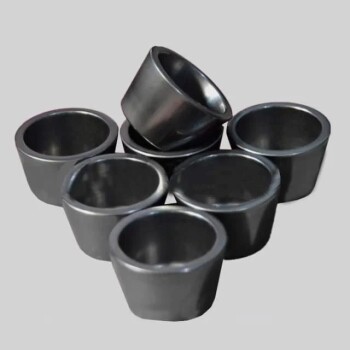
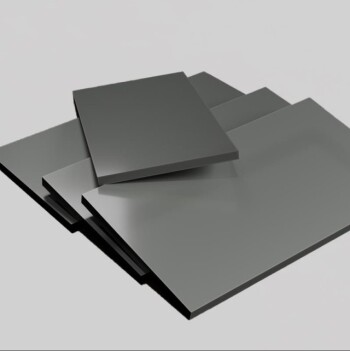
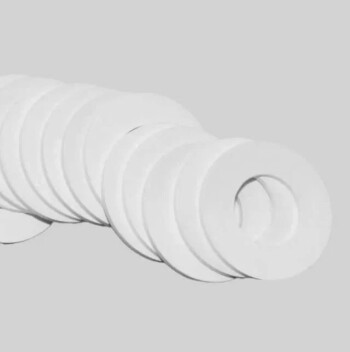
High-purity graphite spacers are essential mechanical interfaces used to minimize interfacial friction between a specimen and compression anvils. During hot compression, these spacers act as a high-performance solid lubricant that prevents the alloy from sticking to the equipment. By reducing friction, they ensure a uniform flow of material, which is critical for maintaining the geometric integrity of the sample and the accuracy of subsequent metallurgical data.
The primary purpose of high-purity graphite spacers is to eliminate the "barreling" effect and ensure uniform internal stress distribution. This allows researchers to obtain precise, reproducible data regarding microstructure evolution and recrystallization behavior during high-temperature deformation.
Optimizing Specimen Geometry and Stress Flow
Suppressing the Barreling Effect
When an alloy specimen is compressed at high temperatures without adequate lubrication, the friction at the contact surfaces restricts the lateral expansion of the ends. This causes the center of the specimen to bulge outward, a phenomenon known as barreling. High-purity graphite spacers provide a low-friction boundary that allows the specimen ends to slide freely, maintaining a cylindrical geometry throughout the test.
Achieving Uniform Internal Stress
Friction-induced barreling creates a complex, non-uniform stress state within the material, with dead-metal zones forming near the anvils. By acting as a solid lubricant, graphite ensures that the compressive load is transmitted evenly across the entire cross-section of the specimen. This uniformity is vital for ensuring that the mechanical properties measured during the test represent the true behavior of the bulk material.
Facilitating Consistent Pressure Transmission
In addition to lubrication, graphite's structural stability allows it to act as an effective pressure transmission medium. It remains stable under high-temperature and high-pressure conditions, ensuring that the hydraulic system's force is applied consistently. This stability prevents localized pressure spikes that could lead to premature specimen failure or inaccurate yield strength measurements.
Enhancing Analytical Accuracy
Precision in Microstructure Observation
The validity of metallurgical research depends on observing how grains and phases respond to specific temperatures and strains. Because graphite spacers ensure homogeneous deformation, the resulting microstructure is consistent throughout the sample. This allows for more accurate microstructure observations and ensures that the grain structures analyzed are representative of the intended deformation parameters.
Quantifying Metadynamic Recrystallization
Researchers utilize hot compression to study metadynamic recrystallization, the process where new grains form after deformation. Without the uniform stress distribution provided by graphite spacers, the recrystallization rates would vary significantly across the specimen. The spacers allow for a precise quantitative analysis, enabling researchers to develop accurate mathematical models for material behavior.
Protecting Equipment and Surface Quality
Graphite paper or spacers provide a critical isolation layer that prevents the specimen from adhering to the punches or anvils. At extreme temperatures, alloys can chemically bond or weld to the compression tools, causing surface damage to both the sample and the machinery. The use of high-purity graphite ensures easy demolding and protects the longevity of expensive anvil components.
Understanding the Trade-offs
Material Purity and Contamination
While graphite is an excellent lubricant, the "high-purity" designation is critical because impurities can react with the alloy specimen at high temperatures. Lower-grade graphite may introduce carbon diffusion into the specimen surface, potentially altering the chemical composition and the mechanical properties being measured. Researchers must balance the need for lubrication with the risk of surface contamination.
Single-Use Limitations
In many hot compression scenarios, graphite spacers are effectively consumables that may degrade or break under extreme axial loads. While they offer superior high-temperature creep resistance, they lack the toughness of metallic spacers and may require frequent replacement. This adds a minor operational cost and requires careful alignment to prevent uneven loading during the initial stages of compression.
Applying Graphite Spacers to Your Research
Making the Right Choice for Your Goal
To maximize the effectiveness of graphite spacers in your hot compression testing, consider your primary experimental objective:
- If your primary focus is accurate flow stress data: Ensure the graphite spacers are perfectly centered to maintain a uniaxial stress state and eliminate frictional errors in your calculations.
- If your primary focus is grain size analysis: Use high-purity spacers to prevent carbon migration into the sample, which could artificially pin grain boundaries or create unwanted carbides.
- If your primary focus is high-volume testing: Implement thin graphite paper rather than thick spacers to facilitate faster setup and easier demolding while still protecting anvil surfaces.
By effectively managing the interface between the anvil and the specimen, high-purity graphite spacers transform a potentially chaotic deformation process into a controlled, scientific measurement of material performance.
Summary Table:
| Function | Mechanism | Research Impact |
|---|---|---|
| Lubrication | Reduces interfacial friction between specimen and anvil | Suppresses the "barreling" effect for cylindrical geometry |
| Stress Distribution | Ensures even load transmission across the cross-section | Eliminates dead-metal zones for uniform deformation |
| Equipment Protection | Acts as an isolation layer to prevent chemical bonding | Protects expensive anvils and ensures easy sample demolding |
| Analytical Accuracy | Facilitates homogeneous microstructure evolution | Enables precise quantification of metadynamic recrystallization |
Optimize Your Materials Research with KINTEK Precision Solutions
Achieving accurate metallurgical data requires more than just high temperatures; it demands the right mechanical interfaces and high-purity consumables. KINTEK specializes in supporting advanced laboratory environments with a comprehensive range of high-purity graphite products, ceramics, and crucibles designed to withstand extreme conditions.
Beyond consumables, we provide the robust machinery needed for precise specimen preparation and testing, including:
- Hydraulic Presses: Pellet, hot, and isostatic systems for consistent loading.
- High-Temperature Furnaces: Muffle, vacuum, and atmosphere furnaces for controlled deformation studies.
- Sample Preparation: Advanced crushing, milling, and sieving equipment.
Ready to eliminate experimental variables and protect your equipment? Contact KINTEK today to consult with our experts on the best spacers and pressing solutions for your specific alloy research. Let us help you ensure every test yields reproducible, high-quality results.
References
- Emil Eriksson, Magnus Hörnqvist Colliander. Meta-Dynamic Recrystallization in the Ni-Based Superalloy Haynes 282. DOI: 10.3390/met13081335
This article is also based on technical information from Kintek Solution Knowledge Base .
Related Products
- High Purity Pure Graphite Crucible for Evaporation
- High Purity Pure Graphite Crucible for Electron Beam Evaporation
- Horizontal High Temperature Graphite Vacuum Graphitization Furnace
- Ultra-High Temperature Graphite Vacuum Graphitization Furnace
- Carbon Graphite Boat -Laboratory Tube Furnace with Cover
People Also Ask
- Why are high-purity graphite crucibles preferred for sulfide solid electrolytes? Achieve Superior Material Purity
- Why is a high-purity graphite crucible required for Chromel-TaC composites? Ensure Peak Purity at 1400°C
- What role do high-purity graphite crucibles play in molten salt corrosion research? Ensure Reactor-Grade Precision
- Why are high-purity graphite crucibles used for magnesium distillation? Ensure 3N8 Purity & Thermal Stability
- Why is a high-purity graphite crucible ideal for nitrogen-doped graphene at 1500 °C? Maximize Purity and Stability