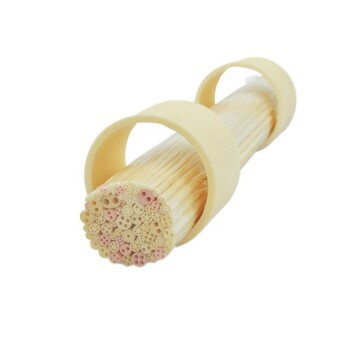
High-purity quartz tubes are the definitive choice for Hastelloy alloy oxidation experiments because they provide a chemically inert and thermally stable environment essential for accurate data collection. By resisting extreme heat and preventing the vessel material from reacting with oxygen or hydrocarbons, these tubes ensure the experimental results reflect only the behavior of the alloy itself.
Core Takeaway: The selection of high-purity quartz is driven by the need for absolute data integrity. Its primary function is to eliminate "noise" in the experiment by preventing secondary chemical reactions, ensuring that surface characterization remains authentic to the catalyst being tested.
The Critical Role of Chemical Inertness
Preventing Secondary Reactions
In oxidation and reforming experiments, the reaction environment is highly reactive. Materials other than high-purity quartz often risk engaging in secondary reactions with oxygen or hydrocarbons.
Using high-purity quartz prevents these unintended interactions. This ensures that the consumption of reactants is attributed solely to the Hastelloy alloy, rather than the vessel walls.
Ensuring Data Accuracy
The primary goal of these experiments is to characterize the catalyst surface authentically. Any interaction between the vessel and the reactants would skew the experimental data.
By acting as a stable carrier, the quartz tube preserves the purity of the reaction environment. This guarantees that the resulting data is a true representation of the alloy's performance.
Handling Extreme Physical Conditions
Superior High-Temperature Resistance
Oxidation experiments inherently involve elevated temperatures. The reaction vessel must maintain its structural integrity without softening or deforming.
High-purity quartz offers superior high-temperature resistance, allowing it to withstand the rigorous thermal demands of the oxidation process without compromising the experiment.
Robust Thermal Shock Resistance
Experimental procedures often involve rapid heating or cooling cycles. Materials with low thermal shock resistance are prone to cracking or shattering under these conditions.
Quartz is selected for its robust thermal shock resistance. This durability ensures the vessel remains intact throughout the heating and cooling phases, protecting both the sample and the operator.
Understanding the Trade-offs
The Necessity of "High Purity"
It is critical to distinguish between standard quartz and high-purity quartz. Standard quartz may contain trace impurities that can leach out at high temperatures, contaminating the Hastelloy sample.
To achieve the "authenticity of surface characterization" mentioned in your reference, you cannot compromise on the grade of the material. The trade-off is that high-purity variants are often more expensive, but they are non-negotiable for valid scientific results.
Physical Fragility
While quartz is thermally robust, it remains a glass-like material. It has excellent resistance to heat but is physically brittle compared to metal vessels.
Operators must handle these tubes with care during setup and cleaning to avoid breakage, as mechanical impact is the material's primary weakness.
Making the Right Choice for Your Goal
When designing your experimental setup, prioritize the material properties that align with your specific data requirements.
- If your primary focus is Data Integrity: Prioritize high-purity quartz over standard grades to eliminate any risk of background interference or secondary reactions with hydrocarbons.
- If your primary focus is Durability: Rely on the quartz's thermal shock resistance for experiments requiring rapid temperature cycling, but implement strict handling protocols to mitigate physical breakage.
By utilizing high-purity quartz, you transform the reaction vessel from a variable into a constant, securing the foundation of your research.
Summary Table:
| Feature | Benefit for Hastelloy Oxidation Experiments | Importance |
|---|---|---|
| Chemical Inertness | Prevents secondary reactions with oxygen/hydrocarbons | Critical for Data Integrity |
| High-Purity Grade | Eliminates trace impurity leaching and sample contamination | Mandatory for Accuracy |
| High-Temp Resistance | Maintains structural integrity under extreme heat | Essential for Safety |
| Thermal Shock Resistance | Withstands rapid heating and cooling cycles without cracking | Ensures Durability |
| Stable Carrier | Ensures results reflect only the alloy's behavior | Authenticity of Results |
Elevate Your Materials Research with KINTEK Precision
Precision in Hastelloy oxidation studies begins with the right environment. KINTEK specializes in high-performance laboratory equipment, providing the high-purity quartz tubes and specialized furnaces necessary to ensure your data remains untainted by secondary reactions.
Whether you are conducting catalyst surface characterization or high-pressure oxidation, our comprehensive range—from high-temperature furnaces (muffle, tube, CVD) to high-temperature high-pressure reactors—is designed for the rigors of advanced metallurgy and battery research. Don't let vessel impurities compromise your scientific integrity.
References
- S. R. de la Rama, Toshio Tagawa. Preliminary Assessment of Oxidation Pretreated Hastelloy as Hydrocarbon Steam Reforming Catalyst. DOI: 10.1155/2014/210371
This article is also based on technical information from Kintek Solution Knowledge Base .
Related Products
- 1200℃ Split Tube Furnace with Quartz Tube Laboratory Tubular Furnace
- High Purity Pure Graphite Crucible for Evaporation
- Laboratory Rapid Thermal Processing (RTP) Quartz Tube Furnace
- High Temperature Resistant Optical Quartz Glass Sheet
- High Purity Alumina Granulated Powder for Engineering Advanced Fine Ceramics
People Also Ask
- What functions does a laboratory high-temperature tube furnace perform? Master Catalyst Synthesis & Carbonization
- What roles does a high-temperature tube furnace play in the synthesis of N/O co-doped carbon? Master Precise Doping
- How does a high-temperature tube furnace influence 253MA steel? Master Microstructure & High-Temp Creep Resistance
- Why is a high-temperature tube furnace required for the production of biochar from tobacco straw? Expert Pyrolysis Guide
- What are the primary applications of muffle and tube furnaces in photocatalysts? Optimize Metal Loading & Support Synthesis