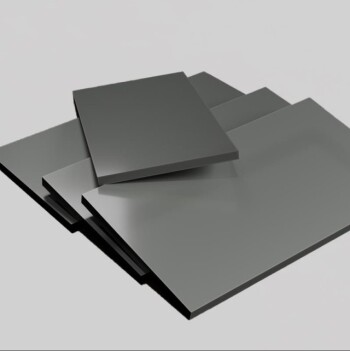
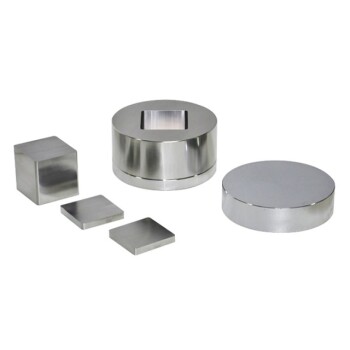
High-strength graphite molds are a prerequisite for this process because they serve as the only viable containment vessel capable of maintaining structural integrity under the extreme processing conditions of TiAl/Ti6Al4V composites. Specifically, these molds must withstand mechanical pressures up to 40 MPa at temperatures of 900°C without fracturing or deforming. This capability is the primary factor in ensuring the final composite achieves the necessary high density and precise dimensional accuracy.
The vacuum hot pressing environment subjects materials to simultaneous thermal shock and immense mechanical load. High-strength graphite is essential because it is one of the few materials that maintains mechanical stability and chemical inertness under these dual stresses, acting as both a pressure vessel and a thermal conductor.
The Mechanical Necessity
The primary function of the mold is to translate hydraulic force into the composite material. This requires specific mechanical characteristics to prevent process failure.
Withstanding Extreme Uniaxial Pressure
During the hot pressing of TiAl/Ti6Al4V, the mold is subjected to pressures up to 40 MPa.
Standard mold materials would yield or creep under this load, especially when combined with high heat. High-strength graphite possesses the unique ability to maintain its stiffness and strength in this environment.
Preventing Deformation and Fracture
If the mold deforms, the pressure is not effectively transmitted to the powder or laminate layers.
High-strength graphite ensures that the applied force is directed entirely into densifying the material. This rigidity prevents the mold walls from bowing, which is critical for maintaining the net shape of the final component.
Defining Geometric Accuracy
The mold acts as the negative shape for the final product.
Because high-strength graphite resists thermal expansion and mechanical creep at 900°C, it guarantees that the dimensions of the sintered TiAl/Ti6Al4V sample match the design specifications precisely.
The Chemical and Thermal Environment
Beyond mechanical strength, the mold must interact favorably with the titanium alloy within the vacuum chamber.
Chemical Stability in Vacuum
Titanium alloys are highly reactive at elevated temperatures.
High-strength graphite exhibits excellent chemical stability when in contact with TiAl/Ti6Al4V under vacuum conditions. This prevents adverse chemical reactions that could contaminate the sample surface or degrade the mold interface.
Uniform Thermal Conductivity
Graphite is an excellent thermal conductor.
This property allows the mold to distribute heat evenly across the sample, minimizing thermal gradients. A uniform thermal field is vital for ensuring consistent diffusion bonding and preventing internal stresses within the composite.
Understanding the Operational Constraints
While high-strength graphite is the optimal choice, it introduces specific operational trade-offs that must be managed.
The Oxidation Risk
Graphite oxidizes rapidly in the presence of oxygen at high temperatures.
The process must be conducted in a vacuum or inert atmosphere. Any breach in the vacuum seal at 900°C will lead to rapid erosion of the mold and potential contamination of the TiAl/Ti6Al4V composite.
Mechanical Brittleness
Despite its high compressive strength, graphite remains brittle.
It has low tensile strength and practically zero ductility. While it can handle the 40 MPa compressive load, it is susceptible to failure from shear forces or impact if the hydraulic rams are misaligned.
Ensuring Success in Composite Fabrication
Selecting the correct mold material is a balance between mechanical requirements and chemical compatibility.
- If your primary focus is Dimensional Precision: Prioritize graphite grades with the highest available compressive strength to eliminate mold creep at 900°C.
- If your primary focus is Material Purity: Ensure the vacuum environment is strictly controlled to leverage graphite's chemical stability and prevent surface contamination.
High-strength graphite is not merely a container; it is an active mechanical component that enables the simultaneous application of heat and pressure required to sinter high-performance titanium composites.
Summary Table:
| Property | Requirement for TiAl/Ti6Al4V | Role of High-Strength Graphite |
|---|---|---|
| Pressure Resistance | Up to 40 MPa | Prevents fracture and maintains structural integrity |
| Temperature Stability | 900°C Operating Temp | Resists creep and deformation under high heat |
| Thermal Conductivity | High Uniformity | Ensures consistent diffusion bonding and low stress |
| Chemical Profile | Inert in Vacuum | Prevents contamination of reactive titanium alloys |
| Geometric Precision | High Net-Shape Accuracy | Resists thermal expansion for exact dimensions |
Maximize Your Material Performance with KINTEK
Precision in vacuum hot pressing starts with the right equipment. At KINTEK, we specialize in providing high-performance laboratory solutions, including advanced high-temperature vacuum furnaces and precision-engineered hydraulic presses designed to handle the rigorous demands of TiAl/Ti6Al4V composite fabrication.
Whether you are developing next-generation aerospace alloys or conducting critical battery research, our comprehensive portfolio of graphite molds, ceramic crucibles, and high-pressure reactors ensures your lab achieves superior density and dimensional accuracy.
Ready to elevate your research? Contact our technical experts today to find the perfect equipment and consumables for your specific application.
Related Products
- Anti-Cracking Press Mold for Lab Use
- Special Shape Press Mold for Lab
- Ball Press Mold for Lab
- Double Plate Heating Press Mold for Lab
- Horizontal High Temperature Graphite Vacuum Graphitization Furnace
People Also Ask
- What is the press mould method? A Guide to Consistent, Detailed Ceramic Forms
- How to use a press mold? Master the Art of Creating Consistent Ceramic Forms
- What is the function of press molds during the preparation of SiCf/Ti-43Al-9V composites? Achieve Structural Precision
- What is a press mold used for? Achieve Repeatable Precision and Efficiency
- What is the purpose of specialized pressure devices in sulfide solid-state batteries? Ensure Chemo-Mechanical Stability