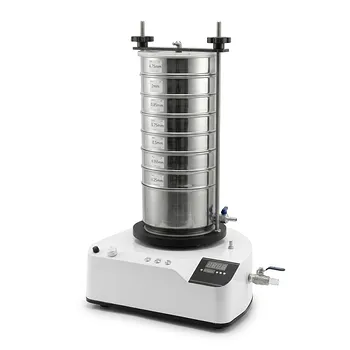
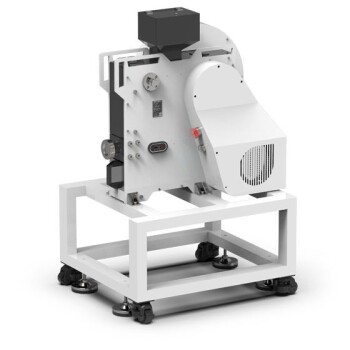
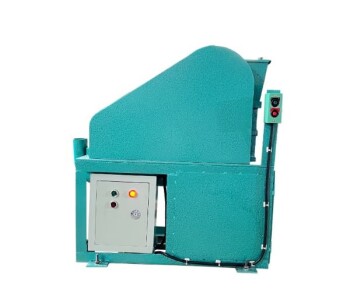
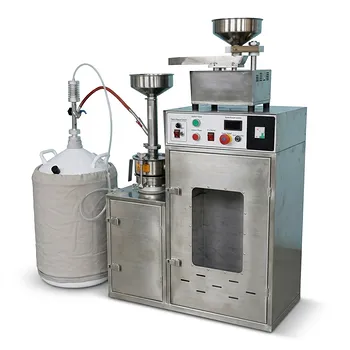
Industrial-grade crushing and sieving are essential because they standardize raw corn cobs into uniform particles, typically 1-2 mm in size. This mechanical reduction is required to dramatically increase the specific surface area of the biomass, which is the primary factor in overcoming the material's natural resistance to chemical processing. Without this step, subsequent chemical reactions cannot occur efficiently or uniformly.
The reduction of corn cobs to a standardized 1-2 mm size lowers mass transfer resistance within the dense lignocellulosic structure. This allows subcritical water to penetrate the material rapidly, ensuring a complete and uniform hydrolysis reaction.
The Physics Behind Reaction Efficiency
Increasing Specific Surface Area
Raw corn cobs are bulky and possess a relatively low surface area compared to their volume. Industrial crushing breaks these structures down, exposing significantly more of the material's internal surface.
High specific surface area is the catalyst for reaction speed. The more surface exposed, the more contact points available for the solvent to interact with the biomass immediately.
Penetrating the Lignocellulosic Structure
Corn cobs are composed of a dense, stubborn lignocellulosic matrix. This structure naturally resists liquid penetration, acting as a barrier to chemical processing.
By reducing the material to small particles, you mechanically disrupt this dense matrix. This disruption paves the way for the rapid penetration of subcritical water into the core of the material.
Reducing Mass Transfer Resistance
In chemical engineering, "mass transfer resistance" refers to how difficult it is for reactants (in this case, water) to move into the material. Large, intact cobs present high resistance.
Crushing the material to 1-2 mm significantly reduces this resistance. This ensures the solvent does not just wash over the surface but actually diffuses deep into the particle structure.
Achieving Uniform Hydrolysis
The ultimate goal of processing corn cobs is often hydrolysis—breaking down the complex molecules. If the particles are too large or irregular, the outside will over-react while the inside remains untouched.
Uniform particles ensure that every piece of material reacts at the same rate. This guarantees a uniform hydrolysis reaction, preventing wasted raw material and ensuring consistent product quality.
Understanding the Operational Trade-offs
The Risk of Inconsistent Particle Sizes
While crushing is vital, sieving is equally important to remove dust or oversized chunks. If the system fails to sieve correctly, you introduce reaction variability.
Dust particles may burn or degrade too quickly, while larger chunks will not fully hydrolyze. This mixture results in a lower quality final product with unpredictable characteristics.
Equipment Precision vs. Throughput
Achieving a strict 1-2 mm range requires precise industrial equipment. There is often a trade-off between the speed of throughput and the precision of the particle size.
Pushing a crusher too hard can result in irregular sizes. However, compromising on the 1-2 mm specification to save time will inevitably cost you more in lost reaction efficiency later in the process.
Optimizing Your Processing Strategy
To ensure your large-scale operation yields the highest return, you must view crushing not as a chore, but as a critical quality control step.
- If your primary focus is Reaction Speed: Ensure your equipment aggressively targets the lower end of the 1-2 mm range to maximize surface area and speed up water penetration.
- If your primary focus is Product Consistency: Prioritize the sieving stage to strictly eliminate outliers, ensuring that mass transfer resistance is identical across the entire batch.
Precision in the mechanical stage dictates the success of the chemical stage.
Summary Table:
| Factor | Impact of Industrial Crushing & Sieving | Purpose in Processing |
|---|---|---|
| Particle Size | Standardized 1-2 mm range | Ensures uniform reaction rates and consistency |
| Surface Area | Drastic increase in specific surface area | Maximizes contact points for solvents/reactants |
| Mass Transfer | Significantly reduced resistance | Facilitates deep penetration into the lignocellulosic matrix |
| Hydrolysis | Uniform and complete reaction | Prevents over-reaction of dust or under-reaction of large chunks |
Maximize Your Biomass Processing Yield with KINTEK
Precision in the mechanical stage dictates the success of your chemical results. KINTEK specializes in high-performance industrial crushing and milling systems alongside precision sieving equipment designed to handle large-scale corn cob raw materials with ease.
Our solutions ensure your feedstock meets the exact specifications required to reduce mass transfer resistance and achieve uniform hydrolysis. Beyond preparation, we offer a comprehensive range of high-temperature high-pressure reactors, autoclaves, and hydraulic presses to support your entire research and production workflow.
Ready to optimize your lab or industrial efficiency? Contact KINTEK today to discover how our expert-grade equipment can transform your material processing outcomes.
References
- Maja Čolnik, Mojca Škerget. Hydrolytic Decomposition of Corncobs to Sugars and Derivatives Using Subcritical Water. DOI: 10.3390/pr13010267
This article is also based on technical information from Kintek Solution Knowledge Base .
Related Products
- Three-dimensional electromagnetic sieving instrument
- Laboratory Vibratory Sieve Shaker Machine for Dry and Wet Three-Dimensional Sieving
- Laboratory Test Sieves and Sieving Machines
- Laboratory Jaw Crusher
- Mini Planetary Ball Mill Machine for Laboratory Milling
People Also Ask
- Why is sieving equipment essential for the classification of processed bio-activated carbon? Optimize Performance
- What are the limitations of sieving? Understanding the Constraints of Particle Size Analysis
- What are advantages and disadvantages of sieving method? A Guide to Reliable & Cost-Effective Particle Sizing
- How is sieving important? The Critical Role of Particle Size Analysis in Quality Control
- What is sieving and how does it work? A Guide to Accurate Particle Size Analysis