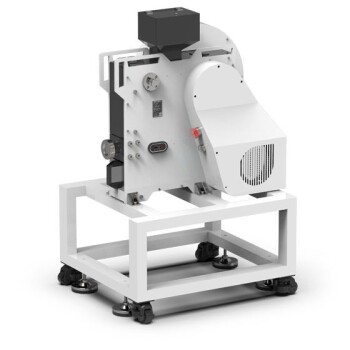
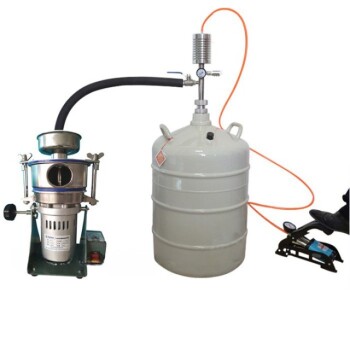
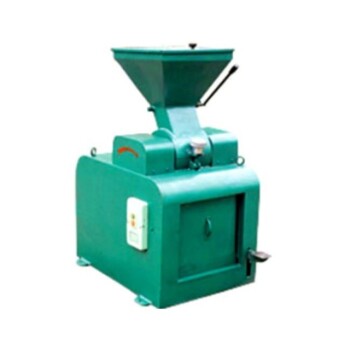
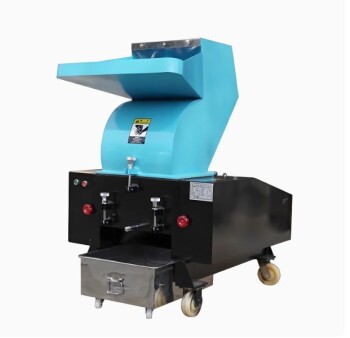
Industrial-grade crushing and sieving systems are essential because nickel-based filler metals, particularly those in the Ni-B and Ni-P systems, are characterized by inherent high brittleness. These robust mechanical systems are required to effectively fracture bulk alloys into powders with a tightly controlled particle size distribution. Without this precise mechanical processing, it is impossible to transform the raw, brittle alloy into a usable form for high-performance brazing applications.
The necessity of these systems lies in the transition from a brittle bulk material to a precise functional powder. Controlling particle size is not merely about shaping the metal, but acts as a critical physical prerequisite for ensuring uniform coating, predictable melting behavior, and structural integrity in complex brazing scenarios.
The Physical Challenge of Nickel Alloys
Managing High Brittleness
Nickel-based filler metals (specifically Ni-B and Ni-P systems) cannot be processed using standard ductile forming methods. Their high brittleness makes them prone to fracture rather than deformation.
Industrial crushing systems utilize this property to break the material down efficiently. They apply the necessary force to shatter the bulk alloy into workable fragments without contaminating the material.
Achieving Precise Particle Distribution
Simply crushing the material is not enough; the resulting powder must meet strict specifications. Sieving systems are employed to segregate these fragments into a specific particle size distribution.
This step acts as a quality filter, removing particles that are too coarse or too fine to function correctly in the final application.
The Impact on Process Performance
Ensuring Uniform Paste Coating
For the filler metal to be useful, it is often converted into a paste for application. The consistency of this paste relies entirely on the uniformity of the powder.
Properly sieved powders ensure a uniform paste coating on the workpiece. This prevents gaps or agglomerations that could lead to weak joints.
Controlling Melting Kinetics
The physical size of a metal particle dictates how quickly it melts when heat is applied. Inconsistent sizes lead to unpredictable melting behavior.
Industrial sieving standardizes the surface-area-to-volume ratio of the powder. This grants engineers precise control over melting kinetics, ensuring the filler metal flows exactly when and how intended.
Protecting Complex Geometries
In high-stakes engineering, brazing is often performed on complex, thin-walled structures. These components are intolerant of process variations.
Consistent particle size helps maintain brazing quality by preventing localized overheating or erosion. It ensures the joining process is gentle enough for delicate structures yet robust enough for a strong bond.
Understanding the Trade-offs
The Balance of Particle Size
While crushing is necessary, there is a limit to how fine the powder should be. Over-processing can lead to an excess of "fines" (extremely small particles).
These fines can react too quickly or oxidize readily, potentially altering the chemistry of the joint.
Equipment Demands
The very characteristic that makes these alloys effective—their hardness and brittleness—takes a toll on processing equipment.
Industrial-grade systems are required not just for power, but for durability. Standard equipment would suffer rapid wear and tear when processing these abrasive nickel-based materials.
Making the Right Choice for Your Goal
To optimize the preparation of nickel-based filler metals, align your processing parameters with your specific engineering requirements.
- If your primary focus is application consistency: Prioritize strict sieving protocols to ensure a narrow particle size distribution for uniform paste coating.
- If your primary focus is thermal precision: Calibrate your crushing targets to produce particle sizes that align with the specific melting kinetics of your heating cycle.
Ultimately, the precision of your crushing and sieving process defines the reliability of the final brazed joint.
Summary Table:
| Feature | Impact on Nickel-Based Filler Metal Powder |
|---|---|
| High Brittleness Management | Efficiently fractures bulk alloys (Ni-B, Ni-P) without material contamination. |
| Particle Size Distribution | Ensures a narrow range for predictable melting behavior and structural integrity. |
| Paste Uniformity | Enables consistent, smooth application to prevent joint gaps or agglomerations. |
| Melting Kinetics | Standardizes surface-area-to-volume ratio for precise flow control during heating. |
| Equipment Durability | Resists high wear from abrasive, hard nickel alloys during industrial processing. |
Elevate Your Material Preparation with KINTEK
Precision in brazing starts with the perfect powder. KINTEK specializes in high-performance crushing and milling systems and sieving equipment designed to handle the toughest nickel-based alloys. Whether you need to manage melting kinetics or ensure uniform paste coatings, our industrial-grade solutions provide the durability and accuracy required for high-stakes engineering.
From high-temperature furnaces to hydraulic presses and precision consumables, KINTEK is your partner in advanced material science. Contact us today to optimize your lab's efficiency!
References
- Milena Penyaz, B.A. Kalin. Overview of nickel-based filler metals for brazing of austenitic stainless steels. DOI: 10.17580/nfm.2021.01.06
This article is also based on technical information from Kintek Solution Knowledge Base .
Related Products
- Nickel Foam for Industrial and Laboratory Applications
- lab cryogenic grinding use liquid-nitrogen for pulverizing plastic raw materials and heat sensitive materials
- Laboratory Test Sieves and Sieving Machines
- Custom PTFE Teflon Parts Manufacturer for PTFE Mesh F4 Sieve
- Laboratory Jaw Crusher
People Also Ask
- What procedures should be followed after using nickel or copper foam? A Guide to Reliable Reuse and Performance
- What is nickel foam used for? A Guide to Its Electrochemical Applications
- In which fields is nickel foam widely used? A Key Material for Advanced Engineering
- What procedures should be followed before using nickel or copper foam? Ensure Optimal Performance and Reliability
- What are the advantages of using high-porosity Nickel Foam or Nickel Mesh? Boost Your MEC Performance