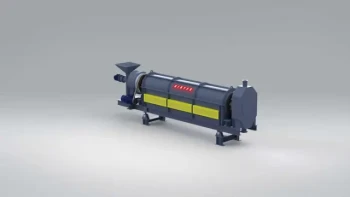
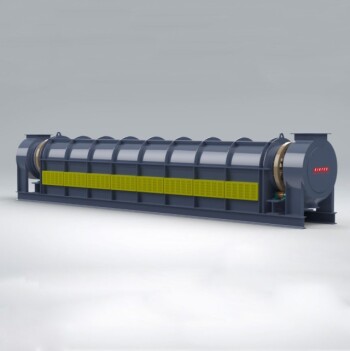
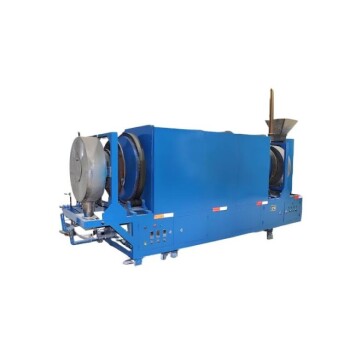
Industrial rotary furnaces and controlled atmosphere tube furnaces are chosen specifically to guarantee uniform thermal distribution and precise environmental control during the heat treatment of hematite ore. These systems maintain a stable temperature of 400°C while utilizing high-purity nitrogen to create an inert atmosphere, effectively preventing unwanted oxidation and ensuring a consistent phase transformation.
Core Takeaway Converting hematite powder requires precise thermal history and isolation from reactive elements; without the controlled motion of these furnaces and the protection of nitrogen, achieving a specific mixed-phase structure is virtually impossible.
The Necessity of Thermal Uniformity
Achieving Consistent Heat Treatment
For hematite powder to undergo a successful phase change, every particle must be exposed to the same temperature profile.
Industrial rotary and tube furnaces are designed to provide uniform thermal distribution. This ensures that the material reaches the critical processing temperature of 400°C evenly throughout the batch.
Eliminating Hot Spots
In static or unevenly heated environments, portions of the ore may overheat or underheat.
Rotary furnaces, in particular, agitate the powder, ensuring that no single section is insulated from the heat source. This dynamic movement guarantees that the phase transformation is consistent across the entire volume of material.
The Role of Nitrogen Protection
Creating an Inert Environment
Heat treatment at elevated temperatures makes materials highly reactive to the surrounding atmosphere.
Introducing high-purity nitrogen displaces oxygen within the furnace chamber. This creates an inert environment that shields the hematite from the ambient air.
Preventing Unintended Oxidation
The primary goal of using nitrogen is to stop unintended oxidation.
If oxygen were present at 400°C, the chemical reactions would become unpredictable. Nitrogen protection ensures that the chemical changes are driven solely by thermal energy, not by uncontrolled reactions with the atmosphere.
Controlling the Phase Transition
Managing Alpha to Gamma Transition
The ultimate objective of this process is to control the local phase transition from alpha-hematite ($\alpha$-$\text{Fe}_2\text{O}_3$) to gamma-hematite ($\gamma$-$\text{Fe}_2\text{O}_3$).
This specific transition alters the magnetic and structural properties of the ore. Precision equipment allows operators to stop the process at the exact moment required to achieve a specific mixed-phase structure.
Precision at the Particle Level
Because the atmosphere and temperature are strictly regulated, the transformation occurs predictably at the local particle level.
This allows for the production of materials with highly specific characteristics, rather than a random mixture of oxidized byproducts.
Understanding the Trade-offs
The Risk of Static Heating
Using equipment without rotary or tumbling capabilities often leads to thermal gradients.
If the powder remains static, the outer layers may transform fully while the core remains unchanged, leading to a heterogeneous product that fails performance specifications.
The Cost of Atmospheric Contamination
Attempting this transformation without an inert gas like nitrogen is a common point of failure.
Even trace amounts of oxygen can skew the phase ratio, preventing the formation of the desired gamma-phase structure and potentially creating irreversible impurities.
Making the Right Choice for Your Process
To achieve high-quality hematite phase transformation, you must align your equipment choices with your specific material goals.
- If your primary focus is material consistency: Prioritize rotary furnaces to ensure every particle experiences the exact same thermal history at 400°C.
- If your primary focus is chemical purity: Ensure your system can maintain a continuous flow of high-purity nitrogen to completely eliminate oxygen exposure during the transition.
True process control comes from the combination of mechanical uniformity and atmospheric isolation.
Summary Table:
| Feature | Rotary Furnace Benefit | Nitrogen Protection Benefit |
|---|---|---|
| Temperature Control | Ensures uniform 400°C distribution | Maintains thermal stability without reactions |
| Material Consistency | Agitates powder to prevent hot spots | Ensures uniform chemical purity |
| Atmospheric Integrity | Sealed environment for gas control | Displaces oxygen to prevent oxidation |
| Phase Transition | Facilitates Alpha to Gamma transition | Enables precise mixed-phase structures |
Maximize Your Material Transformation with KINTEK
Achieving the perfect alpha-to-gamma hematite phase transition requires the highest level of thermal and atmospheric precision. KINTEK specializes in advanced laboratory and industrial solutions, offering high-performance rotary furnaces and controlled atmosphere tube furnaces specifically designed for sensitive processes like ore transformation.
Our expertise extends beyond heating; we provide a comprehensive range of crushing and milling systems, high-purity ceramics and crucibles, and gas-flow control solutions to ensure your laboratory or production line operates with zero contamination and maximum efficiency.
Ready to elevate your research or production quality?
Contact KINTEK Experts Today to discover how our customized furnace systems and premium consumables can optimize your specific heat treatment workflows.
References
- Sulakshana Shenoy, Keiko Sasaki. Mixed-Phase Fe2O3 Derived from Natural Hematite Ores/C3N4 Z-Scheme Photocatalyst for Ofloxacin Removal. DOI: 10.3390/catal13050792
This article is also based on technical information from Kintek Solution Knowledge Base .
Related Products
- Electric Rotary Kiln Small Rotary Furnace for Activated Carbon Regeneration
- Electric Rotary Kiln Small Rotary Furnace Biomass Pyrolysis Plant
- 1400℃ Controlled Atmosphere Furnace with Nitrogen and Inert Atmosphere
- Rotary Tube Furnace Split Multi Heating Zone Rotating Tube Furnace
- Vacuum Sealed Continuous Working Rotary Tube Furnace Rotating Tube Furnace
People Also Ask
- What is a rotary kiln electric furnace? Achieve Superior Uniform Heating for Your Materials
- What is the temperature of activated carbon regeneration? Unlock the 1000°F Process for Reuse
- What is the regeneration temperature of activated carbon? Optimize Your Process with the Right Method
- What are the characteristics of the slipping, slumping, and rolling modes of bed motion? Optimize Your Rotary Process
- What are the parts of a carbon regeneration kiln? A Guide to Its Core Components and Function