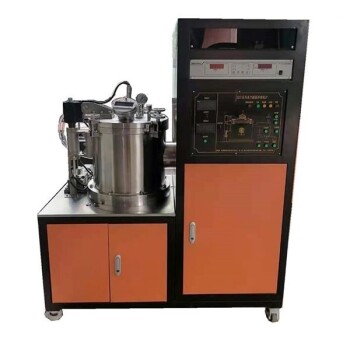
Developing Chromium-based (Cr-based) alloys requires specialized equipment to overcome two fundamental physical barriers: extreme melting points and severe chemical reactivity. Ultra-high-temperature induction furnaces provide the immense heat necessary to melt these alloys—which melt 400 to 550°C higher than traditional superalloys—while thermogravimetric analyzers (TGA) allow researchers to precisely track mass changes caused by rapid oxidation and volatilization at temperatures above 900°C.
Cr-based alloys offer superior thermal resistance but present significant processing challenges due to their extreme melting points and volatility. Specialized furnaces are required to create the alloy, while high-sensitivity analysis is crucial for designing compositions that survive the operating environment.
The Challenge of Extreme Heat
Overcoming the Melting Point Gap
The primary obstacle in developing Cr-based alloys is thermal capacity. These materials possess melting points that are 400 to 550°C higher than traditional nickel-based superalloys. Standard processing equipment often lacks the power density to achieve a stable melt at these elevated temperatures.
The Necessity of Induction Furnaces
To address this, researchers must utilize ultra-high-temperature induction or arc melting furnaces. These systems are specifically engineered to generate and sustain the extreme heat required to transition Cr-based materials from solid to liquid.
Purification and Impurity Removal
Beyond simple heating, induction melting provides critical purification. It effectively reduces gaseous elements like oxygen, nitrogen, and hydrogen, and completely removes non-metallic inclusions. It is also capable of eliminating low-melting-point harmful metal impurities—such as Pb, Bi, Sb, and Cu—which could otherwise cause premature failure.
Managing Reactivity and Volatilization
The Instability Zone
At operating temperatures above 900°C, Chromium becomes chemically unstable in air. It exhibits rapid oxidation and nitridation, reacting aggressively with the atmosphere.
The Risk of Mass Loss
Unlike some materials that form a stable protective scale, Chromium can suffer from oxide volatilization. This means the protective oxide layer turns into a gas and evaporates, leading to continuous material loss and degradation of the component.
The Role of Thermogravimetric Analyzers (TGA)
To solve this, high-sensitivity TGA is essential. These devices act as a precision scale inside a furnace, accurately monitoring minute mass changes in real-time as the alloy is heated to extreme temperatures.
Enabling Optimization
By observing exactly how mass changes over time, researchers can quantify oxidation rates. This data enables them to optimize alloy designs, tweaking the chemical composition to suppress oxidation loss and stabilize the material.
Understanding the Trade-offs
Equipment Cost vs. Performance
Achieving higher operating temperatures requires a significant investment in infrastructure. The shift from standard furnaces to ultra-high-temperature induction systems increases both capital costs and energy consumption.
The Volatility Variable
While TGA provides excellent data, it is a diagnostic tool, not a preventative one. It reveals that oxide volatilization is a persistent threat; the data must be rigorously applied to alloy formulation, or the material will fail in real-world applications regardless of how well it was melted.
Making the Right Choice for Your Goal
Developing high-temperature alloys is a balancing act between melting the material and preventing it from reacting with the environment.
- If your primary focus is synthesis and purity: Prioritize ultra-high-temperature induction melting to reach the necessary thermal thresholds while eliminating gaseous and metallic impurities.
- If your primary focus is environmental stability: Utilize high-sensitivity TGA to rigorously map mass changes, ensuring your design suppresses oxidation and nitridation above 900°C.
By leveraging these specific technologies, you bridge the gap between a promising raw element and a viable, high-performance structural alloy.
Summary Table:
| Feature | Cr-based Alloy Challenge | Equipment Solution | Key Benefit |
|---|---|---|---|
| Melting Point | 400-550°C higher than Ni-superalloys | Ultra-high-temp Induction Furnace | Reliable melting & impurity removal (O, N, H) |
| Atmospheric Stability | Rapid oxidation & nitridation >900°C | High-sensitivity TGA | Real-time monitoring of mass changes |
| Material Integrity | Oxide volatilization & mass loss | Precision Induction Melting | Eliminates harmful low-melting-point impurities |
| Alloy Optimization | Complex oxidation kinetics | Thermogravimetric Analysis | Data-driven refinement of chemical composition |
Elevate Your Material Research with KINTEK Precision Solutions
Developing the next generation of Cr-based high-temperature alloys demands equipment that can withstand the most rigorous thermal and chemical environments. At KINTEK, we specialize in providing the high-performance tools necessary for advanced metallurgy and material science.
From ultra-high-temperature induction melting furnaces designed for extreme purity to high-sensitivity TGA systems and vacuum/atmosphere furnaces, our portfolio supports every stage of your R&D process. Whether you need crushing and milling systems for feedstock preparation or high-temperature high-pressure reactors for stability testing, KINTEK delivers the reliability your lab requires.
Ready to overcome the physical barriers of advanced alloy synthesis? Contact our technical experts today to find the perfect equipment solution for your specific research goals.
References
- Chantal K. Sudbrack. Advances in High-Temperature Alloys. DOI: 10.1007/s11837-016-2107-7
This article is also based on technical information from Kintek Solution Knowledge Base .
Related Products
- Ultra-High Temperature Graphite Vacuum Graphitization Furnace
- Graphite Vacuum Furnace Bottom Discharge Graphitization Furnace for Carbon Materials
- Vertical High Temperature Graphite Vacuum Graphitization Furnace
- High Temperature Muffle Oven Furnace for Laboratory Debinding and Pre Sintering
- Vacuum Heat Treat and Pressure Sintering Furnace for High Temperature Applications
People Also Ask
- What is the disadvantage of graphite furnace? Managing Reactivity and Contamination Risks
- Is a graphite melting point high or low? Discover Its Extreme Thermal Resilience
- What are the advantages and disadvantages of graphite furnace? Unlock Extreme Heat Performance
- What are the disadvantages of graphite furnace? Key Limitations and Operational Costs
- What gas is used in graphite furnace? Maximize Accuracy with the Right Inert Gas