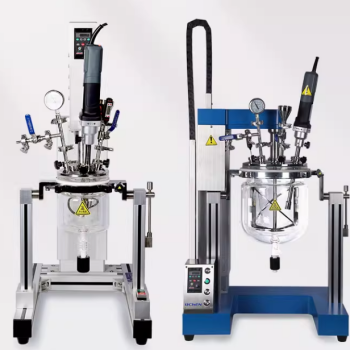
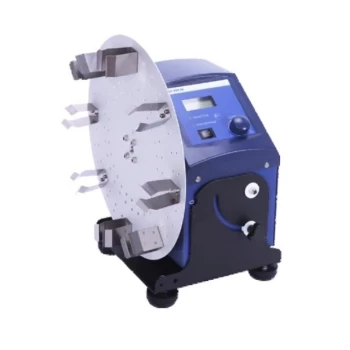
High-energy ultrasonic homogenizers are required to treat hexagonal boron nitride (h-BN) because these materials possess strong Van der Waals forces that cause the nanosheets to stack and form tight aggregates. A high-energy device utilizes the cavitation effect to generate massive local shear forces, which are necessary to physically break these agglomerates and open the layered structure. This physical disruption is the prerequisite for ensuring that chemical modifiers can uniformly penetrate and interact with the h-BN nanolayers.
The core function of the ultrasonic homogenizer is to overcome the natural tendency of h-BN to clump together. By forcefully opening the layered structure, you transform an inert, stacked powder into a high-surface-area material ready for uniform chemical modification.
The Physical Barrier of h-BN
Strong Intermolecular Forces
Hexagonal boron nitride is characterized by a layered crystal structure similar to graphite. The individual layers are held together by strong Van der Waals forces.
Formation of Aggregates
Because of these attractive forces, h-BN nanosheets do not naturally disperse in solution. Instead, they stack upon one another, forming dense powder agglomerates. In this state, the internal surface area of the material is inaccessible to chemical reagents.
The Mechanism of De-agglomeration
Utilizing the Cavitation Effect
A high-energy ultrasonic homogenizer (or cell disrupter) works by transmitting high-frequency sound waves into the suspension. This process creates cavitation bubbles—microscopic voids that form and collapse rapidly.
Generating Shear Forces
When these cavitation bubbles collapse, they release significant energy in the form of massive local shear forces and pressure. These forces are strong enough to overcome the Van der Waals attraction holding the h-BN stacks together.
Opening the Layered Structure
The mechanical impact effectively "peels" or separates the stacked sheets. This process breaks up the large agglomerates and exposes the individual nanosheets, creating a uniform suspension.
Why This Matters for Modification
Enabling Chemical Penetration
For modification to be successful, the modifier (such as iron salt precursors) must reach the surface of the nanosheets. If the h-BN remains agglomerated, the modifier only coats the outer surface of the clump.
Ensuring Uniform Intercalation
Ultrasonic treatment ensures the layered structure is fully opened. This allows the modifiers to uniformly enter the nanolayers, leading to consistent intercalation or coating effects throughout the entire sample, rather than just on the exterior.
Operational Considerations
High-Energy vs. Standard Baths
It is important to distinguish between a standard laboratory ultrasonic cleaning bath and a high-energy homogenizer (probe sonicator). While cleaning baths provide some agitation, they often lack the concentrated power required to generate the massive local shear forces needed to delaminate h-BN effectively.
Heat Generation
The cavitation process generates significant energy, which often converts to heat. When treating temperature-sensitive suspensions or precursors, it is standard practice to use an ice bath or cooling system during the homogenization process to maintain stability.
Making the Right Choice for Your Goal
To ensure your h-BN modification yields high-quality results, apply the following guidelines:
- If your primary focus is deep chemical modification (intercalation): You must use a high-energy homogenizer to fully open the layered structure, allowing precursors to penetrate deep between the sheets.
- If your primary focus is surface coating: You require the de-agglomeration provided by cavitation to ensure the coating material is applied exclusively to individual nanosheets, preventing the "coating of clumps."
High-energy ultrasonication is not merely a mixing step; it is an activation step that dictates the uniformity and success of the subsequent chemical reaction.
Summary Table:
| Feature | Standard Ultrasonic Bath | High-Energy Ultrasonic Homogenizer |
|---|---|---|
| Mechanism | Low-intensity agitation | Intense cavitation and local shear forces |
| H-BN Impact | Poor de-agglomeration | Effective delamination of stacked nanosheets |
| Layer Access | Outer surface only | Opens internal layers for intercalation |
| Result Quality | Uneven clumps/coatings | Uniform, high-surface-area dispersion |
| Application | Basic cleaning/mixing | Deep chemical modification and exfoliation |
Maximize Your Material Potential with KINTEK
Don't let tight h-BN aggregates compromise your research. KINTEK specializes in advanced laboratory solutions designed for high-precision material processing. Our high-energy ultrasonic homogenizers and cell disrupters provide the necessary shear forces to delaminate 2D materials like boron nitride and graphite with ease.
Beyond ultrasonics, KINTEK offers a complete ecosystem for material science, including:
- High-Temperature Furnaces (Muffle, Vacuum, CVD/PECVD) for thermal processing.
- Crushing, Milling, and Sieving systems for particle size control.
- Hydraulic Presses (Pellet, Isostatic) for sample preparation.
- Cooling Solutions (ULT Freezers, Cold Traps) to manage heat during sonication.
Ready to achieve uniform chemical intercalation and superior nanosheet dispersion? Contact KINTEK today to find the perfect equipment for your lab!
References
- Levan Chkhartishvili, Roin Chedia. Obtaining Boron Carbide and Nitride Matrix Nanocomposites for Neutron-Shielding and Therapy Applications. DOI: 10.3390/condmat8040092
This article is also based on technical information from Kintek Solution Knowledge Base .
Related Products
- High Performance Lab Homogenizer for Pharma Cosmetics and Food R&D
- High Shear Homogenizer for Pharmaceutical and Cosmetic Applications
- Laboratory High Throughput Tissue Grinding Mill Grinder
- High Performance Laboratory Stirrers for Diverse Applications
- Lab Sterile Slapping Type Homogenizer for Tissue Mashing and Dispersing
People Also Ask
- Why is a high-performance homogenizer essential for Fe3O4@C9 anode slurries? Boost Battery Performance & Stability.
- What is the primary function of high-performance homogenizers for SAPO-34 MMMs? Ensure Superior Gas Separation Efficiency
- How do lab stirrers & homogenizers ensure uniform distribution? Optimize Your Complex Multiphase Chemical Mixing
- What role does a laboratory homogenizer play in radioactive cesium detection? Ensure Accuracy in Wildlife Sampling
- How does a laboratory automatic masticator or homogenizer facilitate the processing of biofilm samples? Optimize Accuracy