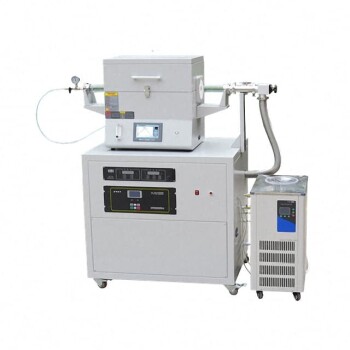
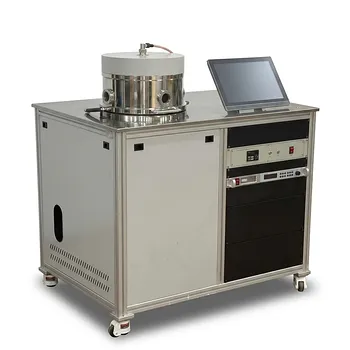
High-precision equipment is the fundamental requirement for successful in-situ synthesis. To create carbon nanotube/copper composites, you must utilize a high-precision tube reaction furnace or Chemical Vapor Deposition (CVD) system to strictly regulate high temperatures and gas flow rates. This specific environment allows for the controlled cracking of carbon source gases, such as acetylene, directly onto the surface of copper particles.
The Core Insight Simply mixing carbon nanotubes with copper results in poor material integration. The high-precision furnace solves this by enabling in-situ growth, where nanotubes form directly on the copper catalyst. This process fundamentally alters the material chemistry, significantly improving wettability and the interfacial bonding strength of the composite.
The Mechanics of In-Situ Growth
Controlling the Chemical Reaction
The creation of carbon nanotubes (CNTs) requires a precise chemical breakdown, known as cracking.
A high-precision furnace manages the specific heat and pressure required to break down volatile precursors like acetylene. If the temperature fluctuates, the cracking becomes inconsistent, leading to poor quality carbon structures or soot rather than nanotubes.
The Role of Gas Flow
Uniformity is critical in composite materials.
The equipment must maintain exact gas flow rates throughout the reaction chamber. This ensures that the carbon source reaches the copper particles evenly, preventing localized defects or uneven growth patterns across the composite batch.
Copper as the Catalyst
In this process, the copper particles serve a dual purpose: they are the matrix of the final composite and the catalyst for the reaction.
The furnace environment must be tuned so that the copper surface activates the growth of the carbon nanotubes. This direct growth mechanism is what differentiates in-situ synthesis from simple mechanical mixing.
Why Precision Defines Material Performance
Improving Wettability
One of the hardest challenges in materials science is combining metal (copper) with carbon. They naturally repel each other, a property known as poor wettability.
By growing the CNTs directly on the copper inside the furnace, the process modifies the surface chemistry. This ensures the copper "wets" or covers the nanotubes effectively, eliminating voids in the material.
Enhancing Interfacial Bonding
The strength of a composite is defined by the interface—the boundary where the two materials meet.
Because the high-precision equipment facilitates direct growth, it creates a robust physical and chemical lock between the copper and the nanotube. This results in superior interfacial bonding strength, allowing the composite to withstand higher mechanical loads without delaminating.
Understanding the Trade-offs
Process Sensitivity
While high-precision CVD yields superior materials, it introduces significant process sensitivity.
The resulting film thickness and nanotube length are heavily dependent on controlling time and power. A slight deviation in furnace conditions can result in an overgrowth of carbon, which may degrade the electrical conductivity of the copper, or undergrowth, which fails to reinforce the material.
Equipment Complexity
High-precision tube furnaces require rigorous calibration.
Unlike mechanical mixing methods (ex-situ), this approach requires sophisticated management of vacuum levels, gas purity, and thermal gradients. The complexity of the equipment is the "cost" of achieving the superior bonding strength of the final material.
Making the Right Choice for Your Goal
To maximize the potential of your carbon nanotube/copper composite, align your process controls with your specific performance targets:
- If your primary focus is Mechanical Strength: Prioritize the precision of the thermal profile to ensure maximum interfacial bonding between the CNTs and the copper surface.
- If your primary focus is Material Uniformity: Focus heavily on the calibration of gas flow rates to ensure even distribution of the carbon source across all copper particles.
True material performance is not just about the ingredients you choose, but the precision of the environment in which you combine them.
Summary Table:
| Feature | Requirement for In-Situ Synthesis | Impact on Composite Performance |
|---|---|---|
| Temperature Control | High-precision thermal stability | Ensures consistent cracking of carbon sources like acetylene |
| Gas Flow Regulation | Uniform and calibrated flow rates | Prevents localized defects and ensures even growth distribution |
| Interfacial Bonding | Direct growth on copper catalyst | Eliminates voids and significantly increases mechanical strength |
| Surface Chemistry | Controlled reaction environment | Improves wettability between carbon and metal matrix |
| Process Sensitivity | Precise time and power management | Determines nanotube length and final electrical conductivity |
Elevate Your Material Research with KINTEK Precision
Achieving the perfect interfacial bond in carbon nanotube/copper composites requires more than just high temperatures—it demands absolute control. KINTEK specializes in advanced laboratory equipment designed for the most rigorous synthesis processes.
Our high-precision tube furnaces and CVD systems provide the thermal stability and gas flow accuracy necessary for superior in-situ growth. Whether you are developing next-generation composites or exploring battery research, our comprehensive portfolio—including vacuum and atmosphere furnaces, crushing systems, and high-pressure reactors—is engineered to meet your exact specifications.
Ready to optimize your synthesis results? Contact our technical experts today to find the perfect equipment solution for your laboratory.
Related Products
- Chemical Vapor Deposition CVD Equipment System Chamber Slide PECVD Tube Furnace with Liquid Gasifier PECVD Machine
- Split Chamber CVD Tube Furnace with Vacuum Station Chemical Vapor Deposition System Equipment Machine
- Customer Made Versatile CVD Tube Furnace Chemical Vapor Deposition Chamber System Equipment
- Multi Heating Zones CVD Tube Furnace Machine Chemical Vapor Deposition Chamber System Equipment
- Inclined Rotary Plasma Enhanced Chemical Vapor Deposition PECVD Equipment Tube Furnace Machine
People Also Ask
- What are the advantages of chemical vapor deposition? Achieve Superior Thin Films for Your Lab
- What types of substrates are used in CVD to facilitate graphene films? Optimize Graphene Growth with the Right Catalyst
- What is the chemical vapor deposition growth process? Build Superior Thin Films from the Atom Up
- How expensive is chemical vapor deposition? Understanding the True Cost of High-Performance Coating
- Why is Chemical Vapor Deposition (CVD) equipment uniquely suited for constructing hierarchical superhydrophobic structures?