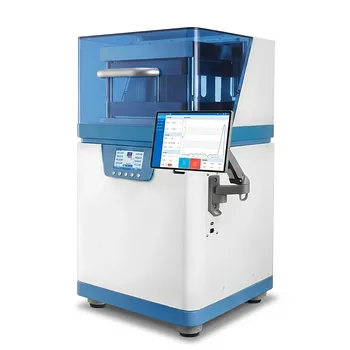
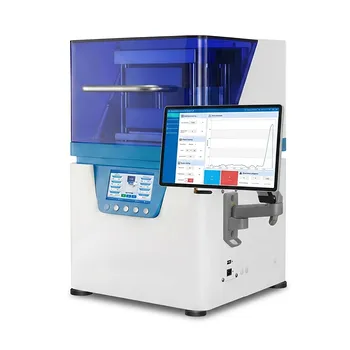
The use of a high-precision laboratory hydraulic press is fundamental to achieving structural homogeneity and high crystallinity in GMAGG: Cr³⁺, xYb³⁺ phosphors. It transforms loose, ball-milled powders into dense "green pellets," ensuring that the subsequent high-temperature sintering process results in a chemically uniform material with the precise phase purity required for advanced optical applications.
A laboratory hydraulic press provides the uniform pressure necessary to maximize particle packing density and eliminate internal voids. This physical compaction is the critical precursor to efficient solid-state diffusion, which directly dictates the final phosphor’s crystallinity, isotropic properties, and luminescence performance.
Enhancing Solid-State Reaction Kinetics
Minimizing Atomic Diffusion Paths
In the synthesis of complex garnets like GMAGG, the reaction occurs primarily through solid-state diffusion. By compressing the powder, the press significantly reduces the physical distance between individual reactant particles. This proximity allows ions to migrate more easily across grain boundaries during heating, facilitating a complete reaction at potentially lower temperatures.
Increasing Reactant Contact Area
High-precision pressing overcomes inter-particle friction, forcing particles into intimate contact. A larger contact area between the precursor materials (such as gadolinium, magnesium, and aluminum oxides) ensures that the chemical transformation is uniform throughout the pellet. This prevents the formation of secondary, unwanted phases that could degrade the phosphor's optical quality.
Suppressing Component Volatilization
During high-temperature calcination, certain dopants or flux materials may become volatile. Forming a dense green body helps physically trap these components within the pellet structure. This minimizes material loss and prevents the stratification of elements, ensuring the final stoichiometry of the GMAGG host remains accurate.
Impact on Structural and Optical Integrity
Achieving High Crystallinity
The density of the green pellet directly influences the crystallinity of the final phosphor. A high-density pellet promotes the growth of well-defined crystal lattices during sintering. High crystallinity is vital for phosphors, as defects in the crystal structure can act as non-radiative recombination centers, significantly quenching fluorescence intensity.
Ensuring Isotropic Physical Properties
Uniform pressure application ensures that the density gradient is consistent throughout the sample. This result is a phosphor with isotropic physical and chemical properties, meaning its performance is predictable regardless of orientation. For GMAGG: Cr³⁺, xYb³⁺, this uniformity is essential for achieving repeatable fluorescence intensity and consistent energy transfer between the Cr³⁺ and Yb³⁺ ions.
Facilitating High-Quality Structural Analysis
To confirm the success of the synthesis, researchers rely on X-ray diffraction (XRD) and other structural tools. Pellets produced with a high-precision press have highly flat surfaces and minimal internal porosity. These characteristics reduce noise and artifacts in analytical data, allowing for a more accurate determination of the lattice parameters and dopant integration.
Understanding the Trade-offs
Pressure-Induced Stress and Cracking
While high pressure is beneficial, exceeding the material's limits can lead to internal mechanical stress. If the pressure is released too quickly or if it is too high for the specific powder morphology, the "green pellet" may experience "capping" or delamination. These micro-cracks can interrupt diffusion paths and lead to structural failure during sintering.
The Risk of Tooling Contamination
The high tonnage required for pelletizing brings the powder into forceful contact with the steel dies. Without proper cleaning or the use of liners, trace metal contamination from the mold can be introduced into the phosphor. In optical materials, even parts-per-million levels of iron or other transition metals can significantly poison the luminescence efficiency.
How to Apply This to Your Synthesis
When preparing GMAGG: Cr³⁺, xYb³⁺ phosphors, the pelletizing strategy should be tailored to your specific characterization needs.
- If your primary focus is Phase Purity: Use higher pressures (often exceeding 150 MPa) to maximize contact area and ensure complete atomic recombination during the solid-state reaction.
- If your primary focus is Optical Repeatability: Prioritize a high-precision press with a stable pressure hold to ensure a uniform density gradient, which minimizes scattering variations during fluorescence testing.
- If your primary focus is Structural Refinement: Focus on achieving a perfectly flat pellet surface and low porosity (ideally <5%) to ensure the highest resolution during X-ray excitation and structural mapping.
Mastering the pelletizing stage transforms a simple powder mixture into a high-performance ceramic phosphor capable of sophisticated energy transfer.
Summary Table:
| Key Factor | Role of the Hydraulic Press | Impact on GMAGG Phosphors |
|---|---|---|
| Diffusion Path | Minimizes distance between reactant particles | Faster, more complete solid-state reactions |
| Contact Area | Increases intimacy between precursors | Prevents unwanted phases & ensures chemical uniformity |
| Stoichiometry | Forms dense bodies to trap volatile dopants | Maintains precise chemical composition and doping |
| Crystallinity | Promotes growth of well-defined crystal lattices | Minimizes non-radiative defects and quenching |
| Surface Quality | Creates highly flat, low-porosity pellet surfaces | Improves accuracy of XRD and structural analysis |
Elevate Your Material Synthesis with KINTEK Precision
Achieving the perfect green body is critical for the performance of advanced optical materials like GMAGG phosphors. KINTEK specializes in providing high-performance laboratory solutions tailored for researchers and manufacturers. Our comprehensive range of hydraulic presses (pellet, hot, isostatic) ensures uniform pressure distribution and maximum density for your samples.
Beyond pressing, KINTEK offers a complete ecosystem for phosphor research, including:
- Crushing and milling systems for precursor homogenization.
- High-temperature furnaces (muffle, vacuum, and atmosphere) for precise sintering.
- Essential consumables such as high-purity ceramics and crucibles.
Don't let structural inconsistencies compromise your luminescence results. Contact KINTEK today to discover how our high-precision equipment can enhance your laboratory’s efficiency and material quality!
References
- Lipeng Jiang, Yanjing Su. Cr<sup>3+</sup>‐Yb<sup>3+</sup>‐Ni<sup>2+</sup> Tri‐Doped NIR Phosphors with Spectral Output Covering NIR‐I and NIR‐II Regions. DOI: 10.1002/admt.202301495
This article is also based on technical information from Kintek Solution Knowledge Base .
Related Products
- Automatic High Temperature Heated Hydraulic Press Machine with Heated Plates for Lab
- Automatic Laboratory Hot Press 400x400 mm with Programmable High Temperature and Hydraulic Force Control
- Manual High Temperature Heated Hydraulic Press Machine with Heated Plates for Lab
- Fully Automatic Heated Hydraulic Lab Press for Materials Sintering and Sample Preparation
- Laboratory Hydraulic Press Lab Pellet Press Machine for Glove Box
People Also Ask
- Why is a heated hydraulic press used for warm pressing NASICON green tapes? Optimize Your Solid Electrolyte Density
- What is a heated hydraulic press used for? Essential Tool for Curing, Molding, and Laminating
- Why is a heated laboratory hydraulic press necessary for composite laminates? Achieve Void-Free Structural Integrity
- What is a hot hydraulic press? Harness Heat and Pressure for Advanced Manufacturing
- What is the core function of a laboratory heated hydraulic press in CSP? Revolutionize Low-Temp Ceramic Sintering