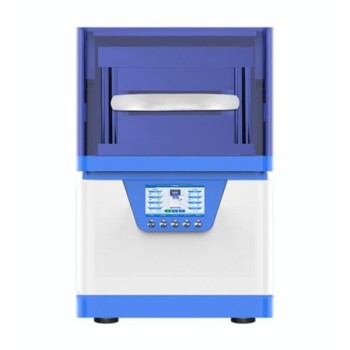
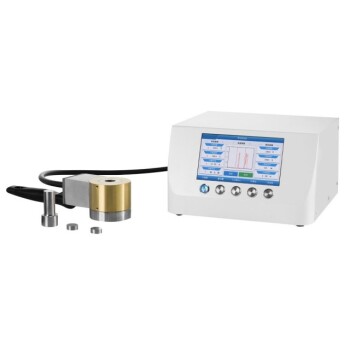
A heated hydraulic press serves as the primary instrument for overcoming the inherent incompatibility between solid lithium metal and hard ceramic electrolytes. During assembly, this device applies a specific mechanical pressure, typically around 3.2 MPa, while simultaneously heating the assembly to approximately 170°C.
Core Takeaway: This process relies on thermal-pressure bonding to exploit the creep characteristics of lithium. By softening the metal with heat and forcing it against the ceramic with pressure, the press eliminates microscopic voids to create a continuous, low-impedance interface essential for ion transport.
The Mechanism of Thermal-Pressure Bonding
Inducing Lithium Creep
The fundamental challenge in solid-state battery assembly is the "solid-solid" interface. At room temperature, lithium metal does not naturally flow into the microscopic irregularities of the ceramic LLZO surface.
By heating the sample to 170°C, the press significantly softens the lithium. This activates the metal's creep characteristics, allowing it to deform over time under constant stress rather than acting as a rigid solid.
Eliminating Interfacial Voids
Once the lithium is in a softened state, the hydraulic press applies a consistent compressive force. This forces the lithium to flow into and fill the surface pores and roughness of the hard LLZO electrolyte.
This physical penetration eliminates the initial voids between the materials. These voids are the primary cause of high interfacial resistance, which blocks the flow of ions.
Establishing Ion Transport Channels
The result of this process is tight, void-free physical contact. This maximizes the active surface area between the anode and the electrolyte.
By removing physical gaps, the press establishes efficient ion transport channels. This allows the battery to function effectively and withstand higher critical current densities during operation.
Key Operational Parameters
Temperature Regulation
Precise temperature control is vital to the success of this method. The device must maintain a steady temperature, such as the referenced 170°C, to ensure the lithium remains malleable without degrading the battery components.
Pressure Application
The pressure applied must be uniform to ensure consistent bonding across the entire interface. While thermal bonding uses moderate pressures (e.g., 3.2 MPa), other methods relying solely on plastic deformation may require significantly higher pressures (up to 71 MPa) to achieve similar void-filling.
Understanding the Trade-offs
Interface Quality vs. Mechanical Integrity
While heat and pressure improve contact, they introduce stress. Excessive pressure can crack the brittle LLZO ceramic pellet, rendering the electrolyte useless.
Thermal Considerations
Heating promotes better flow (wetting) and reduces the pressure required to bond the materials. However, high temperatures must be carefully monitored to avoid unwanted chemical side reactions at the interface.
Processing Complexity
Using a heated hydraulic press adds a variable (temperature) to the assembly process compared to cold pressing. This requires more sophisticated equipment and precise control systems to maintain uniformity.
Making the Right Choice for Your Goal
To optimize your assembly process, consider which parameter effectively reduces impedance for your specific cell architecture.
- If your primary focus is minimizing mechanical stress: Utilize thermal-pressure bonding (approx. 170°C at 3.2 MPa) to maximize lithium flow (creep) while keeping physical pressure moderate to protect the ceramic.
- If your primary focus is room-temperature assembly: You may need to utilize high-precision presses capable of delivering significantly higher pressures (approx. 71 MPa) to induce plastic deformation without the aid of thermal softening.
The ultimate goal is to transform two distinct solids into a unified electrochemical system by erasing the physical boundaries between them.
Summary Table:
| Parameter | Thermal-Pressure Bonding | High-Pressure Plastic Deformation |
|---|---|---|
| Typical Temperature | ~170°C | Room Temperature |
| Applied Pressure | Moderate (~3.2 MPa) | High (~71 MPa) |
| Primary Mechanism | Lithium Creep (Thermal Softening) | Mechanical Plastic Flow |
| Main Advantage | Reduced stress on brittle LLZO | Simpler setup (no heating) |
| Primary Goal | Minimize interfacial resistance | Achieve contact via force |
Elevate Your Battery Research with KINTEK
Precision is the key to unlocking the potential of solid-state batteries. KINTEK specializes in high-performance laboratory equipment and consumables, providing the exact tools needed for advanced Li-LLZO assembly. From heated hydraulic presses (pellet, hot, isostatic) for thermal-pressure bonding to high-temperature furnaces (muffle, tube, vacuum) and specialized crushing and milling systems, we empower researchers to eliminate interfacial resistance and protect delicate ceramics.
Ready to optimize your battery assembly process? Contact KINTEK today to discover how our comprehensive range of hydraulic presses and high-temperature solutions can enhance your lab's efficiency and material integrity.
Related Products
- 24T 30T 60T Heated Hydraulic Press Machine with Heated Plates for Laboratory Hot Press
- Heated Hydraulic Press Machine with Integrated Manual Heated Plates for Lab Use
- Automatic Heated Hydraulic Press Machine with Heated Plates for Laboratory Hot Press 25T 30T 50T
- Heated Hydraulic Press Machine with Heated Plates for Vacuum Box Laboratory Hot Press
- Heated Hydraulic Press Machine with Heated Plates for Vacuum Box Laboratory Hot Press
People Also Ask
- What role does a heated hydraulic press play in Cold Sintering (CSP)? Enhancing LATP-Halide Densification
- Why is the heating function of a laboratory hydraulic press essential for MEA assembly in DEFC? Optimize Cell Bonding
- What technical conditions does a heated hydraulic press provide for PEO batteries? Optimize Solid-State Interfaces
- What is the core function of a laboratory heated hydraulic press in CSP? Revolutionize Low-Temp Ceramic Sintering
- What are heated hydraulic presses used for? Molding Composites, Vulcanizing Rubber, and More