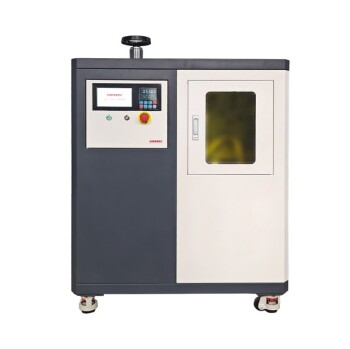
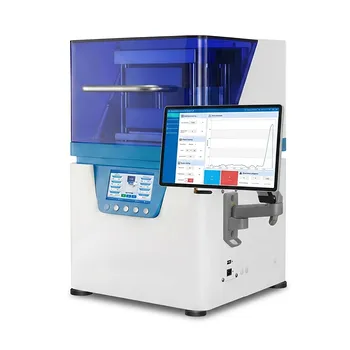
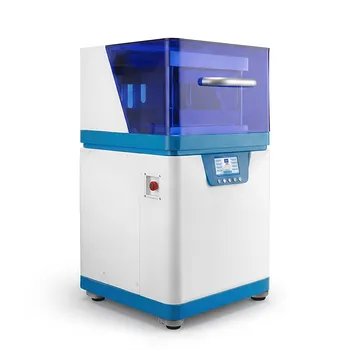
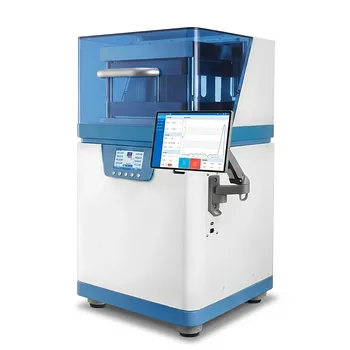
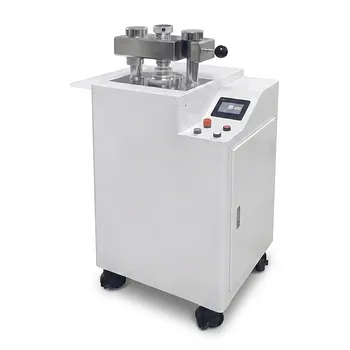
A high-pressure manual or automatic hydraulic press is required because all-solid-state battery (ASSB) components are rigid solids that lack the natural "wetting" capabilities of liquid electrolytes. These presses apply extreme axial pressure—often ranging from 100 MPa to over 500 MPa—to mechanically force powders into intimate contact. This process increases compaction density, eliminates internal voids, and establishes the continuous ion and electron transport channels necessary for electrochemical functionality.
Core Takeaway: High-pressure compaction is the primary mechanism for overcoming the high interfacial resistance inherent in solid-solid systems. By exploiting the ductility of solid electrolytes, a hydraulic press transforms loose powders into a dense, integrated green body that ensures efficient ion transport and structural integrity.
Achieving Maximum Compaction Density
Eliminating Internal Voids and Porosity
Loose composite powders naturally contain significant air gaps that act as insulators, blocking the flow of ions. High mechanical pressure forces these particles to rearrange and deform, reducing porosity to a minimum. A dense green body is the physical foundation required for the battery to function without internal gaps.
Promoting Particle "Necking"
The application of pressure (up to 300 MPa or more) facilitates the formation of "necks" or bridges between individual particles. These connections are essential for the subsequent sintering process and provide the structural stability needed for the green body to remain intact. Without this initial compaction, the material would remain a fragile powder rather than a unified electrode.
Saturating Ionic Conductivity
Experimental data shows that as manufacturing pressure increases, the discharge specific capacity of the battery follows an upward trend. High pressure ensures that the solid electrolyte particles are packed tightly enough to reach their saturation point for ionic conductivity. This maximizes the speed at which lithium ions can move through the battery layers.
Establishing Critical Solid-Solid Interfaces
Overcoming the Lack of Wetting
In traditional batteries, liquid electrolytes flow into every crevice of the electrode; solid electrolytes cannot do this. A hydraulic press uses mechanical force to compensate for this lack of fluidity, forcing the cathode, electrolyte, and anode into a seamless interface. This contact is the only way to achieve low internal resistance in an all-solid system.
Exploiting Material Ductility
Many solid electrolytes, particularly sulfides and halides, possess a degree of ductility or a manageable Young's modulus. The high pressure from the press exploits these mechanical properties to "smear" the electrolyte into the active material. This creates a continuous path for ion transport with minimal resistance at the grain boundaries.
Reducing Interfacial Impedance
By maximizing the contact area between the active materials and the electrolyte, the press significantly reduces interfacial impedance. Precise pressure control ensures that the physical bond is tight enough to allow for reversible charge-discharge cycles. Without this pressure, the high resistance at the interfaces would prevent the battery from delivering usable power.
Enhancing Structural and Electrochemical Durability
Suppressing Lithium Dendrite Growth
A dense, high-strength green body acts as a physical barrier against the formation of lithium dendrites. These needle-like structures can grow through pores in the electrolyte, causing internal short circuits. High-pressure molding creates a solid, pore-free architecture that mechanically resists dendrite penetration.
Managing Volume Changes During Cycling
Active materials often expand and contract as they gain and lose lithium ions during use. The high pressure used during green body preparation creates a pre-stressed, dense structure that can better accommodate these volume shifts. This prevents the layers from delaminating or losing contact during the life of the battery.
Understanding the Trade-offs and Pitfalls
Pressure Limits and Material Damage
While high pressure is necessary, exceeding the mechanical limits of the active materials can lead to particle fracturing. If the pressure is too high, it may crush the active material or create micro-cracks in brittle electrolyte ceramic components. Researchers must calibrate the pressure to the specific Young's modulus of their materials to avoid structural degradation.
Inconsistent Pressure Distribution
Manual hydraulic presses may suffer from human error or uneven force application, leading to non-uniform density across the green body. Variations in density cause localized areas of high resistance, which can lead to "hot spots" and premature battery failure. Automatic presses are often preferred in professional settings to ensure repeatable, precise pressure application.
How to Apply This to Your Battery Project
Making the Right Choice for Your Goal
- If your primary focus is maximizing energy density: Use a high-pressure automatic press to reach levels above 375 MPa to minimize porosity and maximize active material packing.
- If your primary focus is reducing internal resistance: Prioritize precise pressure control (e.g., 98 MPa to 150 MPa) to ensure a perfect, gap-free interface between the electrolyte and the electrodes.
- If your primary focus is long-term cycle life: Focus on using the press to create a dense, "neck-filled" structure that can buffer against volume changes and suppress dendrite growth.
By utilizing a hydraulic press to achieve extreme compaction, you move from a collection of powders to a high-performance electrochemical system.
Summary Table:
| Feature | Impact on Solid-State Battery Performance |
|---|---|
| Pressure Range | 100 MPa to 500+ MPa to overcome solid-solid interfacial resistance. |
| Compaction Density | Eliminates air gaps/voids, creating a continuous path for ion transport. |
| Interface Quality | Compensates for lack of liquid wetting by forcing mechanical contact. |
| Structural Integrity | Promotes particle 'necking' to prevent delamination during cycling. |
| Safety & Life | Creates a dense physical barrier to suppress lithium dendrite growth. |
Elevate Your Battery Research with KINTEK Precision
Achieving the perfect solid-state interface requires more than just force—it requires precision and repeatability. KINTEK specializes in high-performance laboratory equipment designed for the rigorous demands of energy storage research. Whether you are developing next-generation all-solid-state batteries or advanced materials, our range of manual and automatic hydraulic presses (pellet, hot, isostatic) ensures uniform compaction and maximum density.
Beyond pressing, KINTEK provides a complete ecosystem for battery labs, including:
- High-Temperature Furnaces: Muffle, tube, and vacuum furnaces for material synthesis.
- Milling & Grinding: Crushing systems and sieving equipment for ideal powder particle size.
- Advanced Reactors: High-pressure autoclaves and electrolytic cells for electrochemical testing.
- Cooling & Processing: ULT freezers, freeze dryers, and homogenizers.
Don't let interfacial resistance hold back your energy density goals. Contact KINTEK today to find the ideal hydraulic press and consumable solutions for your laboratory's success!
References
- Kazuhiro Hikima, Atsunori Matsuda. Fabrication and electrochemical properties of electrode composites for oxide-type all-solid-state batteries through electrostatic integrated assembly. DOI: 10.1016/j.heliyon.2023.e17889
This article is also based on technical information from Kintek Solution Knowledge Base .
Related Products
- Warm Isostatic Press for Solid State Battery Research
- Fully Automatic Heated Hydraulic Lab Press for Materials Sintering and Sample Preparation
- Laboratory Hydraulic Press Lab Pellet Press for Button Battery
- Automatic Hydraulic Hot Press with 500x500mm Heating Plates and Multi Stage PLC Control for Material Sintering
- Ball Press Mold for Lab
People Also Ask
- What is the temperature of a warm isostatic press? Achieve Optimal Densification for Your Materials
- What is the function of a Warm Isostatic Press (WIP) in all-solid-state pouch cells? Optimize Battery Density
- Why are Warm Isostatic Presses (WIP) necessary for solid-state batteries? Achieve Atomic-Level Contact
- What advantages does a warm isostatic press offer over a traditional uniaxial press for Li6PS5Cl electrolyte sheets?
- How do warm isostatic presses improve dry electrode performance? Enhance ASSB Conductivity with Heat & Pressure