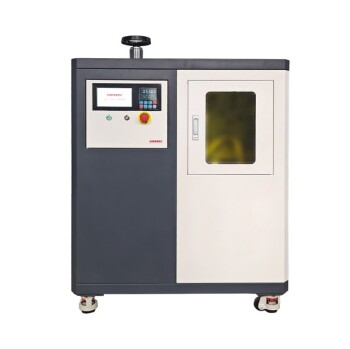
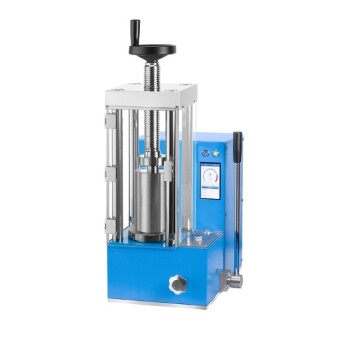
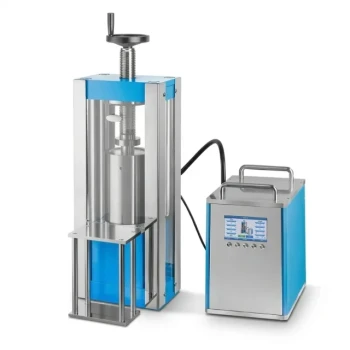
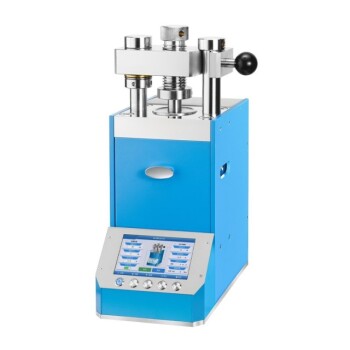
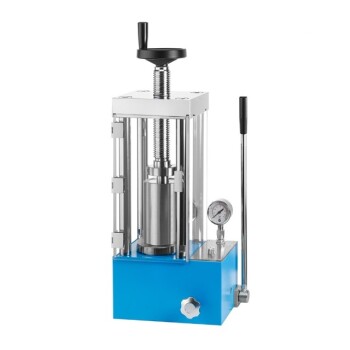
The decisive advantage of a warm isostatic press (WIP) over a traditional uniaxial press lies in its ability to apply uniform, multi-directional fluid pressure while simultaneously heating the sample. Unlike uniaxial pressing, which applies force from a single direction, a WIP eliminates the internal micropores and particle gaps that often persist in Li6PS5Cl sulfide electrolytes, resulting in a denser, more uniform material with superior electrochemical performance.
Core Takeaway: Traditional uniaxial pressing often fails to fully densify sulfide electrolytes, leaving voids that hinder performance. Warm isostatic pressing solves this by combining omni-directional fluid pressure with heat treatment, effectively sealing particle gaps to significantly boost the material's critical current density.
The Mechanics of Superior Densification
Uniform vs. Directional Pressure
A traditional uniaxial press applies force from a single axis (usually top-down). This directional force can lead to density gradients, where the material is dense in some areas but remains porous in others.
In contrast, a warm isostatic press utilizes fluid pressure applied from all directions. This ensures that every part of the Li6PS5Cl sample receives equal force, preventing the formation of low-density regions common in uniaxial processing.
The Synergistic Role of Heat
Pressure alone is often insufficient for optimal densification of sulfide electrolytes. A WIP incorporates a heat treatment alongside the pressure application.
This thermal energy softens the material slightly, allowing particles to rearrange and fuse more effectively. The combination of heat and multi-directional pressure closes internal micropores and particle gaps that cold or uniaxial methods cannot reach.
Impact on Electrochemical Performance
Eliminating Structural Defects
The primary structural goal when processing Li6PS5Cl is the creation of a uniform and dense electrolyte layer.
The WIP process effectively eradicates the voids and gaps between particles. By removing these structural defects, the electrolyte achieves a level of continuity and homogeneity that is difficult to replicate with uniaxial pressing.
Boosting Critical Current Density
The structural improvements translate directly to performance metrics. The primary reference highlights that this process significantly improves the critical current density.
A denser material with fewer voids facilitates better ion transport. This allows the electrolyte to handle higher current loads without degrading, a crucial factor for the viability of solid-state batteries.
Understanding the Trade-offs
The Limitations of Uniaxial Pressing
While uniaxial presses are common, they are mechanically limited when processing complex granular materials like Li6PS5Cl.
The lack of lateral pressure means that particle gaps often remain open perpendicular to the pressing direction. Relying solely on uniaxial pressing creates a high risk of internal porosity, which acts as a bottleneck for ionic movement and limits the final performance of the electrolyte sheet.
Making the Right Choice for Your Project
To achieve the best results for your Li6PS5Cl electrolyte layers, align your processing method with your performance targets:
- If your primary focus is maximizing electrochemical performance: Prioritize warm isostatic pressing to achieve the highest critical current density by eliminating internal voids.
- If your primary focus is structural integrity: Use the multi-directional pressure of a WIP to ensure a uniform density profile, avoiding the weak points and gradients typical of uniaxial pressing.
The uniform application of heat and pressure is the key to unlocking the full potential of sulfide electrolytes.
Summary Table:
| Feature | Traditional Uniaxial Press | Warm Isostatic Press (WIP) |
|---|---|---|
| Pressure Direction | Single-axis (Directional) | Omni-directional (Fluid-based) |
| Heat Integration | Generally cold pressing | Simultaneous heat and pressure |
| Material Density | Leads to density gradients | Uniform, high-density results |
| Structural Integrity | Persistent micropores/gaps | Effectively seals internal pores |
| Electrochemical Impact | Limited current density | Significantly boosted critical current density |
Maximize Your Battery Research Performance with KINTEK
Unlock the full potential of your Li6PS5Cl electrolyte sheets with KINTEK’s advanced processing solutions. As specialists in high-performance laboratory equipment, we provide the precision warm isostatic presses (WIP) and isostatic hydraulic presses essential for achieving superior densification and eliminating critical structural defects.
Whether you are refining sulfide electrolytes or developing next-generation solid-state batteries, KINTEK offers a comprehensive range of battery research tools, high-temperature furnaces, and crushing systems to streamline your workflow. Don't let density gradients and internal voids limit your material's critical current density.
Ready to elevate your electrolyte performance? Contact KINTEK today to discover how our tailored equipment solutions can bring unmatched uniformity and efficiency to your lab.
Related Products
- Warm Isostatic Press for Solid State Battery Research
- Electric Lab Cold Isostatic Press CIP Machine for Cold Isostatic Pressing
- Electric Split Lab Cold Isostatic Press CIP Machine for Cold Isostatic Pressing
- Automatic Lab Cold Isostatic Press CIP Machine Cold Isostatic Pressing
- Manual Cold Isostatic Pressing Machine CIP Pellet Press
People Also Ask
- What is the temperature of a warm isostatic press? Achieve Optimal Densification for Your Materials
- What is the function of a Warm Isostatic Press (WIP) in all-solid-state pouch cells? Optimize Battery Density
- Why are Warm Isostatic Presses (WIP) necessary for solid-state batteries? Achieve Atomic-Level Contact
- How do warm isostatic presses improve dry electrode performance? Enhance ASSB Conductivity with Heat & Pressure
- What is an isostatic press used for? Achieve Uniform Density & Eliminate Defects