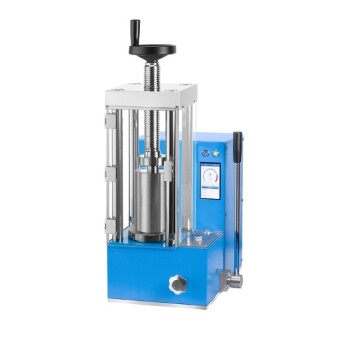
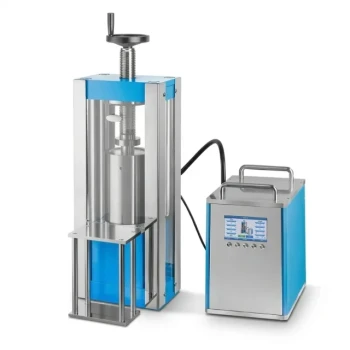
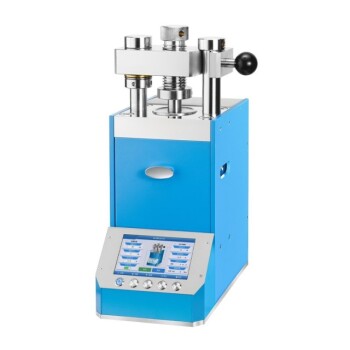
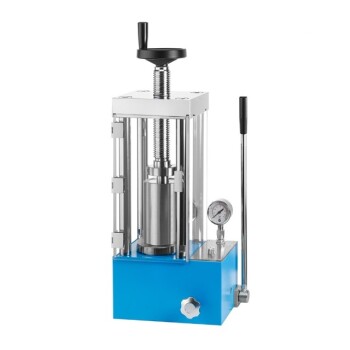
The necessity of Warm Isostatic Presses (WIP) or high-pressure hydraulic presses stems from the fundamental incompatibility of two solid surfaces. Simply stacking a lithium metal anode against a rigid solid electrolyte leaves microscopic voids; these presses apply extreme pressure—often exceeding 250 MPa—to force the lithium to physically deform and fill these gaps, creating a unified interface.
The Core Mechanism These presses do not merely hold components together; they induce plastic deformation and creep in the lithium metal. By combining high pressure with heat, the process liquefies the behavior of the solid lithium, forcing it into the microscopic surface defects of the electrolyte to achieve atomic-level contact.
The Mechanics of Atomic-Level Contact
Overcoming Microscopic Roughness
Even highly polished solid electrolytes possess microscopic surface defects and uneven topography. When a rigid anode is placed against a rigid electrolyte, these irregularities prevent full surface adhesion.
Without intervention, the interface is plagued by voids. These gaps act as insulators, preventing lithium ions from transporting efficiently between the anode and the electrolyte.
Inducing Plastic Deformation
To bridge these gaps, the lithium metal must be forced to behave like a fluid.
High-pressure environments generate the force required to exceed the yield strength of lithium. This induces plastic deformation, permanently reshaping the metal to match the contours of the electrolyte's surface.
The Role of Creep and Heat
In Warm Isostatic Pressing (WIP), the addition of heat accelerates this process.
Heat softens the lithium, promoting creep—the tendency of a solid material to move slowly or deform permanently under mechanical stresses. This ensures the lithium flows deep into the smallest surface voids that pressure alone might miss.
Why High Pressure is Non-Negotiable
Eliminating Interfacial Impedance
The primary operational goal of this process is minimizing interfacial impedance.
Any void between the anode and electrolyte represents high resistance. By achieving atomic-level contact, the press reduces this resistance, allowing for the efficient transfer of energy during charge and discharge cycles.
Suppressing Dendrite Growth
Poor contact is a leading cause of battery failure in solid-state systems.
As noted in the supplementary data, high-quality contact is crucial for suppressing lithium dendrite growth. Voids create "hot spots" where current density spikes, leading to the formation of metal spikes (dendrites) that can short-circuit the battery.
Understanding the Trade-offs
Mechanical Stress Risks
While pressure is necessary, it introduces mechanical risk.
Excessive force, particularly on brittle ceramic electrolytes, can cause micro-cracking. The pressure must be carefully calibrated to deform the lithium without fracturing the rigid electrolyte layer beneath it.
Manufacturing Complexity
Implementing WIP adds significant complexity to the production line.
Unlike liquid electrolyte batteries which wet surfaces naturally, solid-state batteries require this distinct, energy-intensive processing step. This increases the cost and time required for cell assembly.
Making the Right Choice for Your Goal
To maximize the performance of a solid-state battery, consider your primary manufacturing objectives:
- If your primary focus is Cycle Life: Prioritize pressure protocols that maximize atomic-level contact, as this directly suppresses the dendrite growth that causes premature failure.
- If your primary focus is Efficiency: Ensure your process eliminates all microscopic voids to minimize interfacial impedance, ensuring the battery can deliver high power without significant losses.
Ultimately, the mechanical integration of the anode and electrolyte is not just a bonding step; it is the critical determinant of a solid-state battery's electrochemical stability.
Summary Table:
| Feature | Warm Isostatic Press (WIP) | High-Pressure Hydraulic Press |
|---|---|---|
| Primary Mechanism | Heat + Uniform Isostatic Pressure | Uniaxial Mechanical Force |
| Material Effect | Accelerates creep & plastic deformation | Induces plastic deformation |
| Interface Quality | Superior; fills microscopic voids | High; matches surface contours |
| Key Benefit | Minimizes interfacial impedance | Eliminates voids & suppresses dendrites |
| Risk Mitigation | Reduced risk of brittle fracture | Requires precise calibration to avoid cracks |
Elevate Your Solid-State Battery Research with KINTEK
To achieve the electrochemical stability required for next-generation energy storage, precision is non-negotiable. KINTEK specializes in advanced laboratory equipment designed to bridge the gap between solid-state components. From high-performance Warm Isostatic Presses (WIP) and isostatic presses to specialized hydraulic pellet presses, we provide the tools necessary to eliminate interfacial impedance and suppress dendrite growth in lithium metal systems.
Our extensive portfolio also includes high-temperature vacuum furnaces, glove boxes, and battery research consumables, ensuring your lab is equipped for every stage of development. Don't let interfacial resistance hinder your innovation—partner with KINTEK for reliable, high-pressure solutions.
Contact Our Technical Experts Today
Related Products
- Warm Isostatic Press for Solid State Battery Research
- Electric Lab Cold Isostatic Press CIP Machine for Cold Isostatic Pressing
- Electric Split Lab Cold Isostatic Press CIP Machine for Cold Isostatic Pressing
- Automatic Lab Cold Isostatic Press CIP Machine Cold Isostatic Pressing
- Manual Cold Isostatic Pressing Machine CIP Pellet Press
People Also Ask
- What is the temperature of a warm isostatic press? Achieve Optimal Densification for Your Materials
- What is the function of a Warm Isostatic Press (WIP) in all-solid-state pouch cells? Optimize Battery Density
- What advantages does a warm isostatic press offer over a traditional uniaxial press for Li6PS5Cl electrolyte sheets?
- How do warm isostatic presses improve dry electrode performance? Enhance ASSB Conductivity with Heat & Pressure
- What is an isostatic press used for? Achieve Uniform Density & Eliminate Defects