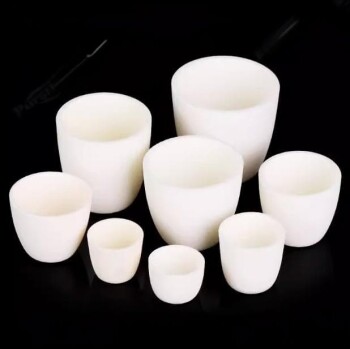
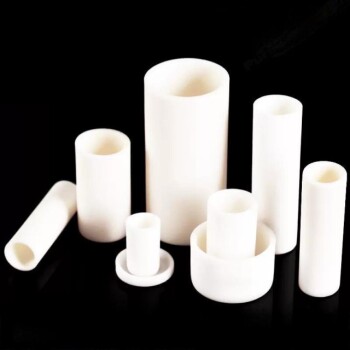
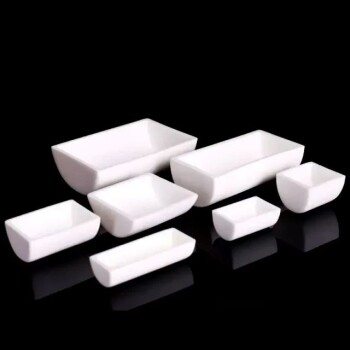
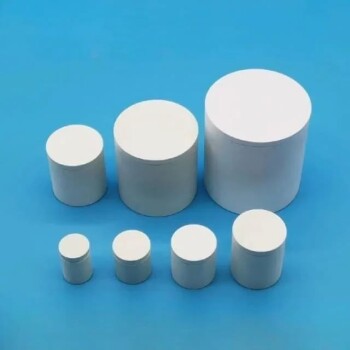
A high-purity alumina crucible acts as an essential, chemically inert barrier during the synthesis of Lithium Lanthanum Titanate (LLTO) nanofibers. Specifically, during the calcination phase at 850°C, this vessel is required to prevent the precursor material from reacting with the furnace environment or degrading due to thermal stress, thereby preserving the material's chemical integrity.
The core function of the alumina crucible is to ensure the precise stoichiometric ratio of the final ceramic product. By offering exceptional chemical stability, it prevents the containment vessel from reacting with reactive components like lithium, ensuring the purity required for high-performance nanofibers.
The Critical Role of Chemical Stability
Preventing Reactions with Alkali Metals
LLTO precursors contain lithium, an alkali metal that can become highly reactive during thermal processing.
High-purity alumina possesses excellent chemical stability. It can hold reactants containing alkali metals without reacting or softening, which is a common failure point for lesser materials.
Maintaining Stoichiometric Precision
The performance of LLTO nanofibers relies on an exact atomic balance (stoichiometry).
If the crucible material reacts with the precursor, it introduces foreign elements into the mixture. This contamination alters the chemical composition, preventing the formation of the desired cubic perovskite structure.
Withstanding the Thermal Environment
Handling High Thermal Loads
The calcination of LLTO precursors typically occurs at approximately 850°C.
Alumina crucibles are designed to withstand temperatures far exceeding this requirement (often maintaining stability up to 1150°C or higher). This provides a significant safety margin, ensuring the vessel does not deform or degrade during the prolonged heating cycle.
Isolation from the Furnace Chamber
The crucible serves as a physical containment shield within the muffle furnace.
It ensures the precursor interacts only with the uniform thermal field required to remove organic components (like PVP and acetic acid). This isolation prevents the precursor from coming into direct contact with the furnace chamber walls, which could otherwise lead to cross-contamination.
Common Pitfalls to Avoid
Managing Volatilization
While the alumina crucible protects the material from the bottom and sides, it does not automatically seal the top.
If your specific sample is prone to evaporation or volatilization upon heating, simply using a high-purity crucible is insufficient. You must utilize a crucible lid to prevent the loss of sample material into the furnace atmosphere.
The Risk of Lithium Loss
Even with a chemically inert crucible, lithium is naturally volatile at high temperatures.
Failing to account for this volatility can result in lithium deficiency in the final product. While the crucible prevents the lithium from reacting with the vessel, a lid may be required to keep the lithium within the sample mixture.
Making the Right Choice for Your Goal
To ensure the successful synthesis of LLTO nanofibers, apply the following guidelines:
- If your primary focus is material purity: Rely on high-purity alumina to prevent the leaching of crucible elements into your electrolyte powder.
- If your primary focus is structural integrity: Ensure your furnace creates a uniform thermal field at 850°C to facilitate proper crystallization of the cubic perovskite phase.
- If your primary focus is preventing mass loss: Determine if your specific precursor mix volatilizes; if so, a crucible lid is mandatory to maintain stoichiometry.
By selecting the correct containment, you transform a chaotic thermal process into a controlled synthesis of high-quality ceramic fibers.
Summary Table:
| Feature | Importance for LLTO Calcination |
|---|---|
| Chemical Inertness | Prevents lithium from reacting with the vessel walls during heating. |
| Temperature Resistance | Stable up to 1150°C+, well above the 850°C calcination requirement. |
| Stoichiometric Control | Ensures no foreign elements leach into the cubic perovskite structure. |
| Isolation | Protects precursor material from cross-contamination with the furnace chamber. |
| Mechanical Strength | Resists deformation or softening during prolonged thermal cycles. |
Elevate Your Advanced Material Synthesis with KINTEK
Precise stoichiometry is the backbone of high-performance LLTO nanofibers. KINTEK specializes in providing the high-purity laboratory equipment and consumables necessary for sensitive thermal processes.
Whether you are scaling battery research or perfecting ceramic synthesis, our portfolio offers:
- High-Purity Alumina & Ceramic Crucibles: Engineered for chemical stability and thermal resilience.
- Precision Muffle & Tube Furnaces: To maintain uniform thermal fields during calcination.
- Advanced Lab Solutions: From high-pressure reactors and autoclaves to battery research tools and cooling systems.
Don't let contamination compromise your results. Contact KINTEK today to discover how our expert-grade consumables and high-temperature systems can optimize your laboratory’s efficiency and output.
Related Products
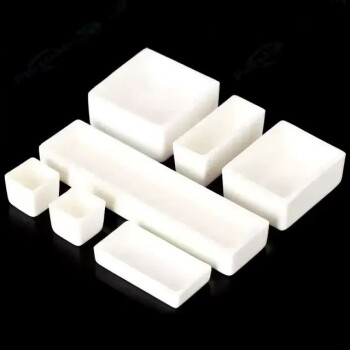
- Arc-Shaped Alumina Ceramic Crucible High Temperature Resistant for Engineering Advanced Fine Ceramics
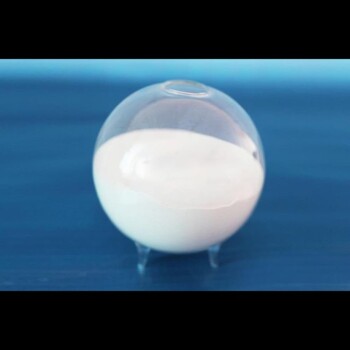
- High Purity Alumina Granulated Powder for Engineering Advanced Fine Ceramics
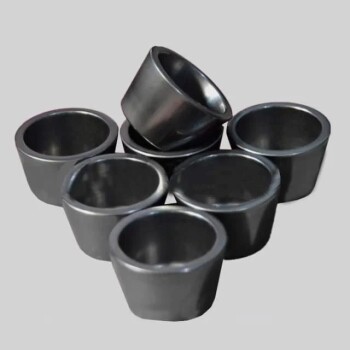
- High Purity Pure Graphite Crucible for Evaporation
- Engineering Advanced Fine Alumina Al2O3 Ceramic Crucible for Laboratory Muffle Furnace
- High Purity Pure Graphite Crucible for Electron Beam Evaporation
People Also Ask
- Why Use Alumina Crucibles & Powder Burial for NaSICON? Ensure Phase Purity and Prevent Elemental Volatilization
- What is the primary purpose of using alumina crucibles for LLTO ceramics? Optimize Your High-Temperature Sintering
- Why are alumina crucibles and mother powder essential for LATP sintering? Optimize Your Solid Electrolyte Performance
- Why are high-purity alumina crucibles used for liquid lead corrosion experiments? Ensure Data Accuracy at 550°C
- Primary considerations for choosing alumina crucibles and quartz tubes in indium intercalation: Ensure Material Purity