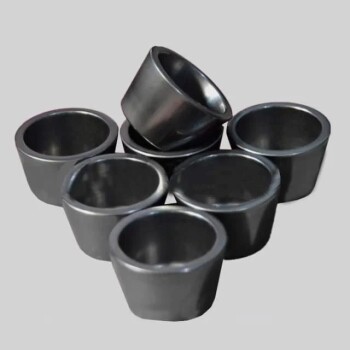
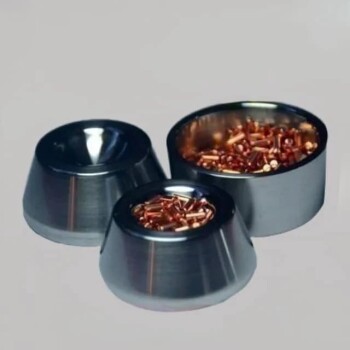
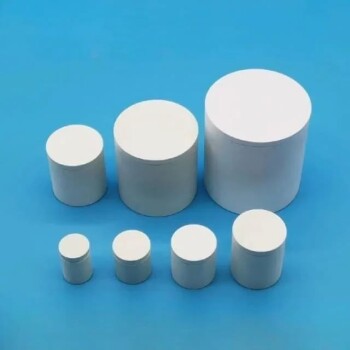
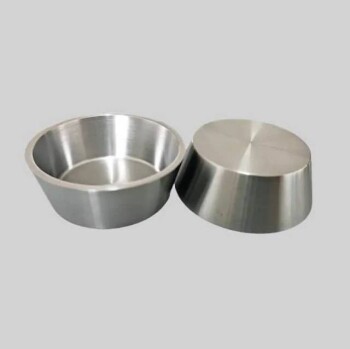
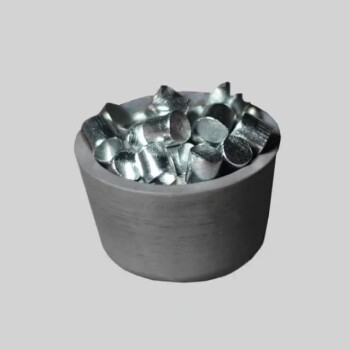
High-purity graphite is the mandatory choice for preparing and melting FLiNaK salts due to its exceptional chemical inertness and stability at high temperatures. By using graphite, you create a neutral environment that prevents the corrosive molten fluoride salts from reacting with the container, thereby guaranteeing the chemical purity of your samples.
Core Takeaway The crucible is not just a container; it is an active variable in your experiment. For FLiNaK salts, high-purity graphite is the only material that ensures data integrity by preventing crucible-salt reactions that would otherwise alter corrosion kinetics and mass transport properties.
The Critical Role of Chemical Inertness
Resisting Corrosive Attack
Molten fluoride salts, such as FLiNaK (LiF-NaF-KF), are highly corrosive environments.
High-purity graphite is selected primarily because it resists this chemical attack. Unlike standard metals or certain ceramics, it maintains exceptional chemical inertness when in contact with reactive fluoride melts.
Preventing Material Leaching
If a crucible reacts with the salt, the crucible material leaches into the melt.
Graphite prevents this degradation. This ensures that the composition of the salt remains exactly as intended, without the introduction of structural elements from the crucible walls.
Impact on Experimental Data
Preserving Corrosion Kinetics
For researchers studying how materials corrode in FLiNaK, the purity of the salt is paramount.
If the crucible dissolves into the salt, those impurities change the chemical potential of the fluid. This acts as an interference, skewing the corrosion kinetics and leading to inaccurate measurements of how fast other materials degrade.
Ensuring Accurate Mass Transport
Scientific analysis often involves measuring how species move through the molten salt.
Impurities introduced by a reacting crucible can alter the viscosity or diffusion properties of the melt. High-purity graphite prevents these impurities, ensuring that mass transport processes observed in the experiment reflect reality, not contamination.
Material Specificity and Trade-offs
Differentiating Salt Types
It is critical to match the crucible material to the specific type of salt being used. Material suitability is not interchangeable.
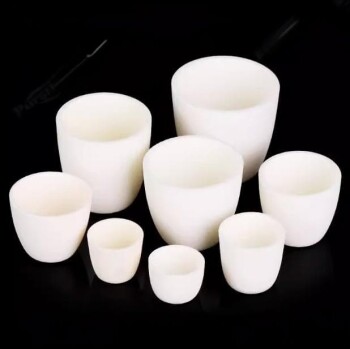
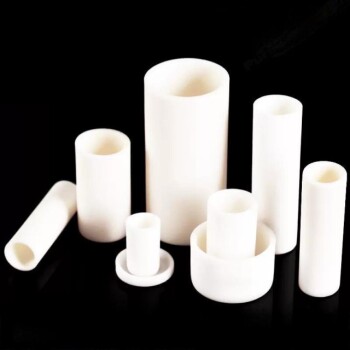
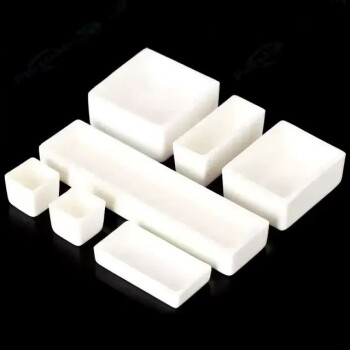
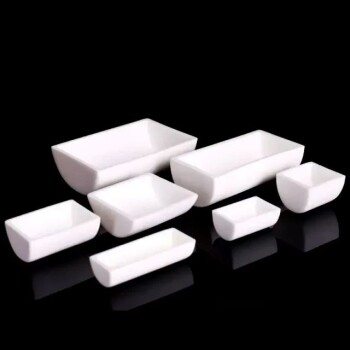
While graphite is required for fluorides (FLiNaK), other salts require different materials. For example, high-purity alumina is preferred for chloride salts because of its specific density and resistance to chloride corrosion up to 800°C.
The Risk of Substitution
Using the wrong crucible material is a common failure point in molten salt experiments.
Attempting to use an alumina crucible (ideal for chlorides) for FLiNaK salts, or vice versa, can lead to rapid material failure or subtle sample contamination. Always adhere to the specific chemical compatibility of the salt family.
Making the Right Choice for Your Goal
Select your equipment based on the specific chemical requirements of your molten salt system.
- If your primary focus is FLiNaK (Fluoride Salts): You must use high-purity graphite to ensure chemical inertness and prevent reaction byproducts from altering your corrosion data.
- If your primary focus is Chloride Salts: You should utilize high-purity alumina, as its dense structure resists chloride penetration and maintains stability at high temperatures.
To ensure valid results in molten salt research, treat the crucible as a chemical reagent that must remain neutral to the reaction.
Summary Table:
| Feature | High-Purity Graphite (for FLiNaK) | High-Purity Alumina (for Chlorides) |
|---|---|---|
| Salt Compatibility | Fluoride Salts (LiF-NaF-KF) | Chloride Salts |
| Chemical Property | Exceptional Chemical Inertness | High Density & Chloride Resistance |
| Primary Benefit | Prevents Material Leaching | Resists Material Penetration |
| Impact on Data | Preserves Corrosion Kinetics | Maintains Salt Stability < 800°C |
| Risk of Misuse | Reaction with Chlorides | Rapid Failure in Fluorides |
Elevate Your Research Precision with KINTEK
Don't let crucible contamination compromise your molten salt experiments. KINTEK specializes in providing high-performance laboratory solutions tailored to your specific chemical requirements.
Whether you need high-purity graphite crucibles for fluoride salts or dense alumina for chlorides, our expert team ensures your materials meet the highest standards of purity and durability. From high-temperature furnaces and vacuum systems to specialized high-pressure reactors and PTFE consumables, KINTEK is your partner in achieving repeatable, accurate results.
Ready to optimize your lab's performance? Contact KINTEK today to find the perfect equipment for your high-temperature research needs.
References
- Cody Falconer, Adrien Couet. Activity gradient driven mass transport in molten fluoride salt medium. DOI: 10.1038/s41529-022-00239-z
This article is also based on technical information from Kintek Solution Knowledge Base .
Related Products
- High Purity Pure Graphite Crucible for Evaporation
- High Purity Pure Graphite Crucible for Electron Beam Evaporation
- Carbon Graphite Boat -Laboratory Tube Furnace with Cover
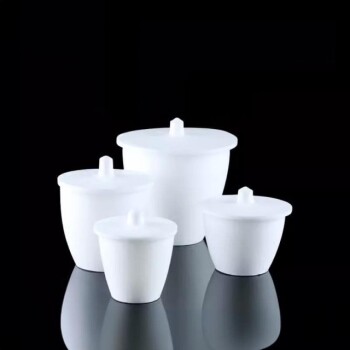
- Custom Machined and Molded PTFE Teflon Parts Manufacturer with PTFE Crucible and Lid
- Arc-Shaped Alumina Ceramic Crucible High Temperature Resistant for Engineering Advanced Fine Ceramics
People Also Ask
- Why are high-purity graphite crucibles preferred for sulfide solid electrolytes? Achieve Superior Material Purity
- Why is a high-purity graphite crucible required for Chromel-TaC composites? Ensure Peak Purity at 1400°C
- What role do high-purity graphite crucibles play in molten salt corrosion research? Ensure Reactor-Grade Precision
- Why are high-purity graphite crucibles used for magnesium distillation? Ensure 3N8 Purity & Thermal Stability
- Why is a high-purity graphite crucible ideal for nitrogen-doped graphene at 1500 °C? Maximize Purity and Stability