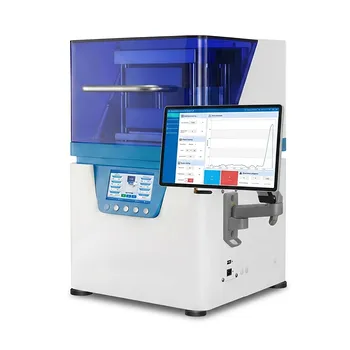
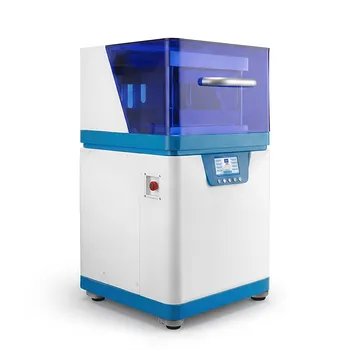
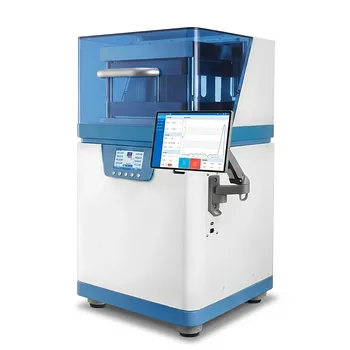
The preparation of YSZ and SDC electrolyte substrates requires a laboratory hydraulic press to transform loose ceramic powders into high-density "green" pellets. By applying significant, controlled axial pressure, the press eliminates air voids and forces particles into intimate contact. This process provides the necessary mechanical strength for handling and ensures a uniform internal density, which is a critical prerequisite for the subsequent high-temperature sintering stage.
Core Takeaway: A laboratory hydraulic press is essential for creating electrolyte substrates because it provides the high-pressure compaction necessary to eliminate internal porosity and ensure a uniform density distribution. This foundation prevents structural failure during sintering and optimizes the ionic conductivity required for electrochemical performance.
Achieving Structural Integrity and Uniformity
The Formation of the "Green Body"
A laboratory hydraulic press applies high axial pressure—often ranging from 125 MPa to 480 MPa—to compress ceramic powders within a mold. This compaction creates a green pellet with enough mechanical strength to be handled and processed without crumbling.
Eliminating Internal Voids
Loose powder contains significant amounts of entrapped air and large pores that act as structural weak points. The press forces particles together to eliminate internal pores, creating a dense, flat substrate that serves as a stable base for additional layers, such as composite electrodes.
Ensuring Uniform Density Distribution
Precise control over the holding time and pressure ensures that the internal density of the pellet is consistent throughout. Without uniform density, the material may develop physical defects or micro-cracks that compromise the substrate's integrity.
Optimizing the Sintering Foundation
Reducing Shrinkage and Deformation
YSZ and SDC substrates must undergo sintering at temperatures between 1000°C and 1600°C to reach full density. A press-compacted green body provides a consistent initial state, which significantly reduces the risk of warping, uneven shrinkage, or deformation during this high-temperature phase.
Establishing Ion Transport Channels
For electrolytes to function, they must facilitate the movement of ions. High-pressure molding increases the contact area between particles, which reduces grain boundary resistance and establishes the continuous transport channels necessary for high ionic conductivity.
Enhancing Thermal and Mechanical Stability
By achieving high density and saturation through compaction, the press ensures the final ceramic can withstand thermal stresses. This is vital for maintaining structural integrity during the high-current cycles of a solid-state battery or fuel cell.
Understanding the Trade-offs
The Risk of Pressure-Induced Defects
Applying excessive pressure can lead to "capping" or "lamination," where the pellet splits into layers upon release from the mold. It is critical to balance the compaction force with the specific elastic properties of the YSZ or SDC powder being used.
Friction and Density Gradients
Friction between the powder and the mold walls can cause density variations within a single pellet. Using a laboratory hydraulic press with a high-quality die set and proper lubrication is necessary to minimize these gradients and ensure a homogenous substrate.
Making the Right Choice for Your Goal
When using a laboratory hydraulic press for electrolyte preparation, your technical parameters should align with your specific research or production objectives.
- If your primary focus is Maximum Ionic Conductivity: Prioritize higher pressures (350+ MPa) to maximize particle-to-particle contact and minimize grain boundary resistance.
- If your primary focus is Dimensional Precision: Utilize a press with a digital gauge and programmable holding times to ensure identical thickness and density across multiple samples.
- If your primary focus is Preventing Sintering Cracks: Focus on a moderate pressure with a longer "dwell time" to allow air to escape and ensure a highly uniform density distribution.
Achieving a high-quality YSZ or SDC electrolyte begins with the controlled application of force, making the hydraulic press the cornerstone of the fabrication process.
Summary Table:
| Key Feature | Benefit for YSZ/SDC Substrates | Impact on Performance |
|---|---|---|
| High Axial Pressure | Eliminates internal voids and air pores | Prevents structural failure during sintering |
| Uniform Compaction | Ensures consistent internal density | Reduces warping and uneven shrinkage |
| Particle Contact | Minimizes grain boundary resistance | Enhances ionic conductivity and transport |
| Precise Control | Enables repeatable green body formation | Improves dimensional precision and stability |
Optimize Your Electrolyte Preparation with KINTEK
Achieving the perfect high-density YSZ or SDC substrate requires more than just pressure; it requires precision. KINTEK specializes in high-performance laboratory equipment designed for advanced material research. Our range includes manual and automated hydraulic presses (pellet, hot, and isostatic), as well as high-temperature furnaces (muffle, vacuum, and atmosphere) and essential ceramic consumables needed to transform your powders into high-conductivity electrolytes.
Ready to enhance your lab's efficiency and material performance? Contact our technical experts today to find the ideal compaction solution tailored to your research goals. Whether you are focusing on solid-state batteries or fuel cell development, KINTEK provides the reliability and expertise you need to succeed.
References
- Sumarni Mansur, Mahendra Rao Somalu. Effect of Calcination Temperature on the Structural and Electrochemical Behaviour of Li-Based Cathode for Intermediate-Temperature SOFC Application. DOI: 10.3390/pr11072139
This article is also based on technical information from Kintek Solution Knowledge Base .
Related Products
- Fully Automatic Heated Hydraulic Lab Press for Materials Sintering and Sample Preparation
- Laboratory Hydraulic Press Split Electric Lab Pellet Press
- Automatic Laboratory Hydraulic Press for XRF & KBR Pellet Press
- Automatic Laboratory Hydraulic Pellet Press Machine for Lab Use
- Automatic High Temperature Heated Hydraulic Press Machine with Heated Plates for Lab
People Also Ask
- How is a laboratory hydraulic press used in the preparation of modified biochar samples for FTIR analysis? Expert Guide
- How does a laboratory heating hydraulic press contribute to the preparation of recycled graphite green bodies? - Optimize Density.
- How does the laboratory hydraulic press contribute to the preparation of solid targets for laser ablation?
- What role does a laboratory hydraulic press play in perovskite-MOF glass fabrication? Master Material Densification
- Why use a laboratory hydraulic press for Fe2O3-CoP conductivity? Achieve Precise Material Characterization