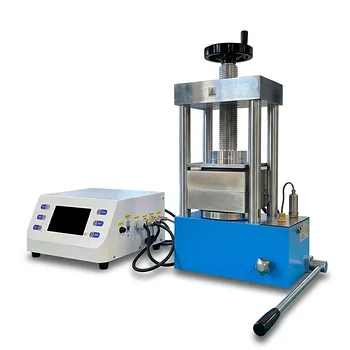
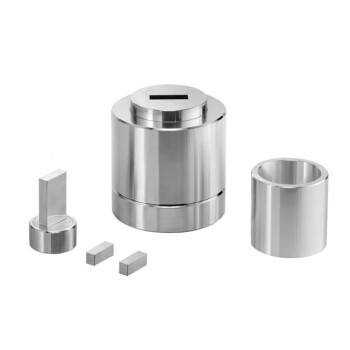
A laboratory hydraulic press is the fundamental tool used to transform loose powder raw materials into a solid, cohesive unit known as a "green body." By applying uniform high pressure, the press forces particles to rearrange and pack tightly within a mold, creating a pre-form with the specific mechanical strength required to withstand subsequent high-temperature processing.
Core Takeaway: The hydraulic press is not merely a shaping tool; it is a density-management device. Its primary function is to establish uniform density and eliminate internal voids in the pre-formed target, which is essential for preventing micro-cracks during sintering and ensuring the stability of the final functional oxide thin film.
The Mechanics of Pre-Forming
To understand the necessity of the press, one must look at the microscopic behavior of ceramic powders.
Forcing Particle Rearrangement
Raw ceramic materials begin as loose powders with significant interstitial space. The hydraulic press applies mechanical force to overcome friction between these particles.
Creating High Packing Density
This pressure forces the particles to move past one another and lock into a tighter configuration. This rearrangement eliminates voids and significantly increases the contact area between particles.
Achieving Green Strength
The result of this compression is a "green body"—a solid object that holds its shape but has not yet been fired. This pre-form must possess sufficient green strength to be handled and processed without crumbling before the sintering phase.
Critical Impact on Target Integrity
The quality of the pre-forming stage dictates the structural success of the final ceramic target.
Ensuring Uniform Density
Uniformity is paramount. If the pressure application is inconsistent, the target will have density gradients. The hydraulic press provides the precise pressure control needed to ensure the density is consistent throughout the entire volume of the target.
Preventing Micro-Cracks
During the subsequent high-temperature sintering, materials shrink. If the pre-formed green body has uneven density or trapped air, this shrinkage will cause stress concentrations. These stresses lead to micro-cracks, rendering the target useless for high-precision applications.
The Connection to Thin Film Quality
The ultimate goal of the ceramic target is to serve as a source material for thin-film deposition.
Providing a Stable Particle Source
For functional oxide thin films, the deposition process requires a target that ablates or sputters evenly. A target with high, uniform density acts as a stable particle source, releasing material consistent in rate and composition.
Influencing Epitaxial Layer Quality
Any structural flaws in the target translate directly to defects in the deposited film. By ensuring the target is dense and crack-free, the hydraulic press directly contributes to the purity and structural quality of the final epitaxial layers.
Common Pitfalls and Trade-offs
While high pressure is necessary, the application of force must be carefully managed.
The Risk of Pressure Gradients
If the mold design or pressure application is not uniform (e.g., in unidirectional pressing), friction at the mold walls can cause density variations. This can lead to warping during sintering despite the high pressure applied.
Balancing Density and Integrity
Applying pressure eliminates voids, but extreme pressure without proper de-airing can trap pockets of gas. These compressed gas pockets can expand explosively during sintering, destroying the target. The process requires a balance of high pressure and careful ramp rates to allow air to escape.
Making the Right Choice for Your Goal
The specific requirements for your hydraulic press setup will depend on the sensitivity of your oxide material and your end goals.
- If your primary focus is Structural Integrity: Prioritize a press with slow-release pressure capabilities to prevent rebound cracking in the green body immediately after compression.
- If your primary focus is Deposition Consistency: Ensure your setup allows for isostatic pressing (if possible), as this applies equal pressure from all directions, guaranteeing the highest possible density uniformity for the target surface.
The hydraulic press is the gatekeeper of quality; without a densely packed, crack-free pre-form, the production of high-performance functional oxide thin films is impossible.
Summary Table:
| Feature | Role in Pre-forming | Benefit to Final Target |
|---|---|---|
| Particle Rearrangement | Overcomes friction to eliminate voids | Increases packing density & contact area |
| Uniform Pressure | Ensures consistent density gradients | Prevents micro-cracks during sintering |
| Green Strength | Creates a cohesive solid "green body" | Allows handling without structural failure |
| Precise Control | Manages pressure ramp and release | Prevents rebound cracking and trapped gas |
| Ablation Stability | Provides a dense, uniform material source | Ensures consistent sputtering and film purity |
Elevate Your Material Research with KINTEK Precision
Don't let structural flaws compromise your thin-film deposition. KINTEK specializes in advanced laboratory equipment designed to meet the rigorous demands of ceramic target preparation. From high-performance hydraulic presses (pellet, hot, isostatic) to crushing and milling systems and high-temperature furnaces, we provide the tools you need for uniform density and superior green strength.
Ready to optimize your pre-forming process? Our experts are here to help you select the perfect system for your functional oxide research. Contact us today to find your solution!
References
- Hasmik Kirakosyan, Sofiya Aydinyan. The preparation of high-entropy refractory alloys by aluminothermic reduction process. DOI: 10.1063/5.0189206
This article is also based on technical information from Kintek Solution Knowledge Base .
Related Products
- Laboratory Hydraulic Press Split Electric Lab Pellet Press
- Automatic Laboratory Hydraulic Press for XRF & KBR Pellet Press
- Automatic Laboratory Hydraulic Pellet Press Machine for Lab Use
- Laboratory Manual Hydraulic Pellet Press for Lab Use
- Laboratory Hydraulic Press Lab Pellet Press Machine for Glove Box
People Also Ask
- What role does a laboratory hydraulic press play in platinum recovery research? Enhancing Sample Precision
- What are the specific applications of a lab hydraulic press in biochar evaluation? Optimize density and data accuracy.
- What are the roles of a laboratory hydraulic press and stainless steel molds in the preparation of graphite samples?
- What is the role of a laboratory hydraulic press in electrode prep? Maximize Energy Density & Sealing Precision
- Why must a laboratory hydraulic press equipped with cylindrical molds be used when preparing BZY green bodies? High Density