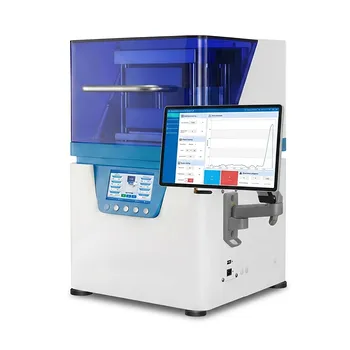
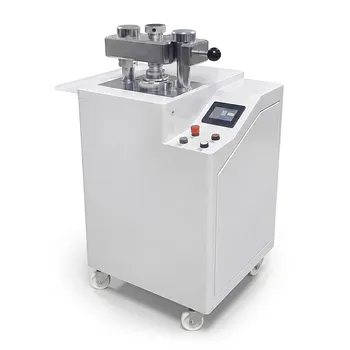
The application of 400 MPa is a critical threshold for inducing plastic deformation in iron powder particles. This high-pressure environment forces the metal particles to physically deform and flow around urea space holders, effectively encapsulating them. This process creates a "green compact" with the necessary mechanical strength to maintain its geometric integrity during the delicate stages of space holder removal and high-temperature sintering.
Core Takeaway: A laboratory hydraulic press providing 400 MPa is essential to transform loose iron powder into a stable, high-density matrix. By inducing plastic flow, the press ensures the powder tightly grips the space holders and establishes the structural "skeleton" required for successful foam production.
The Role of Plastic Deformation in Foam Architecture
Inducing Plastic Flow in Iron Particles
Iron particles possess inherent resistance to movement and deformation. At 400 MPa, the press provides the physical driving force required to overcome internal friction and induce plastic flow, allowing particles to rearrange and pack tightly.
Encapsulating the Space Holder
In foam production, the metal must surround temporary "space holders" like urea. High pressure ensures the iron particles move into and fill the micron-scale gaps around these templates, creating a continuous metal network that defines the eventual foam structure.
Eliminating Inter-particle Voids
High unit pressure is necessary to eliminate micron-scale pores between individual powder particles. By forcing these particles into intimate contact, the press increases the relative density of the green compact, which is vital for preventing structural collapse in later stages.
Achieving Structural Integrity and Green Strength
Establishing Mechanical Interlocking
Mechanical strength in a green compact—the "green strength"—relies on the physical interlocking of deformed particles. The 400 MPa threshold ensures sufficient surface contact and deformation to hold the compact together without the need for chemical binders.
Enhancing Atomic Diffusion Interfaces
High-pressure compaction maximizes the contact area between particles, which is fundamental for the subsequent sintering process. This tight contact provides the necessary interface for atomic diffusion, allowing the particles to bond permanently when heat is applied.
Controlling Volume Shrinkage
By achieving a high initial density (often exceeding 76% of theoretical density), the press minimizes volume shrinkage during sintering. This precision prevents the formation of cracks and ensures the final iron foam matches the intended dimensions and geometric shape.
Understanding the Trade-offs and Technical Limits
Mold Wear and Longevity
Applying pressures as high as 400 MPa subjects high-precision molds to significant stress. While necessary for density, constant operation at these limits can lead to accelerated wear or deformation of the die if the materials are not properly rated for high-tonnage use.
Internal Density Gradients
Unidirectional pressing at high pressures can sometimes create internal density gradients, where the center of the compact is less dense than the edges. If not managed through precise pressure control, these gradients can lead to non-uniform shrinkage or micro-cracking during the heating phase.
Spring-back and Internal Stress
When the 400 MPa load is released, the compacted material may experience "spring-back" due to stored elastic energy. If the pressure is applied or released too rapidly, this expansion can cause internal stresses that compromise the structural integrity of the green compact.
Making the Right Choice for Your Goal
How to Apply This to Your Project
Selecting the correct pressure and equipment is essential for balancing material density with structural stability. Your specific goals will dictate how you utilize the hydraulic press.
- If your primary focus is Maximum Foam Porosity: Ensure the pressure is sufficient to fully encapsulate the space holders without crushing them, typically maintaining the 400 MPa range to secure the metal "skeleton."
- If your primary focus is Dimensional Accuracy: Use precise, adjustable pressure controls to minimize density gradients, which prevents non-uniform shrinkage and warping during high-temperature sintering.
- If your primary focus is High Mechanical Hardness: Increase the unit pressure toward the upper limits (up to 600 MPa if the material allows) to maximize initial density and reduce the final apparent porosity of the metal struts.
The successful production of iron-based foams depends entirely on using high pressure to bridge the gap between loose powder and a stable, sintered metallic structure.
Summary Table:
| Key Process Requirement | Role of 400 MPa Pressure | Impact on Final Foam Quality |
|---|---|---|
| Plastic Deformation | Overcomes internal friction to induce metal flow | Establishes a stable structural "skeleton" |
| Encapsulation | Forces particles into gaps around space holders | Ensures precise and continuous foam architecture |
| Mechanical Interlocking | Maximizes surface contact between particles | Provides high green strength without chemical binders |
| Density Control | Eliminates micron-scale inter-particle voids | Minimizes volume shrinkage and prevents cracking |
Elevate Your Powder Metallurgy with KINTEK Precision
Achieving a precise 400 MPa threshold is vital for the integrity of your iron-based foams. KINTEK specializes in high-performance laboratory equipment designed to meet these rigorous industrial standards. Our comprehensive range of hydraulic presses (pellet, hot, and isostatic) ensures uniform pressure distribution and structural stability for your most demanding research applications.
Beyond pressing solutions, KINTEK offers a full ecosystem for material science, including:
- High-Temperature Furnaces: Muffle, tube, and vacuum systems for precise sintering.
- Advanced Reactors: High-temperature high-pressure reactors and autoclaves.
- Sample Preparation: Crushing, milling, and sieving equipment.
- Essential Consumables: High-quality ceramics, crucibles, and PTFE products.
Whether you are a researcher seeking dimensional accuracy or a distributor looking for reliable OEM/ODM support and certified laboratory solutions, KINTEK is your trusted partner.
Ready to optimize your production workflow? Contact our technical experts today!
References
- Viktória Čákyová, Renáta Oriňáková. Biodegradable iron-based foams prepared by the space holder technique using urea. DOI: 10.1007/s10800-023-01993-x
This article is also based on technical information from Kintek Solution Knowledge Base .
Related Products
- Automatic Hydraulic Hot Press with 500x500mm Heating Plates and Multi Stage PLC Control for Material Sintering
- Heated Hydraulic Press Machine with Heated Plates for Vacuum Box Laboratory Hot Press
- Automatic High Temperature Heated Hydraulic Press Machine with Heated Plates for Lab
- Manual High Temperature Heated Hydraulic Press Machine with Heated Plates for Lab
- 24T 30T 60T Heated Hydraulic Press Machine with Heated Plates for Laboratory Hot Press
People Also Ask
- How do hydraulic presses facilitate material solidification in Low-Temperature LPS? Optimize Your Material Densification
- Why is 800 MPa required for TiNiPdCu alloy green bodies? Master High-Density Compaction for Superior Material Strength
- How does KBr pellet preparation facilitate FTIR of high-ash mud? Precision Sample Prep for Structural Analysis
- Why is an industrial hydraulic press with precision stainless steel molds used? For Uniform Mo-Fe Precursor Compacts.
- Purpose of Coaxial Ring Molds & Presses in EM Testing? Achieve Precise VNA Data & Fit