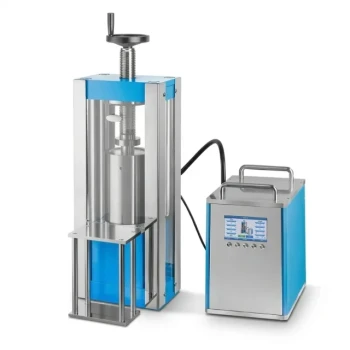
Knowledge Why is a laboratory hydraulic press used for cold pressing SiCp/2009Al composites? Enhance Green Body Quality
Author avatar

Tech Team · Kintek Solution

Updated 4 days ago

Why is a laboratory hydraulic press used for cold pressing SiCp/2009Al composites? Enhance Green Body Quality


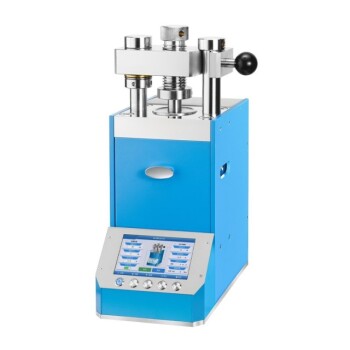
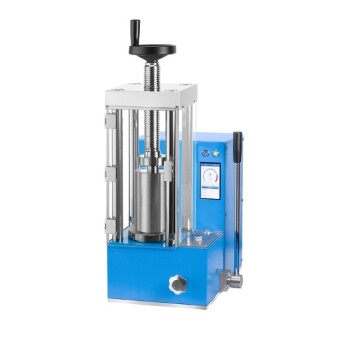
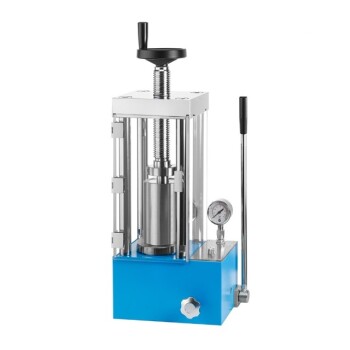
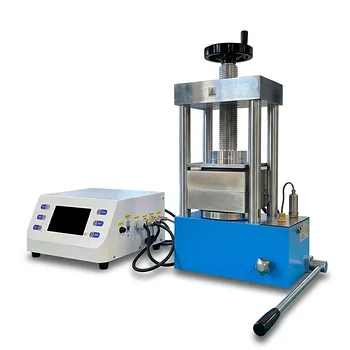
A laboratory hydraulic press is utilized to transform loose powder mixtures into a cohesive solid capable of withstanding downstream processing. By applying high pressure, often reaching 150 MPa, the press compacts SiCp and 2009Al powders into a "green body" with a defined geometry and sufficient structural strength. This initial cold-pressing stage is essential for creating a preform that can be safely handled and loaded into a vacuum hot pressing furnace for final sintering.

The hydraulic press acts as the critical bridge between loose raw materials and a high-performance composite. Its primary function is to maximize initial packing density and minimize porosity, establishing the structural integrity required for the material to successfully undergo the high temperatures of sintering.

The Mechanics of Densification

Increasing Packing Density

The most immediate physical change driven by the hydraulic press is the reduction of volume. By forcing the powder particles closer together, the press significantly increases the initial packing density. This reduces the distance between the Silicon Carbide (SiCp) reinforcement and the Aluminum (2009Al) matrix particles.

Reducing Porosity

Loose powders contain a significant amount of entrapped air and void space. High-pressure cold pressing mechanically eliminates much of this air, drastically reducing porosity between particles. This creates a more solid, continuous structure even before heat is applied.

Mechanical Interlocking

During compression, ductile components like the aluminum alloy (2009Al) undergo plastic deformation. This allows the metal to flow around the harder SiC particles, creating mechanical interlocking. This physical bonding allows the green body to hold its shape without the need for added chemical binders.

Facilitating the Sintering Process

Controlling Shrinkage

A green body with high initial density experiences less volumetric change during sintering. By compacting the material beforehand, you reduce the shrinkage rate during the subsequent high-temperature phase. This allows for tighter dimensional control of the final composite.

Enhancing Mass Transport

Sintering relies on atomic diffusion and mass transport between particles. The hydraulic press ensures tight physical contact between the powder grains. This proximity is a prerequisite for effective grain bonding and consolidation when the material is eventually heated.

Preventing Defects

Proper cold pressing helps prevent internal structural flaws. By establishing a uniform density profile, the process reduces the risk of internal pores or cracks forming within the sintered block, ensuring a homogeneous final product.

Operational Advantages

Shape Formation

The press allows for the creation of specific geometric shapes, such as discs, cubes, or billets. Using precision metal molds, the loose powder is formed into a raw billet that matches the requirements of the final application or the sintering furnace dimensions.

Handling and Loading

Loose powder is difficult to transport and load into graphite molds for vacuum hot pressing. The green body produced by the press provides a stable, solid form. This makes it significantly easier to handle, measure, and position within the furnace without material loss or contamination.

Understanding the Trade-offs

Pressure Optimization

While high pressure is beneficial, it must be carefully controlled. The goal is uniform density, not just maximum force. Excessive pressure can sometimes damage the tooling or cause "spring-back" effects where the material expands upon ejection, potentially causing laminations or cracks.

Green Strength Limits

The "green strength" achieved by cold pressing is strictly mechanical. The part is stable enough for handling but remains brittle compared to the final sintered product. It must still be treated with care to avoid deformation or breakage prior to the sintering stage.

Making the Right Choice for Your Goal

When configuring your hydraulic press for SiCp/2009Al composites, consider the following parameters based on your primary objective:

  • If your primary focus is Maximum Final Density: Prioritize higher pressures (around 150 MPa) to maximize particle contact and minimize the diffusion distance required during sintering.
  • If your primary focus is Dimensional Accuracy: Focus on the precision of the mold and the uniformity of the pressure application to minimize differential shrinkage rates.
  • If your primary focus is Process Efficiency: Ensure the pressure is sufficient to create a robust green body that can be rapidly loaded into graphite molds without crumbling.

By effectively utilizing the cold-pressing stage, you do not just shape the powder; you define the structural foundation of the final composite material.

Summary Table:

Feature Impact on SiCp/2009Al Green Body
Applied Pressure Typically 150 MPa to achieve high packing density
Material Structure Eliminates air voids and promotes mechanical interlocking
Dimensional Stability Reduces shrinkage rates during subsequent sintering
Process Handling Transforms loose powder into a stable, loadable billet
Final Quality Prevents internal cracks and ensures uniform density

Elevate Your Material Research with KINTEK Precision

Maximize the potential of your SiCp/2009Al composites with KINTEK’s industry-leading laboratory solutions. From high-performance hydraulic presses (pellet, hot, and isostatic) for perfect green body formation to advanced vacuum hot pressing furnaces and sintering systems, we provide the tools necessary for superior densification and structural integrity.

Whether you need precision crushing and milling systems or essential consumables like PTFE and ceramics, KINTEK is your partner in achieving research excellence.

Contact KINTEK today to optimize your lab workflow

Related Products

People Also Ask

Related Products

Laboratory Hydraulic Press Lab Pellet Press Machine for Glove Box

Laboratory Hydraulic Press Lab Pellet Press Machine for Glove Box

Controlled environment lab press machine for glove box. Specialized equipment for material pressing and shaping with high precision digital pressure gauge.

Automatic Lab Cold Isostatic Press CIP Machine Cold Isostatic Pressing

Automatic Lab Cold Isostatic Press CIP Machine Cold Isostatic Pressing

Efficiently prepare samples with our Automatic Lab Cold Isostatic Press. Widely used in material research, pharmacy, and electronic industries. Provides greater flexibility and control compared to electric CIPs.

Automatic Laboratory Hydraulic Pellet Press Machine for Lab Use

Automatic Laboratory Hydraulic Pellet Press Machine for Lab Use

Experience efficient sample preparation with our Automatic Lab Press Machine. Ideal for material research, pharmacy, ceramics, and more. Features a compact size and hydraulic press functionality with heating plates. Available in various sizes.

Electric Split Lab Cold Isostatic Press CIP Machine for Cold Isostatic Pressing

Electric Split Lab Cold Isostatic Press CIP Machine for Cold Isostatic Pressing

Split cold isostatic presses are capable of providing higher pressures, making them suitable for testing applications that require high pressure levels.

Rubber Vulcanizer Vulcanizing Machine Plate Vulcanizing Press for Lab

Rubber Vulcanizer Vulcanizing Machine Plate Vulcanizing Press for Lab

The Plate vulcanizing press is a kind of equipment used in the production of rubber products, mainly used for the vulcanization of rubber products. Vulcanization is a key step in rubber processing.

Automatic Heated Hydraulic Press Machine with Heated Plates for Laboratory Hot Press 25T 30T 50T

Automatic Heated Hydraulic Press Machine with Heated Plates for Laboratory Hot Press 25T 30T 50T

Efficiently prepare your samples with our Automatic Heated Lab Press. With a pressure range up to 50T and precise control, it's perfect for various industries.

Automatic High Temperature Heated Hydraulic Press Machine with Heated Plates for Lab

Automatic High Temperature Heated Hydraulic Press Machine with Heated Plates for Lab

The High Temperature Hot Press is a machine specifically designed for pressing, sintering and processing materials in a high temperature environment. It is capable of operating in the range of hundreds of degrees Celsius to thousands of degrees Celsius for a variety of high temperature process requirements.

Single Punch Electric Tablet Press Machine Laboratory Powder Tablet Punching TDP Tablet Press

Single Punch Electric Tablet Press Machine Laboratory Powder Tablet Punching TDP Tablet Press

The single-punch electric tablet press is a laboratory-scale tablet press suitable for corporate laboratories in pharmaceutical, chemical, food, metallurgical and other industries.

Heated Hydraulic Press Machine with Integrated Manual Heated Plates for Lab Use

Heated Hydraulic Press Machine with Integrated Manual Heated Plates for Lab Use

Efficiently process heat-pressing samples with our Integrated Manual Heated Lab Press. With a heating range up to 500°C, it's perfect for various industries.

Vacuum Hot Press Furnace Machine for Lamination and Heating

Vacuum Hot Press Furnace Machine for Lamination and Heating

Experience clean and precise lamination with Vacuum Lamination Press. Perfect for wafer bonding, thin-film transformations, and LCP lamination. Order now!

Single Punch Electric Tablet Press Machine TDP Tablet Punching Machine

Single Punch Electric Tablet Press Machine TDP Tablet Punching Machine

The electric tablet punching machine is a laboratory equipment designed for pressing various granular and powdery raw materials into discs and other geometric shapes. It is commonly used in pharmaceutical, healthcare products, food, and other industries for small batch production and processing. The machine is compact, lightweight, and easy to operate, making it suitable for use in clinics, schools, laboratories, and research units.

Metallographic Specimen Mounting Machine for Laboratory Materials and Analysis

Metallographic Specimen Mounting Machine for Laboratory Materials and Analysis

Precision metallographic mounting machines for labs—automated, versatile, and efficient. Ideal for sample prep in research and quality control. Contact KINTEK today!

Manual High Temperature Heated Hydraulic Press Machine with Heated Plates for Lab

Manual High Temperature Heated Hydraulic Press Machine with Heated Plates for Lab

The High Temperature Hot Press is a machine specifically designed for pressing, sintering and processing materials in a high temperature environment. It is capable of operating in the range of hundreds of degrees Celsius to thousands of degrees Celsius for a variety of high temperature process requirements.

Single Punch Tablet Press Machine and Mass Production Rotary Tablet Punching Machine for TDP

Single Punch Tablet Press Machine and Mass Production Rotary Tablet Punching Machine for TDP

Rotary tablet punching machine is an automatic rotating and continuous tableting machine. It is mainly used for tablet manufacturing in the pharmaceutical industry, and is also suitable for industrial sectors such as food, chemicals, batteries, electronics, ceramics, etc. to compress granular raw materials into tablets.

Laboratory Sterilizer Lab Autoclave Herbal Powder Sterilization Machine for Plant

Laboratory Sterilizer Lab Autoclave Herbal Powder Sterilization Machine for Plant

The herbal powder sterilization autoclave machine for Chinese medicine uses saturated steam for effective sterilization. It utilizes the heat and penetrative properties of steam, achieves sterilization after heat preservation, and maintains a good drying effect with a dedicated drying system.

Small Injection Molding Machine for Lab Use

Small Injection Molding Machine for Lab Use

The small injection molding machinehas fast and stable movements; good controllability and repeatability, super energy saving; the product can be automatically dropped and formed; the machine body is low, convenient for feeding, easy to maintain, and no height restrictions on the installation site.

Lab Internal Rubber Mixer Rubber Kneader Machine for Mixing and Kneading

Lab Internal Rubber Mixer Rubber Kneader Machine for Mixing and Kneading

Lab internal rubber mixer is suitable for mixing, kneading and dispersing various chemical raw materials such as plastics, rubber, synthetic rubber, hot melt adhesive and various low-viscosity materials.

Small Lab Rubber Calendering Machine

Small Lab Rubber Calendering Machine

Small lab rubber calendering machine is used for producing thin, continuous sheets of plastic or rubber materials. It is commonly employed in laboratories, small-scale production facilities, and prototyping environments to create films, coatings, and laminates with precise thickness and surface finish.

Laboratory Test Sieves and Vibratory Sieve Shaker Machine

Laboratory Test Sieves and Vibratory Sieve Shaker Machine

Efficiently process powders, granules, and small blocks with a high-frequency vibration sieve. Control vibration frequency, screen continuously or intermittently, and achieve accurate particle size determination, separation, and classification.

Manual Heated Hydraulic Press Machine with Heated Plates for Laboratory Hot Press

Manual Heated Hydraulic Press Machine with Heated Plates for Laboratory Hot Press

The Manual Heat Press is a versatile piece of equipment suitable for a variety of applications, operated by a manual hydraulic system that applies controlled pressure and heat to the material placed on the piston.


Leave Your Message