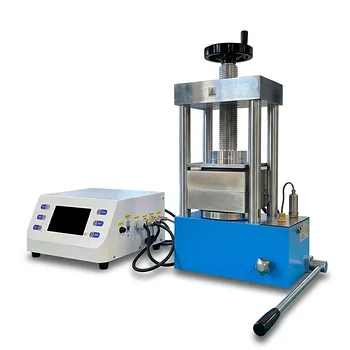
A laboratory hydraulic press serves as the fundamental tool for transforming loose chemical precursors into a structured solid-state material. Specifically, it applies precise, constant molding pressure—often around 12 MPa for standard processes—to compress Li1.3Al0.3Ti1.7(PO4)3 (LATP) mixed powders into "green pellets" with specific mechanical strength and geometry.
The press does not merely shape the powder; it determines the material's internal architecture. By controlling the initial packing density, the hydraulic press sets the baseline for the final porosity, ionic conductivity, and structural integrity of the electrolyte after high-temperature sintering.
The Role of Compaction in LATP Fabrication
Creating the "Green Body"
Before an LATP electrolyte can be sintered into a hard ceramic, it must exist as a cohesive solid known as a green body.
The hydraulic press applies uniaxial pressure to bind loose powder particles together. This mechanical interlocking gives the pellet enough green strength to be handled and transferred to a furnace without crumbling.
Controlling Packing Density
The primary variable in this process is packing density.
By adjusting the force applied (e.g., from 10 MPa up to higher pressures like 240–300 MPa depending on the target density), the press reduces the empty space between particles.
Higher packing density in the green stage generally leads to a denser final ceramic. This is a prerequisite for high-quality electrolytes, as it minimizes the distance lithium ions must travel between particles.
Establishing Ion-Conducting Channels
For the electrolyte to function, lithium ions must move freely through the material.
The compression process forces particles into tight contact, establishing the foundation for continuous ion-conducting channels. Without sufficient pressure, the particles remain isolated, leading to high grain boundary resistance and poor battery performance.
Regulating Porosity and Structure
Tuning for Dense vs. Porous Outcomes
The user's requirement to fabricate either porous or dense pellets relies entirely on the precision of the hydraulic press.
To achieve a dense electrolyte, high pressure is applied to eliminate voids and maximize particle contact. This facilitates the sintering process, where particles fuse together to approach theoretical density.
Conversely, if a porous structure is required (e.g., for specific interface applications or scaffolding), the press allows the operator to apply a lower, controlled pressure. This maintains a specific volume of void space within the green pellet.
Ensuring Geometric Integrity
Uniform pressure application is critical for the physical shape of the pellet.
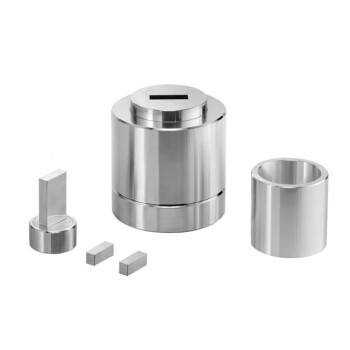
The press utilizes precision molds to ensure the pellet has a consistent thickness and diameter. This geometric uniformity is vital for ensuring accurate testing of ionic conductivity later in the process.
Understanding the Trade-offs
The Risk of Density Gradients
While pressure is essential, applying it incorrectly can ruin the sample.
If the pressure is not applied uniformly, or if the friction between the powder and the die is too high, density gradients can form within the pellet.
Consequences for Sintering
These internal inconsistencies are often invisible in the green body but become catastrophic during sintering.
A pellet with uneven density will shrink unevenly when heated. This leads to warping, deformation, or cracking during the high-temperature phase, rendering the electrolyte useless. Therefore, the press must provide smooth, controlled force rather than sudden shock impacts.
Making the Right Choice for Your Goal
To maximize the effectiveness of your hydraulic press in LATP fabrication, tailor your approach to your specific end-goal:
- If your primary focus is High Ionic Conductivity (Dense): Apply higher pressures (potentially exceeding 200 MPa) to maximize particle contact and minimize grain boundary resistance prior to sintering.
- If your primary focus is Porosity Control: Use lower, precisely regulated pressures (e.g., 10–12 MPa) to achieve sufficient green strength for handling while maintaining the desired void volume between particles.
Ultimately, the hydraulic press is the gatekeeper of quality; it dictates whether your powder becomes a high-performance ceramic or a failed experiment.
Summary Table:
| Process Objective | Pressure Range | Impact on LATP Pellet |
|---|---|---|
| Porous Structure | Low (10–12 MPa) | Higher void volume, maintained scaffold geometry |
| Dense Electrolyte | High (200–300 MPa) | Maximized particle contact, reduced grain boundary resistance |
| Green Strength | Consistent (12+ MPa) | Mechanical interlocking for handling without crumbling |
| Geometric Integrity | Uniform Application | Prevents warping and cracking during sintering |
Elevate Your Solid-State Battery Research with KINTEK
Precision in pellet fabrication is the difference between a high-performance electrolyte and a failed experiment. KINTEK specializes in advanced laboratory equipment designed for the rigorous demands of material science.
Our precision hydraulic presses (pellet, hot, and isostatic) combined with our crushing and milling systems provide the exact pressure control and particle consistency required for LATP fabrication. Whether you need a dense ceramic for high ionic conductivity or a controlled porous scaffold, our tools deliver the reliability your research deserves.
Ready to optimize your lab's performance? Contact KINTEK today for expert solutions and high-quality consumables
Related Products
- Automatic Laboratory Hydraulic Pellet Press Machine for Lab Use
- Laboratory Hydraulic Press Split Electric Lab Pellet Press
- Laboratory Manual Hydraulic Pellet Press for Lab Use
- Laboratory Manual Hydraulic Pellet Press for Lab Use
- Automatic Laboratory Hydraulic Press for XRF & KBR Pellet Press
People Also Ask
- What is the role of a laboratory hydraulic pellet press and stainless steel molds in the fabrication of RuO2/NbC anodes?
- What role does a laboratory pellet press play in the enhancement of biomass energy products? Optimize Fuel Efficiency
- What is the purpose of using a laboratory pellet press when evaluating the electronic conductivity of carbon powders? Guide
- How does a laboratory hydraulic pellet press contribute to SiCw/2024 aluminum composite preforms? Optimize Densification
- What is the significance of applying 200 MPa of pressure with a laboratory hydraulic pellet press for composite ceramics?