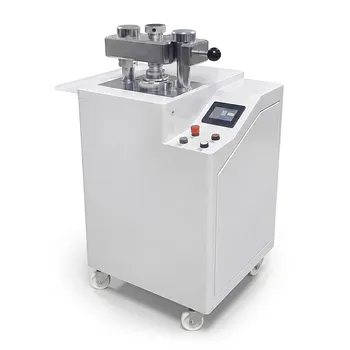
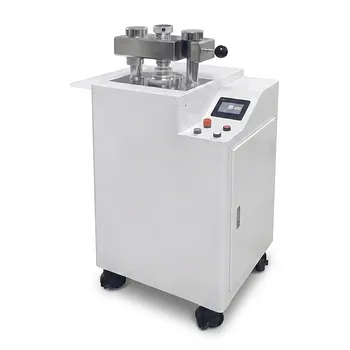
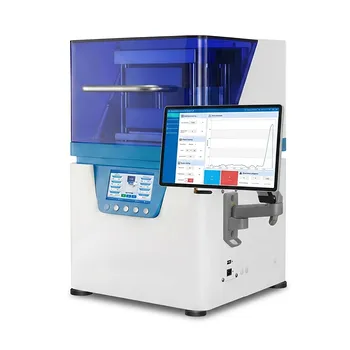
A laboratory hydraulic press is essential for transforming loose tellurium compound powders into dense, uniform pellets to ensure accurate electrical conductivity measurements. By applying high, controlled pressure, the press eliminates air gaps and maximizes particle-to-particle contact, which is the only way to minimize contact resistance and obtain reliable resistance-temperature data.
The hydraulic press serves as the bridge between raw powder and a measurable semiconductor sample. It creates a structurally consistent medium that allows researchers to accurately calculate intrinsic properties, such as the material’s band gap, using the Arrhenius equation.
Eliminating Internal Porosity and Air Gaps
The Necessity of High-Pressure Compaction
Loose tellurium powders contain significant air gaps that act as insulators, preventing a clear electrical path. A hydraulic press applies several tons of force to collapse these voids, creating a dense cylindrical pellet that mimics the behavior of a bulk solid.
Improving Sample Density
High, controlled pressure ensures that the resulting pellet has a uniform density throughout its structure. This uniformity is critical because density gradients can lead to uneven current distribution, which would skew conductivity results.
Standardizing Sample Geometry
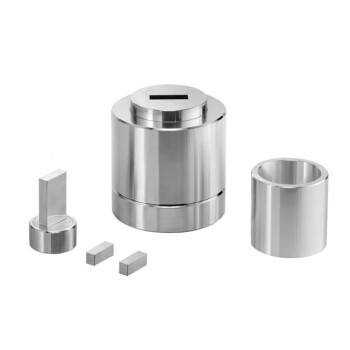
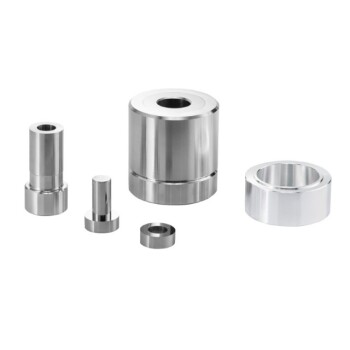
Measurements require a consistent thickness and diameter to calculate resistivity accurately. The use of precision molds within the hydraulic press ensures that every tellurium sample meets the specific geometric requirements for standardized testing.
Optimizing Electrical and Thermal Conductivity
Reducing Interfacial Contact Resistance
In powder form, the resistance between individual particles (contact resistance) often outweighs the intrinsic resistance of the tellurium compound itself. The press forces these particles into tight mechanical contact, significantly reducing this parasitic resistance.
Impact on Resistance-Temperature Data
To study semiconductors, researchers must measure how resistance changes with temperature. Without the compaction provided by a hydraulic press, the data would reflect the erratic behavior of air gaps and loose contacts rather than the actual electronic properties of the tellurium compound.
Enhancing Thermal Stability
Dense pellets produced by a hydraulic press are more thermally stable than loose powders. This stability allows the sample to undergo heating and cooling cycles during testing without the physical structure shifting, which would otherwise invalidate the data.
Enabling Precise Material Characterization
Facilitating the Arrhenius Equation
The goal of conductivity testing in tellurium compounds is often to apply the Arrhenius equation to determine the semiconductor's activation energy. This mathematical model requires a highly consistent and dense sample to produce a linear and reliable data plot.
Calculating the Precise Band Gap
The band gap defines how a semiconductor behaves under different energy states. By providing a pellet with minimal internal defects and maximum particle contact, the hydraulic press ensures the calculated band gap reflects the intrinsic nature of the material.
Ensuring Reproducibility in Research
The ability to apply a specific, repeatable pressure (such as 10 MPa or higher) allows researchers to produce identical samples across multiple trials. This level of control is fundamental for verifying experimental results and comparing different tellurium-based composites.
Understanding the Trade-offs and Limitations
Risk of Mechanical Failure
While high pressure is necessary for density, excessive force can cause the tellurium pellet to crack or laminate upon release from the mold. These micro-fractures can introduce new resistance points that are difficult to detect but will significantly impact conductivity readings.
Potential for Sample Contamination
The high-pressure environment can lead to wear on the stainless steel molds or dies, potentially introducing trace metal impurities into the tellurium compound. Any foreign material on the surface of the pellet can alter the electrical interface and lead to inaccurate surface resistivity measurements.
Pressure-Induced Phase Changes
In some sensitive compounds, the extreme pressure required to form a dense pellet can inadvertently trigger a phase transition or alter the crystal structure. It is vital to determine the optimal pressure that ensures density without compromising the material’s original chemical identity.
Applying This Process to Your Research
How to Apply This to Your Project
To achieve the most accurate conductivity measurements, your sample preparation strategy must account for both the material properties and the requirements of your testing equipment.
- If your primary focus is determining the intrinsic band gap: Use the highest pressure possible that the material can sustain without cracking to ensure the Arrhenius equation remains valid.
- If your primary focus is high-throughput screening of various compounds: Prioritize a standardized pressing time and pressure to ensure that variations in data are caused by the material chemistry rather than preparation inconsistencies.
- If your primary focus is minimizing surface artifacts: Ensure that all mold surfaces are polished and cleaned between uses to prevent cross-contamination that could skew electrical contact readings.
By mastering the controlled application of pressure, you ensure that your experimental data reflects the true physical properties of your tellurium compounds.
Summary Table:
| Key Function | Benefit for Tellurium Samples | Impact on Research Data |
|---|---|---|
| High-Pressure Compaction | Eliminates insulating air gaps & voids | Minimizes contact resistance for clear electrical paths |
| Geometric Standardization | Creates uniform pellet thickness & diameter | Enables accurate resistivity & band gap calculations |
| Structural Densification | Maximizes particle-to-particle contact | Ensures reliable resistance-temperature (Arrhenius) data |
| Thermal Stabilization | Maintains integrity during heating cycles | Prevents physical shifts from invalidating test results |
Elevate Your Material Research Precision with KINTEK
Achieving accurate electrical conductivity measurements starts with flawless sample preparation. KINTEK specializes in high-performance laboratory hydraulic presses (pellet, hot, isostatic) designed to produce the dense, uniform samples essential for advanced semiconductor and tellurium compound research.
Beyond our industry-leading presses, KINTEK offers a comprehensive ecosystem of laboratory solutions, including:
- High-Temperature Equipment: Muffle, tube, vacuum, and CVD furnaces for precise heat treatment.
- Sample Processing: Advanced crushing, milling, and sieving systems.
- Specialized Reactors: High-temperature high-pressure reactors and autoclaves.
- Consumables: High-purity ceramics, crucibles, and PTFE products.
Whether you are calculating band gaps or performing high-throughput screening, our equipment ensures the reproducibility and reliability your data demands. Contact KINTEK today to find the perfect solution for your lab!
References
- Marcus Zink, Johannes Beck. The 1D‐Polymeric (Te<sub>7</sub><sup>2+</sup>)<sub>n</sub> in (Te<sub>7</sub>)[MF<sub>6</sub>]<sub>2</sub> (M=As, Sb, Nb, Ta) by Solvothermal, Microwave Assisted, and Electrochemical Synthesis. DOI: 10.1002/zaac.202300142
This article is also based on technical information from Kintek Solution Knowledge Base .
Related Products
- Laboratory Hydraulic Pellet Press for XRF KBR FTIR Lab Applications
- Automatic Laboratory Hydraulic Press for XRF & KBR Pellet Press
- Automatic Laboratory Hydraulic Pellet Press Machine for Lab Use
- Laboratory Manual Hydraulic Pellet Press for Lab Use
- Laboratory Hydraulic Press Lab Pellet Press Machine for Glove Box
People Also Ask
- What is the role of a laboratory hydraulic pellet press and stainless steel molds in the fabrication of RuO2/NbC anodes?
- How does a laboratory hydraulic pellet press contribute to SiCw/2024 aluminum composite preforms? Optimize Densification
- What is the necessity of using a laboratory hydraulic pellet press in the preparation of biomass fuel pellets? Guide
- What is the significance of applying 200 MPa of pressure with a laboratory hydraulic pellet press for composite ceramics?
- What key role does a laboratory pellet press play in FTIR analysis? Master KBr Sample Preparation Excellence