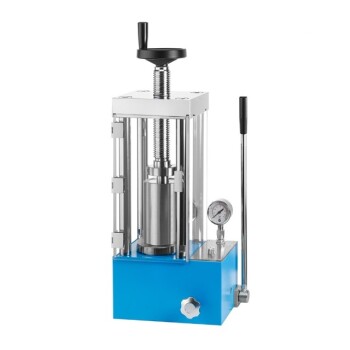
Compacting isotope boron powder into dense, standardized pellets is the critical precursor to successful thin-film deposition. A laboratory manual pellet press transforms loose, irregular powder into a solid cylindrical target blank that fits precisely within an evaporation crucible. This physical transformation is necessary to ensure thermal stability, prevent material loss, and achieve a controllable evaporation rate during electron beam heating.
The primary role of a pellet press in this context is to eliminate the unpredictability of loose powder by creating a dense medium with high thermal conductivity. This ensures that the electron beam's energy is distributed uniformly, resulting in a stable and repeatable deposition process.
The Physical Benefits of Powder Compaction
Optimizing Crucible Fit and Material Loading
Loose isotope boron powder is inherently voluminous and difficult to manage within the confined space of a vacuum chamber. A pellet press allows technicians to mold the material into a specific diameter that matches the evaporation crucible perfectly.
This precise fit maximizes the amount of material that can be loaded into a single run. It also prevents loose particles from migrating or "dusting" inside the vacuum system, which can contaminate sensitive components.
Eliminating Air Gaps for Increased Density
In its raw form, boron powder contains significant interstitial air gaps that act as thermal insulators. The high pressure applied by a manual press (often measured in megapascals) forces these particles into close contact, significantly increasing the energy density of the source.
By removing these air gaps, the pellet mimics the physical morphology of a bulk solid. This standardization is essential for ensuring that the material behaves predictably when subjected to the intense local heating of an electron beam.
Enhancing Thermal and Process Stability
Improving Thermal Conductivity
Boron requires high temperatures to evaporate, and efficient heat transfer is vital for a clean process. Compacted pellets facilitate better atomic-level contact between particles, which shortens the paths for heat conduction throughout the target.
Without this compaction, the electron beam may cause "hot spots" where the powder remains trapped in low-conductivity pockets. This leads to uneven heating and can cause the material to "spit" or eject macro-particles onto the substrate.
Achieving a Stable Evaporation Rate
A manual pellet press provides a flat, uniform surface for the electron beam to strike. This uniformity is critical for maintaining a constant flux of evaporated boron atoms over time.
Consistent evaporation rates are necessary for controlling the thickness and purity of the resulting isotope thin films. A solid pellet ensures that the beam energy is converted into vapor at a steady state rather than in erratic bursts common with loose powders.
Understanding the Trade-offs and Pitfalls
Risk of Tooling Contamination
The primary trade-off when using a manual pellet press is the risk of introducing impurities from the steel die set into the high-purity isotope powder. Even microscopic amounts of iron or chrome from the die can be compressed into the pellet surface and later evaporated onto the sample.
Mechanical Fragility and Cracking
If the pressure applied is too low, the pellet may remain friable and crumble during handling or when the vacuum is drawn. Conversely, excessive pressure can cause internal stresses that lead to "capping" or delamination, where the pellet cracks into layers during the heating cycle.
Material Loss During Transfer
Isotope boron is often extremely expensive and available in limited quantities. The process of loading the die and recovering the pellet involves multiple handling steps where material can be lost to the surfaces of the tools or the laboratory environment.
How to Apply This to Your Project
Recommendations for Effective Source Preparation
The necessity of a pellet press depends on your specific deposition requirements and the form factor of your starting material. Use these guidelines to determine your approach:
- If your primary focus is high-purity thin films: Use a hardened tungsten carbide die set and clean it ultrasonically between runs to prevent cross-contamination of isotopes.
- If your primary focus is process repeatability: Standardize the mass of the powder and the specific pressure (MPa) applied to ensure every target blank has identical thermal properties.
- If your primary focus is minimizing material waste: Use a small-diameter die that closely matches your beam's spot size to ensure you only compact the amount of boron necessary for the specific deposition thickness.
By utilizing a pellet press, you transition from an unpredictable powder-based evaporation to a controlled, solid-state thermal process.
Summary Table:
| Feature | Impact on Evaporation Process | Benefit for Isotope Boron |
|---|---|---|
| Powder Compaction | Eliminates air gaps and increases density | Mimics bulk solids for predictable thermal behavior |
| Standardized Geometry | Ensures precise fit in evaporation crucibles | Maximizes material loading and prevents vacuum dusting |
| Surface Uniformity | Provides a flat target for electron beams | Maintains a constant evaporation rate and film thickness |
| Improved Conductivity | Enhances atomic-level contact and heat transfer | Prevents material "spitting" and localized hot spots |
Elevate Your Material Research with KINTEK Precision
Achieve unparalleled accuracy in your thin-film deposition and sample preparation with KINTEK’s high-performance laboratory solutions. We specialize in providing researchers with the robust tools needed for sensitive applications, including:
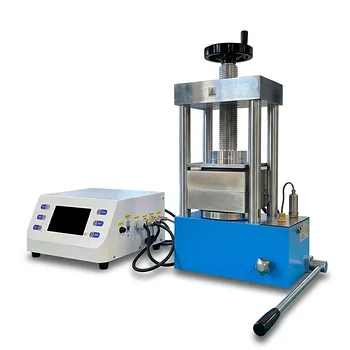
- Manual & Hydraulic Pellet Presses: Perfect for creating dense, high-purity isotope boron targets.
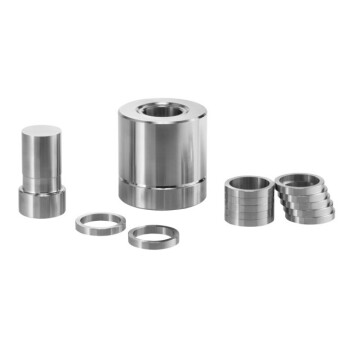
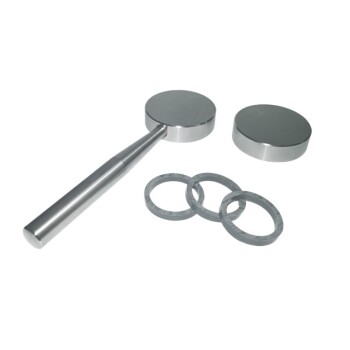
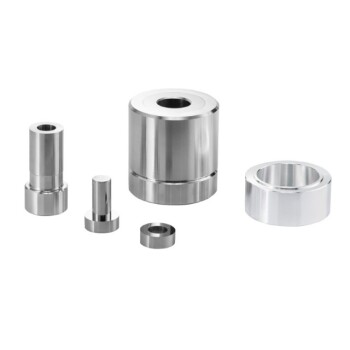
- Specialized Tooling: Hardened steel and tungsten carbide die sets to minimize contamination.
- Thermal Processing: A full range of high-temperature furnaces (muffle, vacuum, CVD) and cooling solutions.
- Material Preparation: Advanced crushing, milling, and sieving systems for uniform powder consistency.
Whether you are preparing isotope sources or developing new battery technologies, KINTEK offers the technical expertise and comprehensive equipment portfolio—from high-pressure reactors to essential ceramic consumables—to ensure your success.
Ready to optimize your lab's efficiency and sample quality? Contact KINTEK today to discuss your project requirements!
References
- J. P. Greene, Matthew Gott. The preparation of isotopic boron targets – searching for a more consistent approach. DOI: 10.1051/epjconf/202328510002
This article is also based on technical information from Kintek Solution Knowledge Base .
Related Products
- Laboratory Manual Hydraulic Pellet Press for Lab Use
- Laboratory Manual Hydraulic Pellet Press for Lab Use
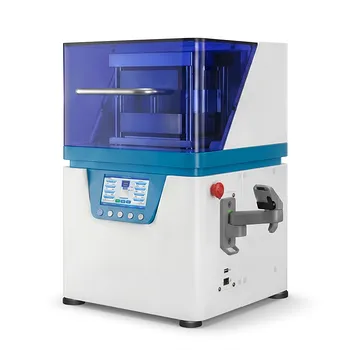
- Automatic Laboratory Hydraulic Press for XRF & KBR Pellet Press
- Manual Cold Isostatic Pressing Machine CIP Pellet Press
- Automatic Laboratory Hydraulic Pellet Press Machine for Lab Use
People Also Ask
- What is the role of a laboratory hydraulic pellet press and stainless steel molds in the fabrication of RuO2/NbC anodes?
- What is the necessity of using a laboratory hydraulic pellet press in the preparation of biomass fuel pellets? Guide
- What is the significance of applying 200 MPa of pressure with a laboratory hydraulic pellet press for composite ceramics?
- How does a laboratory hydraulic pellet press contribute to SiCw/2024 aluminum composite preforms? Optimize Densification
- Why use laboratory manual hydraulic presses for semiconductor pellets? Optimize Annealing & Crystalline Quality