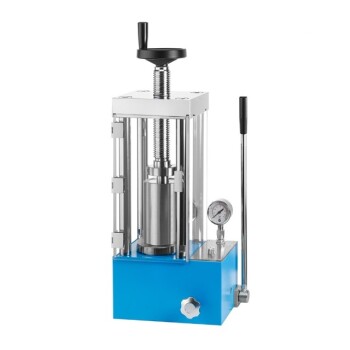
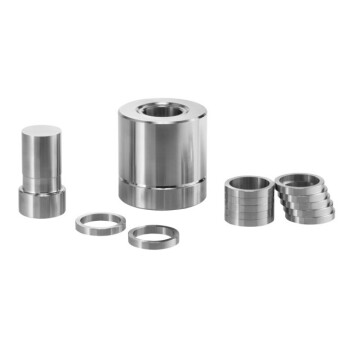
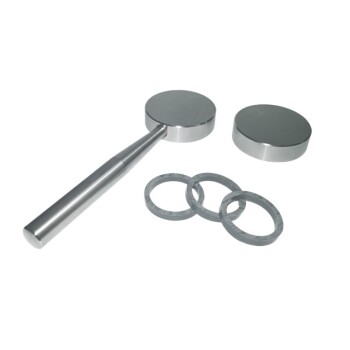
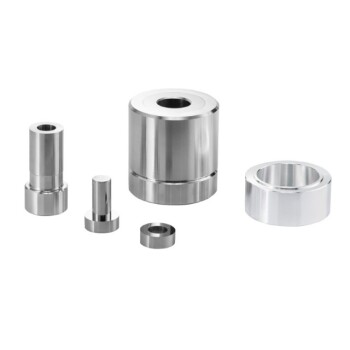
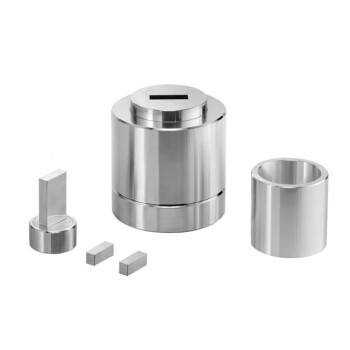
The laboratory powder pellet press is the critical mechanism for transforming loose, calcined CoxAl3FeyOm±δ powders into a physical form suitable for reactor use. By applying uniform pressure, the press compacts the powder into dense blocks, which acts as a mandatory prerequisite for subsequent crushing and sieving. This process is the only way to achieve a standardized particle size range of 20 to 40 mesh, which is essential for maintaining hydraulic stability and catalytic efficiency in fixed-bed reactors.
The pellet press functions as a bridge between raw chemical synthesis and practical engineering application. It converts unmanageable dust into structural blocks, enabling the precise sizing required to prevent reactor clogs and maximize gas-solid interaction.
The Role of Densification in Catalyst Preparation
Creating a Uniform Precursor
The primary function of the pellet press is to alter the physical state of the catalyst material. After calcination, the catalyst exists as a loose powder which lacks the structural integrity needed for immediate use.
By applying uniform pressure, the press consolidates this powder into dense, cohesive blocks. This densification creates a consistent substrate that can be mechanically processed in later stages without reverting immediately to dust.
Enabling Precise Particle Sizing
You cannot effectively sieve loose powder into a specific mesh range without first aggregating it. The dense blocks created by the pellet press provide the necessary mass to be crushed down.
This crushing process targets a specific particle size range of 20 to 40 mesh. The initial compression by the press ensures that when the material is crushed, it fractures into these desired geometric sizes rather than disintegrating into unusable fines.
Optimizing Fixed-Bed Reactor Performance
Preventing Pressure Drops
The ultimate goal of using the pellet press is to secure the hydrodynamics of the fixed-bed reactor. If a catalyst is too fine or irregular, it packs too tightly, creating high resistance to flow.
Standardizing the particle size prevents these significant pressure drops. By ensuring the catalyst shaped via the press falls within the 20 to 40 mesh range, the reactor maintains an open structure that allows gas to flow through the bed with minimal resistance.
Maximizing Contact Efficiency
Beyond flow mechanics, the shaping process dictates how well the reactants interact with the catalyst surface. Randomly packed powders often suffer from channeling, where gas bypasses the catalyst entirely.
The uniform particles resulting from the press-and-crush method optimize gas-solid contact efficiency. This ensures that the chemical reaction occurs uniformly throughout the reactor bed, maximizing the yield of the CoxAl3FeyOm±δ catalyst.
Understanding the Trade-offs
The Consequence of Skipping Densification
It is important to understand that the pellet press is not merely for aesthetic shaping; it is a functional necessity. Skipping this step would require loading loose powder directly into the reactor.
This results in a "packed bed" that acts more like a plug than a filter. The resistance would likely stall the reactor flow entirely or lead to dangerous pressure buildups, rendering the high-performance CoxAl3FeyOm±δ catalyst chemically active but operationally useless.
Making the Right Choice for Your Goal
When preparing CoxAl3FeyOm±δ catalysts, the pellet press allows you to balance physical flow with chemical availability.
- If your primary focus is Hydraulic Stability: Use the press to ensure a hard, dense block that yields larger, robust particles (closer to 20 mesh) to minimize pressure drop.
- If your primary focus is Reaction Efficiency: Ensure the pressure applied is uniform to allow for a consistent 40 mesh fraction after crushing, maximizing surface area without blocking flow.
The laboratory pellet press transforms a delicate chemical powder into a robust engineering material capable of sustaining high-efficiency reactor operations.
Summary Table:
| Process Stage | Function of Pellet Press | Impact on Catalyst Performance |
|---|---|---|
| Densification | Converts loose calcined powder into cohesive blocks | Prevents material disintegration into unusable fines |
| Sizing | Enables crushing to a precise 20-40 mesh range | Ensures standardized particle geometry |
| Hydrodynamics | Creates a stable structure for fixed-bed loading | Prevents pressure drops and reactor clogging |
| Efficiency | Optimizes gas-solid interaction surface | Maximizes catalytic yield and reaction uniformity |
Elevate Your Catalyst Research with KINTEK Precision
Don't let poor material shaping compromise your reactor performance. KINTEK specializes in advanced laboratory equipment designed for the rigorous demands of material science. From our high-performance hydraulic pellet presses (manual, electric, and isostatic) to our specialized crushing and sieving systems, we provide the tools you need to transform raw CoxAl3FeyOm±δ powders into high-efficiency catalysts.
Why choose KINTEK?
- Comprehensive Lab Solutions: We offer everything from high-temperature furnaces and reactors to precise pelletizing tools and consumables.
- Engineering Excellence: Our equipment ensures uniform pressure distribution for superior densification and hydraulic stability.
- Expert Support: Our team understands the critical link between material shaping and catalytic yield.
Ready to optimize your catalyst preparation workflow? Contact KINTEK today to find the perfect pellet press for your lab!
References
- Qiao Wang, Lihong Huang. Effect of Fe on CoxAl3FeyOm±δ Catalysts for Hydrogen Production by Auto-thermal Reforming of Acetic Acid. DOI: 10.15541/jim20180356
This article is also based on technical information from Kintek Solution Knowledge Base .
Related Products
- kbr pellet press 2t
- Manual Cold Isostatic Pressing Machine CIP Pellet Press
- Automatic Laboratory Hydraulic Press for XRF & KBR Pellet Press
- XRF Boric Acid Lab Powder Pellet Pressing Mold for Laboratory Use
- Automatic Laboratory Hydraulic Pellet Press Machine for Lab Use
People Also Ask
- How do you prepare samples for IR spectroscopy? A Step-by-Step Guide for Solids, Liquids, and Gases
- What measurement methods are commonly used for powder samples in infrared spectroscopy? Optimize Your FTIR Analysis
- Why KBr is used in IR spectrophotometry? A Key to Transparent Sample Analysis
- How are a KBr pellet press and mortar utilized in FTIR analysis of activated carbon? Expert Sample Prep Guide
- How do you prepare KBr pellets for FTIR analysis? Master the Technique for High-Quality IR Spectra