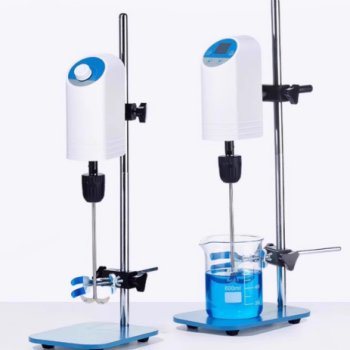
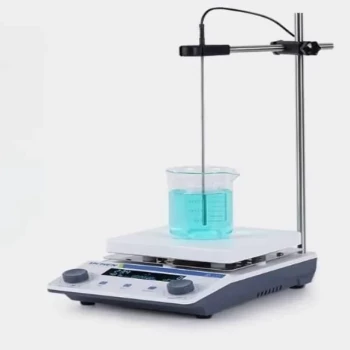
A mechanical stirring system is indispensable because the epoxidation of polyols involves reacting two incompatible liquid phases: palm oil and acidic aqueous reagents. Without the high-intensity shear force provided by mechanical agitation, these immiscible layers would remain separate, preventing the necessary contact for the reaction to occur. The stirrer is the physical mechanism that forces these distinct fluids to interact, enabling the chemical transformation.
Since the reactants naturally repel one another, mechanical stirring is the primary driver of mass transfer. It ensures the chemical reaction proceeds efficiently while simultaneously protecting the product quality by preventing dangerous local overheating.
Overcoming Phase Incompatibility
Bridging the Oil and Water Gap
The core challenge in polyol epoxidation is that the reactants—palm oil and acidic aqueous reagents—do not naturally mix.
If left undisturbed, these liquids separate into distinct layers due to their differing polarities.
To initiate a reaction, you must force these phases to interact at a microscopic level.
The Role of Shear Force
A mechanical stirring system provides high-intensity shear force to overcome this natural separation.
This force physically disrupts the interface between the liquids, breaking them into smaller droplets.
By maximizing the surface area where the oil and acid touch, the stirrer enables the necessary chemical bonding.
Driving Convection
Beyond simple mixing, the system creates strong convection currents within the reactor.
This movement ensures that fresh reagents are constantly brought into contact with one another.
Without this active transport, the reaction would stall as soon as the reagents at the interface were consumed.
Managing Reaction Dynamics and Safety
Ensuring Effective Mass Transfer
For the reaction to proceed at a viable industrial rate, mass transfer must be optimized.
Mechanical stirring accelerates the movement of molecules across the phase boundary.
This ensures that the conversion of reagents into the final product happens efficiently and completely.
Preventing Thermal Runaway
Chemical reactions often release heat, and epoxidation is no exception.
Without adequate agitation, heat can build up in stagnant zones, leading to local overheating.
Continuous mechanical stirring distributes this thermal energy evenly, preventing hot spots that could degrade the product or compromise safety.
Guaranteeing Product Quality
Achieving Structural Uniformity
The utility of the final polyol product depends entirely on its consistency.
If the mixing is uneven, different parts of the batch will react to different degrees.
Mechanical stirring ensures chemical structural uniformity, resulting in a reliable product with predictable properties.
Understanding Operational Trade-offs
Energy Intensity vs. Reaction Yield
Generating high-intensity shear force requires significant mechanical energy.
While this increases operational costs, attempting to reduce stirring speed to save power is a false economy.
Inadequate stirring leads to incomplete reactions and wasted raw materials, far outweighing the energy savings.
Maintenance and Complexity
Mechanical stirring systems introduce moving parts, seals, and motors into the reactor design.
These components are points of failure that require regular maintenance to prevent leaks or breakdowns.
However, the risk of equipment failure is a necessary trade-off for the essential capability of mixing immiscible fluids.
Optimizing Your Reactor Setup
Selecting the right agitation strategy is critical for balancing process safety with product quality.
- If your primary focus is Reaction Efficiency: Prioritize high-torque motors capable of maintaining consistent shear force to maximize the contact area between the incompatible phases.
- If your primary focus is Product Consistency: Ensure your impeller design promotes full-tank circulation to eliminate dead zones and guarantee chemical uniformity.
Effective mechanical stirring is not just an accessory; it is the fundamental enabler of the chemical transformation in polyol epoxidation.
Summary Table:
| Feature | Role in Epoxidation | Benefit to Process |
|---|---|---|
| High-Intensity Shear | Breaks immiscible liquid phases into droplets | Maximizes surface area for reaction |
| Convection Currents | Constant transport of fresh reagents | Prevents reaction stalling and improves yield |
| Thermal Distribution | Eliminates stagnant zones and hot spots | Prevents thermal runaway and product degradation |
| Mass Transfer | Accelerates molecular movement across boundaries | Ensures efficient and complete chemical conversion |
| Uniform Mixing | Consistent agitation throughout the reactor | Guarantees chemical structural uniformity |
Elevate Your Chemical Synthesis with KINTEK Precision
High-performance reactions like polyol epoxidation demand more than just basic mixing—they require robust, reliable agitation systems designed for high-intensity shear and thermal safety. KINTEK specializes in advanced laboratory equipment, offering high-torque stirring solutions, high-temperature high-pressure reactors, and specialized autoclaves that ensure your most challenging immiscible reactions achieve perfect structural uniformity.
Whether you are refining battery research, developing polymers, or scaling up chemical production, our comprehensive range of heating, milling, and reactor systems is engineered to provide the precision your lab deserves. Don't let inadequate mixing compromise your yields.
Contact KINTEK today to optimize your reactor setup and enhance your lab's efficiency.
References
- Teuku Rihayat, Tezara Cionita. Investigation of Polyurethane Primer Coating Paint Based on Local Palm Oil with Antimicrobial and Anticorrotion Agent Formula Bentonite-Chitosan. DOI: 10.61972/cetics.v1i2.15
This article is also based on technical information from Kintek Solution Knowledge Base .
Related Products
- High Performance Laboratory Stirrers for Diverse Applications
- Laboratory Small Constant Temperature Heated Magnetic Stirrer Heater and Stirrer
- Custom PTFE Teflon Parts Manufacturer for Magnetic Stirring Bar
People Also Ask
- How does a laboratory stirrer influence MOF product quality? Master Precision in Non-Solvothermal Synthesis
- What critical role does a Laboratory Stirrer play during leaching? Enhance Titanium-Magnesium Waste Recovery
- What is the primary function of laboratory stirring equipment in the preparation of compost leachate? Optimize Extraction
- What is a laboratory mixer? A Guide to Achieving Perfect Sample Homogeneity
- What is a laboratory mixer used for? Choose the Right Tool for Liquids or Solids