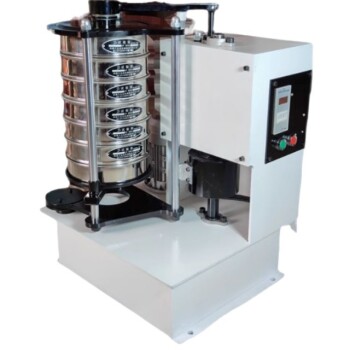
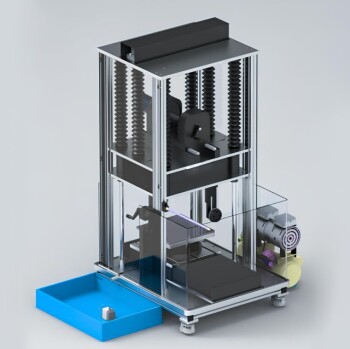
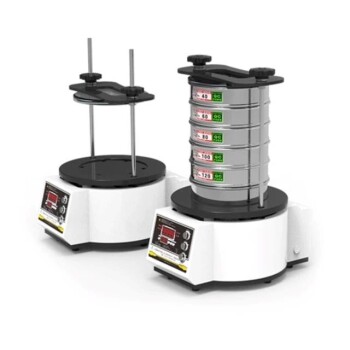
A precision sieving system is required to strictly control the particle size range of dried MgCuCeOx solids, specifically targeting a range such as 250–600 μm. This step is critical for ensuring the mechanical stability of the adsorbent's bead-like structure and optimizing fluid dynamics within a packed bed environment to prevent operational failures.
Core Takeaway Processing MgCuCeOx adsorbents is not just about chemical composition; it is about physical uniformity. Precision sieving balances the need for high contact efficiency with the necessity of minimizing pressure drops, directly enabling successful industrial hydrogen purification.
The Critical Role of Particle Size in Packed Beds
Optimizing Fluid Dynamics
In industrial applications like hydrogen purification, the adsorbent operates within a packed bed reactor.
The behavior of gas flowing through this bed is dictated by the size and shape of the particles.
By limiting particles to a specific range (250–600 μm), sieving ensures a uniform void fraction, allowing for predictable and efficient gas flow patterns.
Preventing Excessive Pressure Drops
One of the primary operational risks in a packed bed is a high pressure drop.
If the particle distribution is too wide, smaller particles (fines) tend to fill the void spaces between larger particles.
This restricts gas flow, dramatically increasing the energy required to push gas through the system and potentially stalling the process.
Enhancing Contact Efficiency
For the MgCuCeOx adsorbent to function, the gas must effectively contact the solid surface.
A precision sieving system eliminates oversized particles that offer poor surface-area-to-volume ratios.
This ensures maximum interaction between the hydrogen stream and the adsorbent, improving the overall purification rate.
Mechanical Integrity and Structure
Preserving the Bead-Like Structure
The preparation of MgCuCeOx precursors aims to create a specific bead-like structure.
Sieving does not just size the particles; it acts as a quality control step to remove broken or irregular fragments.
maintaining this structural integrity is vital for the material to withstand the physical stresses of industrial operation without degrading.
Understanding the Trade-offs
The Cost of Precision
Implementing a precision sieving system introduces an additional processing step, increasing time and equipment costs.
However, skipping this step results in a heterogeneous mixture that causes uneven flow distribution (channeling).
Yield vs. Quality
Strictly enforcing the 250–600 μm range means rejecting material that falls outside these parameters.
While this reduces the total yield of the precursor batch, it ensures that 100% of the material entering the reactor contributes to performance rather than impeding it.
Making the Right Choice for Your Process
To apply this to your specific project, evaluate your priorities based on the reactor scale and operational limits.
- If your primary focus is Operational Stability: Prioritize a narrow sieve cut (e.g., strictly 250–600 μm) to minimize pressure drop risks and ensure uniform flow.
- If your primary focus is Kinetic Performance: Ensure the removal of all oversized particles to maximize the effective contact area for the hydrogen purification reaction.
Precision sieving is the bridge between a chemically active precursor and an industrially viable adsorbent.
Summary Table:
| Parameter | Impact of Precision Sieving | Outcome |
|---|---|---|
| Particle Size Range | Targeted 250–600 μm control | Uniform bead-like structural integrity |
| Fluid Dynamics | Consistent void fraction | Predictable and efficient gas flow patterns |
| Pressure Control | Elimination of fines/small particles | Reduced pressure drops and energy consumption |
| Contact Efficiency | Removal of oversized particles | Maximized surface-area-to-volume ratio |
| Operational Risk | Prevention of channeling | Stable and reliable hydrogen purification |
Maximize Your Material Performance with KINTEK Precision Solutions
Achieving the perfect particle size distribution is critical for the success of your MgCuCeOx adsorbents and industrial hydrogen purification processes. KINTEK specializes in high-performance laboratory equipment, including advanced crushing and milling systems and precision sieving equipment designed to ensure mechanical stability and optimal fluid dynamics for your materials.
From high-temperature reactors to specialized sieving tools, KINTEK provides the reliability your research and production demand. Contact us today to find the right sieving solution for your lab!
References
- Gina Bang, Chang‐Ha Lee. Mg-incorporated sorbent for efficient removal of trace CO from H2 gas. DOI: 10.1038/s41467-023-42871-6
This article is also based on technical information from Kintek Solution Knowledge Base .
Related Products
- Three-dimensional electromagnetic sieving instrument
- Custom PTFE Teflon Parts Manufacturer for PTFE Mesh F4 Sieve
- Laboratory Vibratory Sieve Shaker Machine for Dry and Wet Three-Dimensional Sieving
- Laboratory Test Sieves and Sieving Machines
- Precision Wire Saw Laboratory Cutting Machine with 800mm x 800mm Workbench for Diamond Single Wire Circular Small Cutting
People Also Ask
- Why is sieving equipment essential for the classification of processed bio-activated carbon? Optimize Performance
- What are the limitations of sieving? Understanding the Constraints of Particle Size Analysis
- What are advantages and disadvantages of sieving method? A Guide to Reliable & Cost-Effective Particle Sizing
- How is sieving important? The Critical Role of Particle Size Analysis in Quality Control
- What is sieving and how does it work? A Guide to Accurate Particle Size Analysis