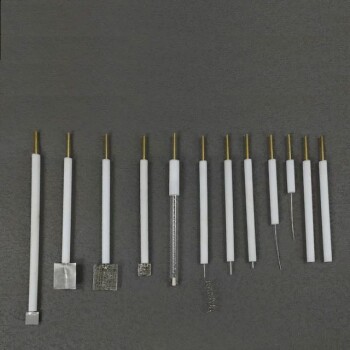
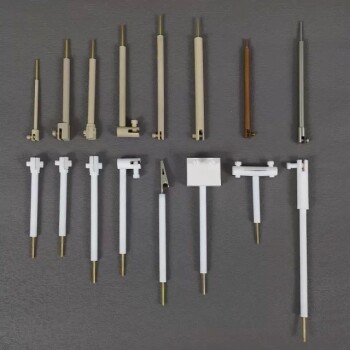
The standard three-electrode system is mandatory because it decouples potential measurement from current flow. In electrochemical corrosion testing of welded samples, this configuration isolates the measurement circuit from the power circuit. By doing so, it eliminates the voltage drop caused by solution resistance, ensuring that the data reflects the true behavior of the material surface rather than the properties of the electrolyte.
By separating the current circuit from the potential measurement circuit, this system eliminates the influence of potential drop (ohmic drop). This allows for the high-precision capture of polarization curves and the accurate extraction of critical thermodynamic parameters like corrosion potential.
The Architecture of Accuracy
To understand why this system is non-negotiable for welded samples, you must first understand the specific role of each component defined in the standard setup.
The Working Electrode
This is the weld sample itself. It is the material currently under investigation and the focal point of the electrochemical reaction.
The Counter Electrode
Typically a platinum electrode, this component completes the current circuit. It allows electricity to flow through the electrolyte solution without participating in the reaction being measured at the weld surface.
The Reference Electrode
Usually a saturated calomel electrode (SCE), this provides a stable, known potential. It serves as the "ruler" against which the potential of the weld sample is measured.
The Core Problem: Current vs. Measurement
The fundamental challenge in corrosion testing is measuring the potential of a sample while simultaneously inducing a reaction (which requires current).
The Interference of Resistance
When current passes through an electrolyte, it encounters resistance. According to Ohm's Law, this resistance creates a voltage drop (often called the IR drop).
The Failure of Two-Electrode Systems
In a simple two-electrode setup, the same electrode is used to carry current and measure potential. Consequently, the measurement includes the IR drop errors, distorting the data.
The Distortion of Data
If these errors are not removed, the resulting polarization curves will be inaccurate. This makes it impossible to distinguish the actual corrosion properties of the weld from the resistance of the test solution.
How the Three-Electrode Solution Works
The three-electrode system solves the resistance problem by splitting the operation into two distinct circuits.
Circuit 1: The Current Loop
Current flows exclusively between the working electrode (weld) and the counter electrode (platinum). This loop drives the electrochemical reaction but is not used for measurement.
Circuit 2: The Measurement Loop
Voltage is measured between the working electrode and the reference electrode. Because this measurement circuit has very high impedance, negligible current flows through it.
Eliminating the Drop
Since virtually no current flows through the reference electrode, there is no IR drop in the measurement circuit. The system captures the pure potential of the weld surface, unaffected by the solution's resistance.
Understanding the Trade-offs
While the three-electrode system is the standard for precision, it requires careful implementation to avoid introducing new errors.
Setup Complexity
This system is physically more complex than simple resistance probes. It requires precise geometry; the reference electrode must be positioned close to the working electrode to be effective.
Reference Electrode Stability
The accuracy of the entire test hinges on the stability of the reference electrode (SCE). If the SCE is contaminated or damaged, the "baseline" shifts, rendering all collected thermodynamic parameters invalid.
Making the Right Choice for Your Goal
When performing electrochemical tests on welds, the configuration you choose dictates the validity of your thermodynamic data.
- If your primary focus is obtaining accurate polarization curves: You must use the three-electrode system to prevent solution resistance from skewing the curve shape.
- If your primary focus is determining specific corrosion potential: You must rely on the stable baseline provided by the separate reference electrode (SCE) to extract precise thermodynamic parameters.
Ultimately, the three-electrode system is the only viable method for isolating the true electrochemical behavior of a weld from the electrical noise of the testing environment.
Summary Table:
| Component | Role | Description |
|---|---|---|
| Working Electrode | Weld Sample | The focal point of the electrochemical reaction being investigated. |
| Counter Electrode | Platinum | Completes the current circuit without interfering with the reaction. |
| Reference Electrode | SCE | Provides a stable potential baseline to measure the weld's potential accurately. |
| Circuit Isolation | Decoupling | Separates current flow from potential measurement to eliminate Ohm's Law errors. |
Elevate Your Electrochemical Research with KINTEK
Precision in corrosion testing starts with the right equipment. KINTEK provides high-performance electrolytic cells and electrodes, tailored for demanding electrochemical studies on welded samples and advanced materials. Beyond testing, we support your entire lab workflow with a comprehensive range of:
- High-Temperature Furnaces (Muffle, Vacuum, CVD/PECVD) for material synthesis.
- Crushing & Milling Systems and Hydraulic Presses for sample preparation.
- Battery Research Tools and Consumables (PTFE, Ceramics, Crucibles).
Ensure the integrity of your thermodynamic data with professional-grade solutions. Contact KINTEK today to find the perfect equipment for your laboratory needs!
References
- M. Dziekońska, T. Jung. Microstructure and Properties of Dissimilar Joints of AISI 430 Steel with Inconel 625 Obtained by Electron Beam Welding. DOI: 10.12913/22998624/152529
This article is also based on technical information from Kintek Solution Knowledge Base .
Related Products
- Three-dimensional electromagnetic sieving instrument
- H Type Electrolytic Cell Triple Electrochemical Cell
- Gold Disc Electrode
- Rotating Platinum Disk Electrode for Electrochemical Applications
- Metal Disc Electrode Electrochemical Electrode
People Also Ask
- Why is sieving equipment essential for the classification of processed bio-activated carbon? Optimize Performance
- What are the limitations of sieving? Understanding the Constraints of Particle Size Analysis
- What are advantages and disadvantages of sieving method? A Guide to Reliable & Cost-Effective Particle Sizing
- How is sieving important? The Critical Role of Particle Size Analysis in Quality Control
- What is sieving and how does it work? A Guide to Accurate Particle Size Analysis