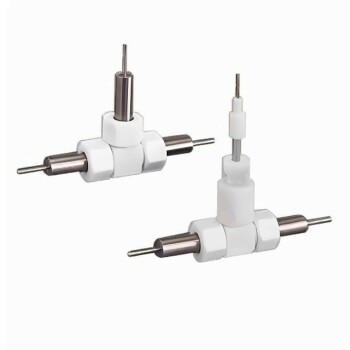
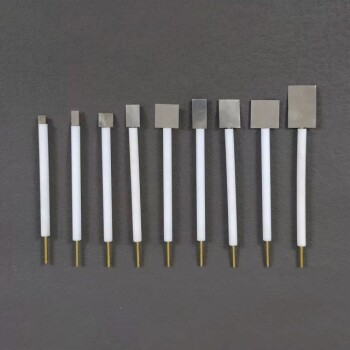
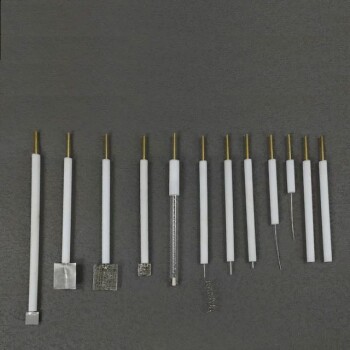
The necessity of a three-electrode system lies in its ability to isolate the working electrode. By decoupling the potential measurement from the current-carrying circuit, this configuration allows researchers to measure the intrinsic catalytic activity of $(Co,Fe,Ni)_3Se_4$ without interference from the counter electrode or internal resistance.
Core Takeaway: A three-electrode system is required to obtain precise, reproducible data by ensuring that the measured overpotential reflects only the processes occurring at the $(Co,Fe,Ni)_3Se_4$ surface, free from the errors caused by polarization and ohmic voltage drops.
The Mechanics of Potential Control
Decoupling Current and Potential
In a standard two-electrode setup, the measured voltage is the sum of the potentials at both the anode and the cathode. A three-electrode system introduces a reference electrode that carries no current, allowing for the precise clamping of the working electrode’s potential relative to a stable baseline.
The Role of the Reference Electrode
Reference electrodes, such as Ag/AgCl or Saturated Calomel Electrodes (SCE), provide a constant, well-defined potential. This stability is critical for determining the exact onset overpotential of the Hydrogen Evolution Reaction (HER), as any drift in the reference would lead to inaccurate kinetic data.
The Function of the Counter Electrode
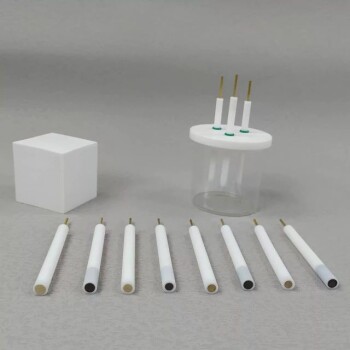
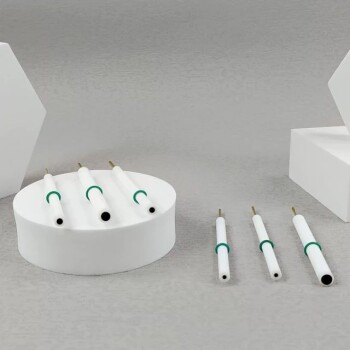
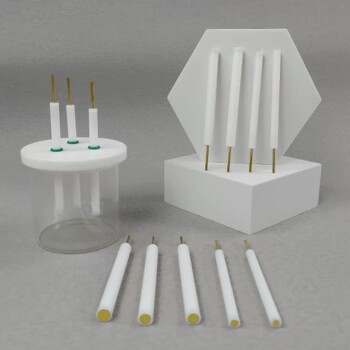
The counter electrode (typically platinum or graphite) completes the circuit to allow current flow. In a three-electrode configuration, the polarization of the counter electrode does not affect the potential measurement of the $(Co,Fe,Ni)_3Se_4$ catalyst, ensuring the data remains "clean."
Impact on Kinetic Parameter Accuracy
Ensuring Reliable Tafel Slope Measurements
The Tafel slope is a fundamental indicator of the reaction mechanism and catalytic efficiency. Because a three-electrode system eliminates the interference of counter-electrode polarization, it provides the high-fidelity polarization curves necessary to calculate an accurate slope and exchange current density.
Eliminating Ohmic Resistance (iR Drop)
Electrolytes and electrical contacts possess inherent resistance that can artificially inflate the measured overpotential. The three-electrode setup, often paired with iR compensation, minimizes these ohmic drops, revealing the inherent hydrogen evolution performance of the material rather than the limitations of the experimental environment.
Precise Measurement of Charge Transfer Resistance
Using Electrochemical Impedance Spectroscopy (EIS) within this configuration allows for the derivation of charge transfer resistance ($R_{ct}$). This measurement helps researchers understand how efficiently electrons move from the $(Co,Fe,Ni)_3Se_4$ catalyst to the hydrogen ions in the electrolyte.
Common Pitfalls and Trade-offs
Reference Electrode Compatibility
Not all reference electrodes are suitable for all environments; for example, Mercury/Mercury Oxide (Hg/HgO) is preferred in alkaline conditions, while Ag/AgCl is standard for acidic or neutral media. Using the wrong reference can lead to potential shifts or chemical contamination of the electrolyte.
Counter Electrode Leaching
When using a platinum counter electrode in HER testing, there is a small risk of platinum dissolving and redepositing onto the working electrode. This "platinum poisoning" can lead to a false perception of high catalytic activity, as platinum is itself a world-class HER catalyst.
Making the Right Choice for Your Research
How to Apply This to Your Project
- If your primary focus is determining intrinsic activity: Use a high-purity graphite rod as the counter electrode to avoid the potential for platinum redeposition and ensure the results reflect only the $(Co,Fe,Ni)_3Se_4$ catalyst.
- If your primary focus is precision in acidic media (0.5 M $H_2SO_4$): Utilize a Saturated Calomel Electrode (SCE) or Ag/AgCl reference electrode and ensure you perform manual or automatic iR compensation for the most accurate overpotential readings.
- If your primary focus is understanding reaction kinetics: Prioritize the collection of high-resolution polarization curves to derive Tafel slopes, ensuring the scan rate is slow enough to maintain steady-state conditions.
By employing a rigorous three-electrode configuration, you transform a simple current measurement into a definitive assessment of electrochemical performance.
Summary Table:
| Component | Role in HER Testing | Key Benefit for Analysis |
|---|---|---|
| Working Electrode | Hosts the (Co,Fe,Ni)3Se4 catalyst | Measures intrinsic catalytic activity |
| Reference Electrode | Provides stable potential baseline | Decouples current from potential control |
| Counter Electrode | Completes the electrical circuit | Prevents counter-electrode interference |
| iR Compensation | Corrects for electrolyte resistance | Reveals true overpotential and kinetics |
Elevate your electrochemical research with KINTEK’s high-precision laboratory solutions. Whether you are characterizing (Co,Fe,Ni)3Se4 catalysts or optimizing energy storage systems, our premium electrolytic cells, high-purity electrodes, and comprehensive battery research tools ensure your data is accurate and reproducible. From high-temperature furnaces for material synthesis to specialized reactors for HER testing, we provide the reliable equipment you need to push the boundaries of science. Contact our technical experts today to find the perfect configuration for your laboratory!
References
- Andrzej Mikuła, Ulf‐Peter Apfel. Synthesis, properties and catalytic performance of the novel, pseudo-spinel, multicomponent transition-metal selenides. DOI: 10.1039/d2ta09401k
This article is also based on technical information from Kintek Solution Knowledge Base .
Related Products
- H Type Electrolytic Cell Triple Electrochemical Cell
- Lab Electrochemical Workstation Potentiostat for Laboratory Use
- Graphite Disc Rod and Sheet Electrode Electrochemical Graphite Electrode
- Three-dimensional electromagnetic sieving instrument
- Metal Disc Electrode Electrochemical Electrode
People Also Ask
- What is a H type cell? A Guide to Divided Electrochemical Cells for Accurate Experiments
- How should the electrolyte be prepared and added to the H-type electrolytic cell? Best Practices for Purity and Safety
- What is the technical necessity of using an H-type electrolytic cell for NO3RR tests? Protect Your Ammonia Yields
- How does the design of an H-type electrolytic cell benefit the neutral water electrolysis process for metal recovery?
- What is the primary function of an H-type electrolytic cell in NitRR? Ensure Accurate Product Yields