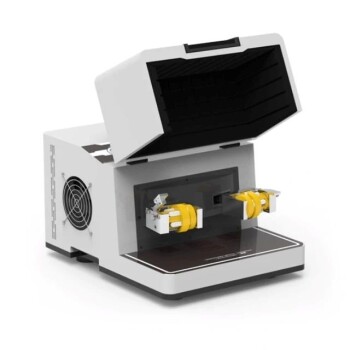
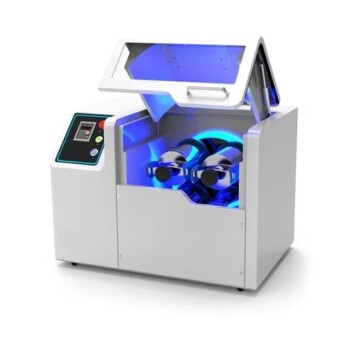
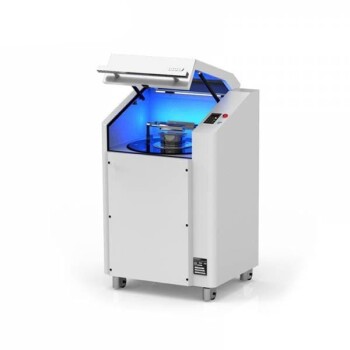
The two-stage ball milling process for LAGP powders is engineered to transition the material from coarse sintered blocks to uniform nanoparticles without compromising purity.
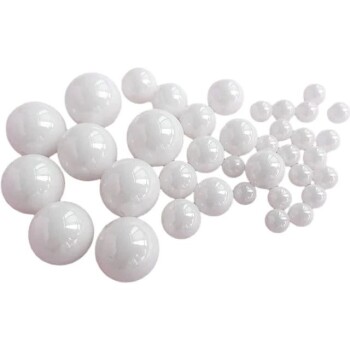
The first stage utilizes dry milling to mechanically fracture large, sintered chunks into coarse powder. The second stage employs wet milling with 1mm zirconia beads and an ethanol solvent to deliver high shear frequencies, effectively reducing the powder to an average particle size of approximately 100 nm for use in high-performance composite electrolytes.
Core Insight: The use of 1mm beads in the second stage is a precision tactic; it maximizes the number of contact points to grind the material down to the nanoscale gently, preventing the structural damage often caused by larger, high-impact grinding media.
The Mechanics of the Two-Stage Strategy
Stage 1: Coarse Fragmentation (Dry Milling)
The initial processing of LAGP typically begins with large, hard blocks resulting from high-temperature sintering.
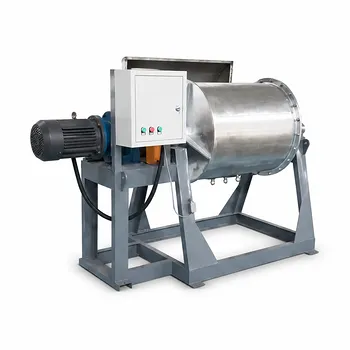
Dry ball milling acts as the primary crushing mechanism. It utilizes high-impact energy to break these sintered blocks down into a manageable, coarse powder, creating the necessary feedstock for the refinement phase.
Stage 2: Nanoscale Refinement (Wet Milling)
Once the material is broken down, the goal shifts from crushing to refining.
Wet milling is employed here, often using ethanol as a solvent to create a slurry. This prevents particle agglomeration and facilitates a more uniform reduction in size, targeting an average diameter of 100 nm.
The Role of Shear Force
In this wet stage, the interaction between the fluid and the media generates high shear frequencies.
This ensures that the particles are polished and separated rather than just pulverized, which is critical for creating smooth, homogeneous electrolyte pastes later in the manufacturing process.
Why 1mm Zirconia Beads are Critical
Maximizing Contact Points
The choice of 1mm micro-beads is specific to the geometry of grinding.
Smaller beads occupy more volume for a given weight, exponentially increasing the number of contact points between the beads and the LAGP powder. This allows for efficient, continuous grinding that reduces particle size through attrition and shear rather than heavy impact.
Preserving Crystal Structure
Using smaller, lighter beads constitutes a "Low-energy Wet Milling" (LWM) approach.
Because the individual impact energy of a 1mm bead is lower than that of a larger ball, the process refines the particle size without destroying the material's crystal structure. This is vital, as the ionic conductivity of LAGP relies heavily on its crystalline integrity.
Ensuring Chemical Purity
Zirconia is selected for its extreme hardness and chemical inertness.
During the extended milling required to reach 100 nm, softer media would wear down, introducing impurities into the batch. Zirconia resists this wear, preventing metal contamination that would otherwise degrade the ionic conductivity of the final electrolyte.
Understanding the Trade-offs
The Risk of Over-Milling
While smaller particles offer better contact area in the final battery, there is a limit to beneficial size reduction.
If the milling process is too aggressive or prolonged, even with 1mm beads, you risk converting the crystalline LAGP into an amorphous phase. This loss of crystallinity will significantly reduce the material's ionic conductivity.
Solvent Compatibility
The wet milling process relies on the compatibility of the solvent with the ceramic.
Ethanol is standard because it disperses the particles well and evaporates cleanly. However, using a solvent that reacts with LAGP or fails to disperse the nanoparticles will lead to agglomeration, negating the benefits of the 1mm beads.
Making the Right Choice for Your Goal
To optimize your LAGP preparation, align your milling parameters with your specific performance targets:
- If your primary focus is High Ionic Conductivity: Prioritize the use of high-purity zirconia media and strictly monitor milling time to prevent crystal structure damage.
- If your primary focus is Composite Paste Quality: Ensure the second wet-milling stage creates a uniform 100 nm distribution to maximize the interface between the electrolyte and active materials.
Success in LAGP preparation lies in balancing the mechanical force required to pulverize the material with the delicacy needed to preserve its electrochemical properties.
Summary Table:
| Milling Stage | Method | Primary Objective | Key Media/Conditions |
|---|---|---|---|
| Stage 1 | Dry Ball Milling | Coarse fragmentation of sintered blocks | High-impact energy media |
| Stage 2 | Wet Ball Milling | Nanoscale refinement (~100 nm) | 1mm Zirconia beads + Ethanol |
| Benefit | Shear Frequency | Uniform particle separation | Low-energy attrition |
| Result | Purity & Structure | High ionic conductivity | Minimal wear & crystal preservation |
Optimize Your LAGP Synthesis with KINTEK Precision
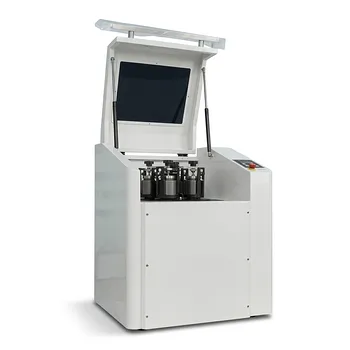
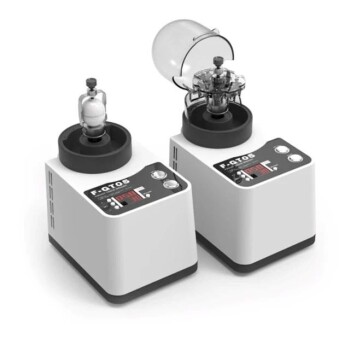
Achieving the perfect 100nm particle size without compromising crystalline integrity requires precision equipment. KINTEK specializes in advanced laboratory solutions, offering high-performance crushing and milling systems and premium zirconia media tailored for delicate nanomaterial refinement.
Beyond milling, our comprehensive portfolio supports every step of your battery research, including:
- High-temperature furnaces (muffle, tube, and atmosphere) for sintering.
- Battery research tools and consumables for electrolyte testing.
- High-temperature high-pressure reactors and specialized PTFE/ceramic crucibles.
Ready to enhance your lab's efficiency and material purity? Contact our technical experts today to find the ideal equipment for your specific research goals!
Related Products
- Laboratory Jar Ball Mill with Alumina Zirconia Grinding Jar and Balls
- Precision Machined Zirconia Ceramic Ball for Engineering Advanced Fine Ceramics
- Laboratory Horizontal Planetary Ball Mill Milling Machine
- Laboratory Jar Mill with Agate Grinding Jar and Balls
- Laboratory Planetary Ball Mill Cabinet Planetary Ball Milling Machine
People Also Ask
- What are the primary functions of using a ball mill for BZCY72 powder? Achieve High Purity and Enhanced Sintering
- In what way does a laboratory ball mill affect material properties when modifying PHBV/pulp fiber composites?
- Why is a laboratory ball mill required for ultra-fine fly ash? Unlock Nano-Scale Adsorption Power
- What is the function of a laboratory ball mill in the preparation of AMMCs? Optimize Dispersion & Grain Refinement
- What is the function of a laboratory ball mill in the pretreatment of waste tire char (WTC)? Optimize Material Reactivity