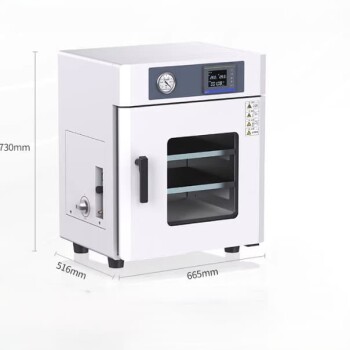
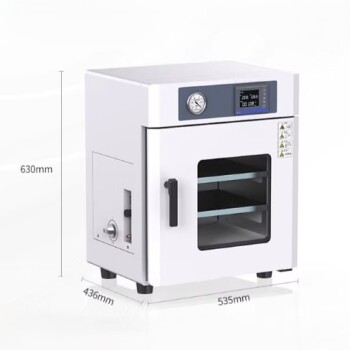
A vacuum drying oven is strictly necessary to decouple drying from chemical reaction. It allows for the complete removal of residual moisture and trace solvents from washed solids at a safe, low temperature (approximately 65°C). By using a vacuum, you can purify the product without triggering the thermal curing reaction that would ruin the benzoxazine monomers.
The core purpose of this equipment is to lower the boiling point of impurities, enabling "deep drying" at temperatures that are too cool to initiate polymerization. This preserves the material's reactivity while ensuring high purity.
The Physics of Gentle Purification
Lowering Boiling Points
The fundamental advantage of a vacuum oven is its ability to alter physical properties through pressure reduction. By creating a vacuum environment, the atmospheric pressure surrounding the material is significantly decreased.
This drop in pressure lowers the boiling points of water and organic solvents. Consequently, these liquids can vaporize and exit the solid material with much less heat energy than would be required at standard atmospheric pressure.
Deep Removal of Contaminants
Washed benzoxazine solids often retain "deep" moisture or trace solvents within their structure. Standard air drying is often insufficient to draw these out without excessive heat.
The vacuum environment facilitates deep drying, pulling out stubborn volatiles from the washed solids effectively. This results in a much drier, purer final powder compared to ambient drying methods.
Critical Protection of the Monomer
Preventing Premature Curing
Bio-based benzoxazine is a reactive monomer intended to cure (polymerize) at specific high temperatures. This presents a processing paradox: you need heat to dry it, but heat causes it to react.
If a standard oven were used, the temperatures required to fully evaporate solvents might overlap with the monomer's activation temperature. Vacuum drying solves this by operating at approximately 65°C. This temperature is sufficient to dry under vacuum but low enough to prevent the thermal curing reaction from starting prematurely.
Ensuring Product Consistency
The result of this process is a high-purity benzoxazine powder. By removing impurities without altering the chemical structure, the vacuum oven ensures the final product behaves predictably during its intended application.
Understanding Process Constraints
The Thermal Threshold
While vacuum drying is effective, it requires strict adherence to temperature limits. The specific target of 65°C is not arbitrary; it represents a safety zone.
Exceeding this temperature, even under vacuum, risks initiating the curing process. Conversely, dropping significantly below this temperature might result in incomplete drying, leaving impurities that degrade the final material's performance.
Optimizing the Final Treatment Stage
To ensure the highest quality bio-based benzoxazine, the drying process must be viewed as a balance between purification and preservation.
- If your primary focus is maximizing shelf-life: Strictly control the temperature at or below 65°C to ensure zero premature cross-linking occurs during drying.
- If your primary focus is material performance: Ensure the vacuum level is sufficient to remove all trace solvents, as residual impurities can weaken the final cured resin.
The vacuum drying oven is not just a drying tool; it is a preservation device that safeguards the chemical potential of your product.
Summary Table:
| Feature | Standard Drying Oven | Vacuum Drying Oven (KINTEK) |
|---|---|---|
| Mechanism | Convection/Thermal | Pressure Reduction + Gentle Heat |
| Process Temp | High (Often >80°C) | Precise Low-Temp (≈65°C) |
| Solvent Removal | Surface Level | Deep Volatile Extraction |
| Monomer Safety | High risk of premature curing | Preserves chemical reactivity |
| Resulting Quality | Impure or partially cured | High-purity, reactive powder |
Maximize Your Material Integrity with KINTEK
Don't let premature polymerization ruin your bio-based benzoxazine synthesis. KINTEK provides high-precision vacuum drying ovens specifically engineered to handle sensitive chemical reactions and high-purity laboratory workflows. Our comprehensive range of laboratory equipment—including vacuum furnaces, freeze dryers, and high-temperature reactors—is designed to give researchers and manufacturers the control they need over thermal thresholds.
Whether you are refining advanced resins or conducting battery research, KINTEK's technical expertise ensures you receive the highest quality consumables (PTFE, ceramics, crucibles) and advanced machinery to optimize your final treatment stage.
Ready to elevate your lab's precision? Contact our technical specialists today to find the perfect drying solution for your specific application.
References
- Rumeng Li, Qixin Zhuang. The Spatial and Electronic Effects of Substituent Groups on the Thermal Curing of Bio-Based Benzoxazines. DOI: 10.32604/jrm.2021.015827
This article is also based on technical information from Kintek Solution Knowledge Base .
Related Products
- 56L Vertical Laboratory Vacuum Drying Oven
- 23L Laboratory Vacuum Drying Oven
- Laboratory Scientific Electric Heating Blast Drying Oven
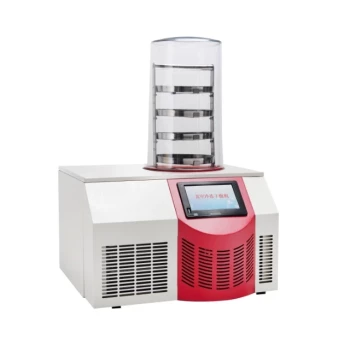
- Benchtop Laboratory Vacuum Freeze Dryer
- Dental Porcelain Zirconia Sintering Ceramic Vacuum Press Furnace
People Also Ask
- Why is a laboratory vacuum drying oven recommended for rice straw residues? Protect Your Biomass Integrity
- What role does a laboratory vacuum drying oven play in the preparation of modified multi-walled carbon nanotubes?
- What is the importance of using a laboratory vacuum drying oven? Preserving Slow-Release Microcapsule Integrity
- Why is a Laboratory Vacuum Drying Oven recommended for PBAT microspheres? Protect Sensitive Polymer Integrity
- What role does a laboratory vacuum drying oven play in processing nanoparticle powder samples? Protect Sample Integrity