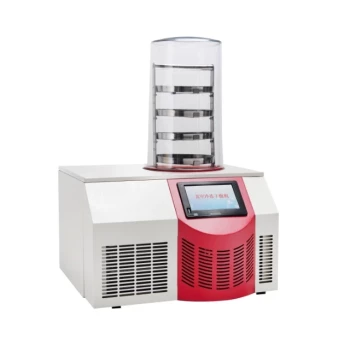
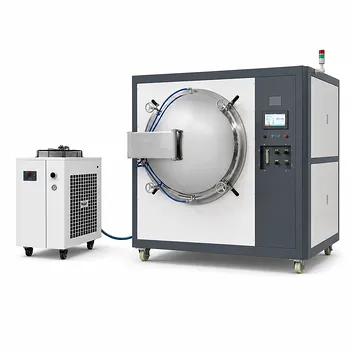
A vacuum drying oven is essential for Aluminum Nitride (AlN) post-treatment to simultaneously protect the material’s chemical purity and accelerate processing efficiency. It functions by lowering the pressure to facilitate the rapid evaporation of solvents, such as anhydrous ethanol, at a safe, low temperature (typically 80°C), while the oxygen-depleted environment prevents the highly reactive AlN powder from oxidizing.
Core Takeaway: The vacuum drying process solves two problems at once: it accelerates the removal of volatile solvents without requiring damaging high heat, and it creates an inert atmosphere that prevents the active AlN powder from chemically reacting with oxygen.
The Critical Role of Vacuum Drying
Preventing Material Oxidation
Aluminum Nitride fine powder is highly active and chemically sensitive. If exposed to standard atmospheric oxygen while being heated, the powder is prone to oxidation.
The vacuum oven removes oxygen from the drying chamber. This inert environment allows the material to be heated without degrading its chemical composition, thereby maintaining the high purity of the raw AlN material.
Accelerating Solvent Removal at Low Temperatures
The slurry mixture contains solvents, often anhydrous ethanol, which must be completely removed. Under standard atmospheric pressure, removing these solvents might require higher temperatures or longer durations.
Vacuum drying lowers the boiling point of these solvents. This allows for rapid, efficient evaporation at relatively low temperatures (around 80°C), speeding up the drying rate significantly compared to conventional ovens.
Preventing Structural Defects
Although the primary reference focuses on purity and speed, the principle of solvent removal is critical for structural integrity. As seen in similar powder metallurgy processes, residual solvents or moisture can vaporize rapidly during subsequent high-temperature sintering.
Thoroughly removing these volatiles in the vacuum stage prevents the formation of pores or cracks caused by gas expansion later in the process. This ensures the final ceramic body has high density and fewer defects.
Understanding the Trade-offs
The Formation of Soft Agglomerates
While vacuum drying protects purity, the process of removing solvents inevitably causes the fine powder particles to clump together.
These "soft agglomerates" can negatively affect the flowability of the powder. If left untreated, they result in uneven mold filling and density variations in the final product.
The Necessity of Mechanical Sieving
To counteract agglomeration, a secondary post-treatment step is required immediately after drying. The dried AlN mixed powder must be processed through a standard sieve (e.g., 200-mesh).
This breaks down the agglomerates, ensuring uniform particle size and excellent flowability. This step is crucial for minimizing density variations and preventing structural defects in the final sintered ceramic.
Making the Right Choice for Your Goal
To maximize the quality of your Aluminum Nitride ceramics, consider these priorities during the drying phase:
- If your primary focus is Chemical Purity: Ensure your vacuum seal is impeccable and maintain temperatures strictly around 80°C to prevent any risk of oxidation during the drying cycle.
- If your primary focus is Structural Density: Prioritize the duration of the drying cycle to guarantee 100% solvent removal, preventing gas-expansion defects during sintering, followed immediately by sieving.
By strictly controlling the atmosphere and temperature, vacuum drying transforms a sensitive, reactive slurry into a stable, high-performance ceramic precursor.
Summary Table:
| Feature | Impact on Aluminum Nitride (AlN) Processing |
|---|---|
| Oxygen-Depleted Environment | Prevents chemical oxidation of highly reactive AlN powder. |
| Lowered Boiling Point | Facilitates rapid evaporation of solvents like anhydrous ethanol at 80°C. |
| Volatile Removal | Prevents internal pores or cracks during high-temperature sintering. |
| Agglomerate Control | Enables easier mechanical sieving to ensure uniform particle flowability. |
Elevate Your Advanced Ceramic Production with KINTEK
Precise material processing starts with the right environment. KINTEK specializes in high-performance laboratory equipment designed to meet the rigorous demands of advanced materials research. Whether you are processing reactive Aluminum Nitride or developing new ceramic precursors, our comprehensive range of vacuum drying ovens, crushing and milling systems, and sieving equipment ensures your powders maintain maximum purity and structural integrity.
From high-temperature furnaces and hydraulic presses to specialized consumables like crucibles and ceramics, KINTEK provides the end-to-one solutions you need for consistent, high-density results. Contact us today to optimize your lab's workflow and material quality!
Related Products
- 56L Vertical Laboratory Vacuum Drying Oven
- 23L Laboratory Vacuum Drying Oven
- Laboratory Scientific Electric Heating Blast Drying Oven
- Benchtop Laboratory Vacuum Freeze Dryer
- Dental Porcelain Zirconia Sintering Ceramic Vacuum Press Furnace
People Also Ask
- Why is a laboratory vacuum drying oven recommended for rice straw residues? Protect Your Biomass Integrity
- What role does a laboratory vacuum drying oven play in the preparation of modified multi-walled carbon nanotubes?
- What is the importance of using a laboratory vacuum drying oven? Preserving Slow-Release Microcapsule Integrity
- Why is a Laboratory Vacuum Drying Oven recommended for PBAT microspheres? Protect Sensitive Polymer Integrity
- What role does a laboratory vacuum drying oven play in processing nanoparticle powder samples? Protect Sample Integrity