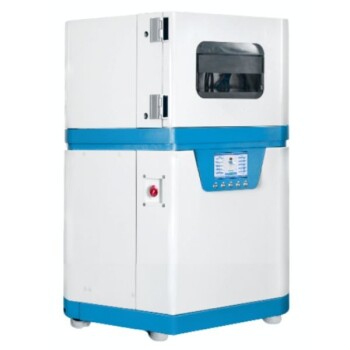
The vacuum environment is a non-negotiable prerequisite for processing SiCf/TC17/TB8 composites due to the extreme chemical reactivity of titanium alloys at elevated temperatures.
Without a vacuum, the titanium matrix (TC17 and TB8) would react rapidly with oxygen, leading to severe oxidation and material embrittlement that compromises the composite's structural integrity. The vacuum effectively isolates the system from oxygen, preserving the matrix, protecting the silicon carbide (SiC) fiber coatings, and ensuring a pristine interface for bonding.
Core Takeaway Processing SiCf/TC17/TB8 composites without a vacuum ensures failure; the titanium matrix acts as an oxygen "getter," reacting to form brittle oxides that destroy mechanical performance. A high-vacuum environment is the only way to maintain the ductility of the matrix and the integrity of the fiber-matrix interface.
The Critical Role of Oxygen Isolation
Preventing Titanium Matrix Embrittlement
Titanium alloys like TC17 and TB8 are highly chemically active.
When exposed to oxygen at the high temperatures required for hot pressing, these alloys oxidize rapidly.
This reaction creates a brittle "alpha-case" layer or internal oxide inclusions, which drastically reduces the ductility and fatigue strength of the final composite.
Preserving Silicon Carbide (SiC) Fiber Coatings
The vacuum environment is equally critical for the reinforcement phase.
It prevents the oxidation of the specialized coatings applied to the SiC fibers.
If these coatings degrade due to oxygen exposure, the fibers degrade, and the critical interface between the fiber and the metal matrix is compromised.
Enhancing Interface Mechanics
Promoting Strong Interface Bonding
The mechanical performance of a composite relies on the transfer of load from the matrix to the fiber.
This transfer requires a clean, chemically stable interface, which is impossible to achieve if oxidation occurs during consolidation.
By eliminating oxygen, the vacuum maintains the interface bonding strength necessary for the material to perform under stress.
Removing Oxidation-Induced Impurities
Oxidation does not just affect the surface; it introduces impurities into the bulk material.
These impurities act as stress concentrators and defect sites within the composite.
A vacuum environment effectively prevents the formation of these impurities, ensuring the material retains its designed mechanical properties.
Facilitating Densification (General Principles)
Eliminating Adsorbed Contaminants
While the primary threat is oxidation, the vacuum also serves a secondary purification role.
It aids in removing moisture and adsorbed gases from the surface of the raw materials before full consolidation occurs.
This purification promotes better atomic diffusion and matrix flow, which are essential for achieving full density and minimizing voids.
Understanding the Trade-offs
High Equipment Complexity
Implementing a vacuum system significantly increases the complexity of the hot pressing equipment.
Operators must maintain intricate sealing systems and pumps, as even a minor leak can ruin an entire batch of expensive titanium composite.
Slower Cycle Times
Vacuum hot pressing is inherently a batch process that requires time for evacuation and thermal stabilization.
This reduces throughput compared to non-vacuum methods, making the process more expensive and less suitable for high-volume mass production.
Thermal Management Challenges
Heat transfer in a vacuum relies primarily on radiation rather than convection.
This can lead to longer heating and cooling cycles and requires sophisticated thermal control to ensure uniform temperature distribution across the composite part.
Making the Right Choice for Your Goal
To achieve the best results with SiCf/TC17/TB8 composites, align your processing parameters with your specific performance targets:
- If your primary focus is Maximum Fatigue Strength: Prioritize high vacuum levels (lowest possible oxygen partial pressure) to completely eliminate embrittlement risks in the TC17/TB8 matrix.
- If your primary focus is Interface Reliability: Ensure the vacuum is established well before peak temperature is reached to protect the delicate SiC fiber coatings during the heating ramp.
- If your primary focus is Densification: Combine the vacuum environment with optimized pressure application to facilitate matrix flow into void spaces once contaminants are removed.
Ultimately, the cost of a vacuum system is an investment in the fundamental viability of titanium matrix composites.
Summary Table:
| Feature | Impact of Vacuum Environment | Risk Without Vacuum |
|---|---|---|
| Titanium Matrix | Prevents alpha-case & maintains ductility | Severe embrittlement & oxidation |
| SiC Fiber Coating | Protects delicate coatings from degradation | Fiber damage & interface failure |
| Interface Bond | Ensures clean, high-strength load transfer | Impurities & weak mechanical bonding |
| Material Density | Removes adsorbed gases & contaminants | Porosity & internal stress sites |
| Heat Transfer | Radiation-dominant for uniform heating | Convection-based (risks contamination) |
Elevate Your Material Research with KINTEK Precision
Processing advanced SiCf/TC17/TB8 composites requires absolute control over atmospheric conditions. KINTEK specializes in state-of-the-art vacuum hot pressing furnaces and isostatic presses designed to eliminate oxidation and maximize densification for reactive titanium alloys.
Our comprehensive laboratory portfolio—including high-temperature vacuum systems, crushing and milling equipment, and custom ceramic crucibles—is engineered to meet the rigorous demands of aerospace and advanced materials science.
Ready to achieve superior interface mechanics and material purity?
Contact KINTEK Experts Today to find the perfect thermal processing solution for your laboratory.
Related Products
- Vacuum Hot Press Furnace Heated Vacuum Press Machine Tube Furnace
- 600T Vacuum Induction Hot Press Furnace for Heat Treat and Sintering
- Vacuum Hot Press Furnace Machine Heated Vacuum Press
- Vacuum Hot Press Furnace Machine for Lamination and Heating
- Vacuum Heat Treat and Pressure Sintering Furnace for High Temperature Applications
People Also Ask
- What advantages does a vacuum hot press furnace provide for LSLBO ceramic electrolytes? Achieve 94% Relative Density
- What role does a Vacuum Hot Press (VHP) furnace play in the densification of austenitic stainless steel 316 composites?
- What are the advantages of using a vacuum hot pressing furnace? Superior Densification for 2024Al/Gr/SiC Composites
- What are the advantages of a vacuum hot press furnace for LTPO solid electrolytes? Boost Density and Conductivity
- What core processing conditions does a vacuum hot press furnace provide? Achieve High-Density Cu-SiC/Diamond Composites