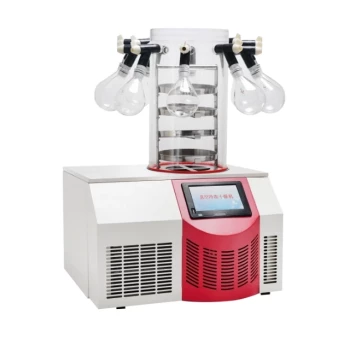
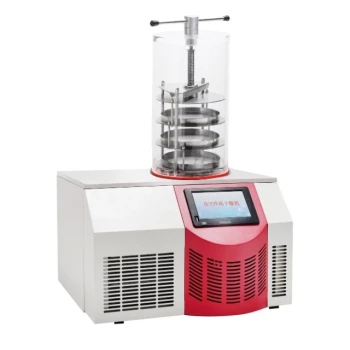
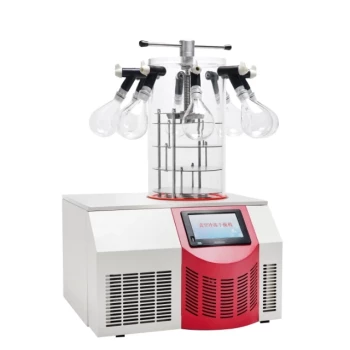
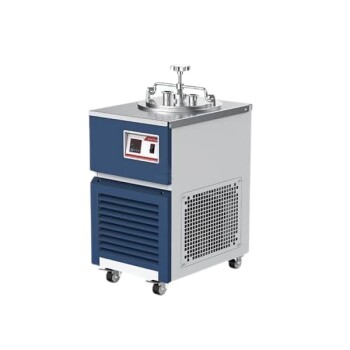
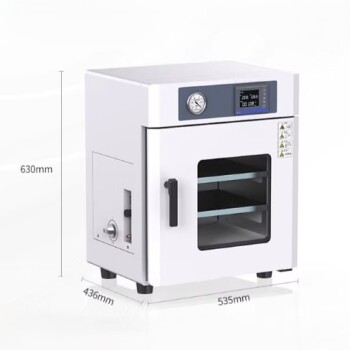
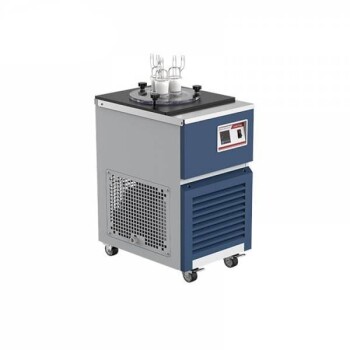
The vacuum freeze dryer is indispensable for synthesizing iron-nitrogen co-doped biochar (Fe@N-BC) because it removes moisture via sublimation rather than liquid evaporation. By maintaining high vacuum conditions, the device prevents the destructive force of surface tension that occurs during conventional thermal drying. This ensures the delicate pore structure of the biomass precursor remains intact, which is the foundational requirement for a high-performance catalyst.
The Core Takeaway The freeze dryer is not just a drying tool; it is a structural preservation device. By bypassing the liquid water phase entirely, it locks in the precursor's microscopic "skeleton," creating the high specific surface area necessary to host catalytic active sites.
The Mechanism of Structural Preservation
Avoiding the Surface Tension Trap
When biomass precursors are dried using heat (conventional drying), water transitions from liquid to gas. during this phase, the surface tension of the receding liquid water exerts a powerful pulling force on the pore walls.
Preventing Pore Collapse
This force is often strong enough to cause the microscopic pores of the material to collapse inward. Once these pores collapse, the material becomes dense and loses the vast internal surface area that defines a high-quality biochar.
The Role of Sublimation
A vacuum freeze dryer avoids this issue by lowering the pressure in the chamber to a specific level via a vacuum pump. Under these conditions, frozen moisture in the sample undergoes sublimation, turning directly from solid ice into vapor without ever becoming liquid.
From Precursor to High-Performance Catalyst
Preserving the Precursor Skeleton
Biomass precursors, such as lotus leaf powder, possess a naturally complex and highly developed porous structure. The freeze-drying process effectively "freezes" this architecture in place, removing the water while leaving the solid framework untouched.
Enabling Catalytic Activity
This preservation results in a material with a high specific surface area and developed porosity. These physical attributes are critical because they provide the necessary surface area for the subsequent formation of iron-nitrogen (Fe-N) active sites in a tube furnace.
The Consequence of Poor Drying
Without the porosity preserved by freeze drying, the iron and nitrogen dopants would have significantly less surface area to anchor onto. This would result in a catalyst with fewer active sites and substantially lower performance.
Understanding the Trade-offs
Process Duration and Intensity
While freeze drying is technically superior for structure, it is significantly slower than oven drying. The process requires freezing the sample first, followed by a lengthy primary and secondary drying phase under vacuum.
Equipment Complexity
A vacuum freeze dryer is more complex and expensive to operate than standard thermal drying equipment. It relies on the continuous operation of a vacuum pump to maintain the critical low-pressure environment required for sublimation.
Making the Right Choice for Your Goal
The necessity of this equipment depends on the performance metrics required for your final material.
- If your primary focus is Maximum Catalytic Activity: You must use a vacuum freeze dryer to maximize porosity and ensure the highest density of active sites.
- If your primary focus is Rapid Prototyping: You might attempt thermal drying, but you must accept that the pore structure will likely collapse, yielding a significantly inferior catalyst.
Ultimately, for high-performance Fe@N-BC, the porosity preserved by freeze drying is the physical stage upon which all chemical activity occurs.
Summary Table:
| Feature | Vacuum Freeze Drying | Conventional Thermal Drying |
|---|---|---|
| Mechanism | Sublimation (Solid to Gas) | Evaporation (Liquid to Gas) |
| Structural Impact | Preserves delicate pore "skeleton" | Causes pore collapse due to surface tension |
| Surface Area | High specific surface area | Low/Dense material structure |
| Catalytic Sites | Maximum hosting capacity for Fe-N | Limited sites for anchoring dopants |
| Process Speed | Slower (Primary/Secondary phases) | Faster (Direct heating) |
| Final Quality | Superior (High-performance catalyst) | Inferior (Rapid prototyping only) |
Elevate Your Material Synthesis with KINTEK Precision
Don't let surface tension compromise your research. KINTEK specializes in high-performance laboratory solutions, providing the advanced vacuum freeze dryers and freeze dryers essential for preserving the delicate architecture of catalysts like Fe@N-BC.
Beyond drying, we empower your entire workflow with our comprehensive range of tube furnaces for precise doping, crushing and milling systems for precursor preparation, and high-temperature high-pressure reactors for advanced synthesis. Whether you are developing next-generation biochar or complex battery materials, KINTEK delivers the reliability and precision your lab demands.
Ready to maximize your catalytic activity? Contact our technical experts today to find the perfect drying and thermal processing solution for your specific application.
References
- Zhixin Hu, Shengke Yang. A Novel Double-Coated Persulfate Slow-Release Material: Preparation and Application for the Removal of Antibiotics from Groundwater. DOI: 10.3390/w17010010
This article is also based on technical information from Kintek Solution Knowledge Base .
Related Products
- Benchtop Laboratory Vacuum Freeze Dryer
- High Performance Laboratory Freeze Dryer
- High Performance Laboratory Freeze Dryer for Research and Development
- Benchtop Laboratory Freeze Dryer for Lab Use
- Vacuum Cold Mounting Machine for Sample Preparation
People Also Ask
- What are the technical advantages of using a laboratory freeze dryer for porous carbon precursors? Preserve 3D Networks
- How do laboratory freeze dryers support scientific research? Preserve Sample Integrity for Reproducible Results
- Why is a laboratory freeze dryer preferred over traditional heating? Preserve Biochar Structure & Maximize Porosity
- What types of liquid samples can be processed using a laboratory freeze dryer? Preserve Your Sensitive Materials
- What role do laboratory freeze dryers play in the food industry? Unlock Superior Food Preservation