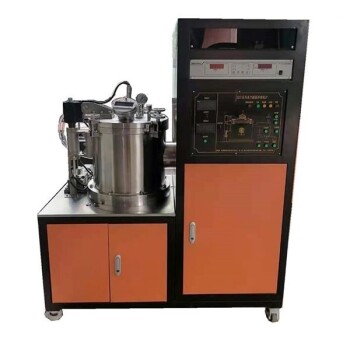
A vacuum high-temperature furnace is essential for the XTO silicification process because it creates the specific environmental conditions required for pure chemical diffusion. By eliminating atmospheric gases, the furnace allows silicon atoms to react directly with refractory metals like molybdenum and tungsten without interference, preventing oxidation and ensuring the formation of a high-quality protective coating.
The vacuum environment acts as a process enabler, transforming a standard heat treatment into a precision chemical reaction that yields a coating with superior adhesion, uniformity, and purity.
The Mechanism of Vacuum Silicification
Removing Chemical Interference
The primary function of the vacuum furnace is to remove impurity gases from the processing chamber. In a standard atmosphere, or even some inert atmospheres, trace gases can interfere with chemical reactions.
By operating in a high-vacuum state, the system minimizes the physical and chemical barriers between the silicon source and the metal substrate.
Preventing High-Temperature Oxidation
Refractory metals, despite their high melting points, are highly susceptible to rapid oxidation when heated.
A vacuum furnace eliminates oxygen from the environment surrounding the product. This prevents the metal substrate from degrading before the protective silicon layer can form.
Facilitating Unobstructed Diffusion
The XTO process relies on the diffusion of silicon atoms into the metal surface. Under vacuum gas-phase conditions, these atoms move freely without colliding with impurity gas molecules.
This unobstructed path allows the silicon to deposit evenly and react chemically with the substrate rather than reacting with contaminants in the air.
Critical Outcomes for Coating Quality
Uniform Deposition
Because the diffusion path is clear of disturbances, the silicon deposition occurs consistently across the entire geometry of the part.
This results in a disilicide protective coating characterized by uniform thickness, which is critical for parts with complex shapes or tight tolerances.
Pure Phase Composition
The absence of contaminants ensures that the reaction produces a "pure phase" composition.
Instead of forming brittle oxides or mixed compounds, the process yields a clean, high-quality silicide layer that performs predictably under stress.
Superior Adhesion
The deep, undisturbed diffusion facilitated by the vacuum creates a metallurgical bond between the coating and the substrate.
This leads to strong adhesion, reducing the risk of the coating delaminating or spalling during thermal cycling or mechanical stress.
The Risks of Alternative Environments
The Threat of Impurity Gases
Without a vacuum, impurity gases act as a barrier to diffusion. They can react with the silicon or the metal substrate, creating weak points in the coating.
Compromised Structural Integrity
Attempting this process in a non-vacuum environment typically results in oxidation. This weakens the refractory metal and prevents the formation of a continuous, protective disilicide layer.
Making the Right Choice for Your Project
The use of a vacuum high-temperature furnace is not just a preference; it is a technical requirement for achieving functional protective coatings on refractory metals.
- If your primary focus is coating longevity: Rely on the vacuum process to ensure strong adhesion and prevent delamination during operation.
- If your primary focus is material performance: Prioritize this method to guarantee a pure phase composition that maintains the refractory metal's inherent thermal strength.
The purity of your processing environment directly dictates the reliability of your final product.
Summary Table:
| Feature of Vacuum Furnace | Impact on XTO Silicification Process | Benefit for Refractory Metals |
|---|---|---|
| High-Vacuum Environment | Eliminates oxygen and impurity gases | Prevents substrate oxidation and degradation |
| Unobstructed Diffusion | Allows free movement of silicon atoms | Ensures uniform coating thickness on complex parts |
| Oxygen-Free Heating | Facilitates direct chemical reaction | Creates a pure-phase disilicide composition |
| Controlled Thermal Cycle | Promotes deep metallurgical bonding | Enhances adhesion and prevents delamination |
Elevate Your Advanced Material Processing with KINTEK
Precision in refractory metal treatment starts with the right environment. KINTEK specializes in high-performance laboratory equipment, offering a comprehensive range of high-temperature vacuum and atmosphere furnaces specifically designed for demanding processes like the XTO silicification treatment.
Our advanced vacuum systems ensure the purity and uniformity your molybdenum or tungsten substrates require for superior oxidation resistance. Beyond heat treatment, our portfolio includes high-temperature high-pressure reactors, crushing and milling systems, and precision hydraulic presses to support your entire material research workflow.
Ready to achieve superior coating adhesion and pure phase composition?
Contact KINTEK Experts Today to find the perfect thermal solution for your lab and ensure the structural integrity of your high-temperature materials.
References
- S. V. Lytovchenko. High-Temperature Silicides: Properties and Application. DOI: 10.26565/2312-4334-2016-3-01
This article is also based on technical information from Kintek Solution Knowledge Base .
Related Products
- Vacuum Heat Treat and Pressure Sintering Furnace for High Temperature Applications
- 2200 ℃ Tungsten Vacuum Heat Treat and Sintering Furnace
- Ultra-High Temperature Graphite Vacuum Graphitization Furnace
- 2200 ℃ Graphite Vacuum Heat Treat Furnace
- Vertical High Temperature Graphite Vacuum Graphitization Furnace
People Also Ask
- What is the purpose of the heat treatment (sintering) step? Engineering Robust Electroactive Membranes
- What is a vacuum sintering furnace? Unlock Purity and Performance in Advanced Materials
- What are some alternative atmospheres to pure hydrogen for powder metallurgy sintering processes? Top Sintering Solutions
- How does the vacuum environment impact sintering of diamond-copper composites? Protect Against Thermal Damage
- Why must green bodies produced via binder jetting undergo treatment in a vacuum sintering furnace?