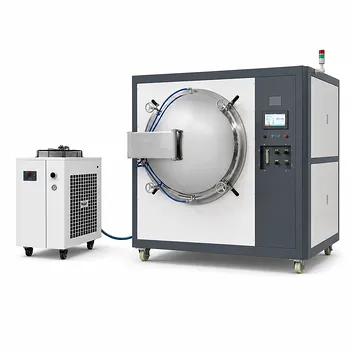
Success in diffusion bonding depends entirely on controlling the interface environment. A vacuum hot press furnace is required because it simultaneously solves two fundamental problems that a conventional furnace cannot: it eliminates oxygen to prevent barrier formation, and it applies massive mechanical pressure to force atomic-level contact.
Diffusion bonding tungsten and copper is not merely about heating materials; it is about merging dissimilar atomic structures. The vacuum hot press furnace is essential because it provides a contaminant-free environment to prevent oxidation and the physical force necessary to crush surface irregularities, ensuring a dense, high-strength bond.
The Critical Role of the Vacuum Environment
A conventional furnace exposes materials to atmospheric gases. For tungsten and copper bonding, this is catastrophic to the process.
Preventing Substrate Oxidation
Tungsten is highly sensitive to oxygen at elevated temperatures. If heated in a standard atmosphere, a tungsten oxide layer forms almost immediately on the substrate surface.
This oxide layer acts as a ceramic barrier. It effectively blocks the migration of atoms between the tungsten and copper, making a strong bond impossible.
Protecting the Reactive Interlayer
The bonding process often utilizes an interlayer, such as an amorphous Fe-W (Iron-Tungsten) alloy, to facilitate the connection. This interlayer is highly reactive.
The vacuum environment, maintained between $10^{-4}$ and $10^{-3}$ Pa, is critical to protecting this interlayer. Without this high vacuum, the interlayer would oxidize, losing its ability to promote adhesion and significantly weakening the final joint strength.
The Necessity of Mechanical Pressure
Heat alone is rarely sufficient to bond high-melting-point metals like tungsten. The "hot press" function of the furnace provides the mechanical element missing from conventional heating.
Overcoming Surface Irregularities
On a microscopic level, even polished metal surfaces are rough, consisting of peaks and valleys. When two pieces of metal touch, they only make contact at the highest peaks.
A vacuum hot press applies continuous mechanical pressure, typically around 30 MPa. This force plastically deforms the materials, flattening the peaks and closing the voids between the tungsten, the interlayer, and the copper.
Disrupting Residual Oxides
Even in a vacuum, slight residual oxide films may persist. The application of mechanical pressure helps to physically disrupt and break up these thin films.
By fracturing these residual layers, the pressure exposes fresh, clean metal surfaces. This allows for the mutual diffusion of atoms across the interface, leading to the formation of a dense solid-solution diffusion layer.
Understanding the Trade-offs
While the vacuum hot press is technically superior for this application, it introduces specific constraints compared to conventional furnaces.
Process Complexity and Throughput
Vacuum hot pressing is a batch process. The time required to pump down the chamber to $10^{-4}$ Pa and apply precise pressure profiles makes it significantly slower than continuous atmospheric belts.
Equipment Cost and Size limitations
The equipment is complex and expensive. The physical size of the parts you can bond is strictly limited by the size of the vacuum chamber and the hydraulic ram, whereas conventional furnaces can often accommodate larger or continuously fed parts.
Making the Right Choice for Your Goal
The choice of furnace dictates the integrity of your component. When working with difficult-to-bond materials like tungsten and copper, the equipment must match the physics of the problem.
- If your primary focus is Bond Strength: You must use a vacuum hot press furnace. The combination of high vacuum (to prevent oxides) and high pressure (30 MPa) is the only reliable way to achieve a dense, structural bond.
- If your primary focus is Cost Reduction: You cannot swap to a conventional furnace for this specific material pair without risking total bond failure. Cost savings must be found in optimizing the cycle time or batch size, not the equipment type.
Ultimately, the vacuum hot press is not an optional upgrade but a fundamental requirement for overcoming the chemical and physical barriers of tungsten-copper diffusion.
Summary Table:
| Feature | Vacuum Hot Press Furnace | Conventional Heating Furnace |
|---|---|---|
| Atmosphere Control | High Vacuum ($10^{-3}$ to $10^{-4}$ Pa) | Atmospheric/Gas Shielding |
| Oxidation Prevention | Eliminates oxygen/ceramic barriers | High risk of tungsten oxide formation |
| Mechanical Force | High Pressure (e.g., 30 MPa) | No applied pressure |
| Surface Contact | Plastically deforms peaks for full contact | Limited to microscopic high points |
| Bond Quality | Dense, high-strength solid solution | Weak or failed joints due to voids |
Upgrade Your Material Joining Precision with KINTEK
Don't let oxidation or surface irregularities compromise your bond integrity. KINTEK specializes in advanced laboratory solutions, providing the high-performance vacuum hot press furnaces and isostatic presses required for challenging applications like tungsten-copper diffusion bonding. Our comprehensive portfolio also includes high-temperature muffle and CVD furnaces, hydraulic presses, and specialized consumables like ceramics and crucibles designed to withstand extreme environments.
Ready to achieve superior joint strength and density? Contact our technical experts today to find the perfect equipment configuration for your research or production needs.
Related Products
- Vacuum Hot Press Furnace Heated Vacuum Press Machine Tube Furnace
- 600T Vacuum Induction Hot Press Furnace for Heat Treat and Sintering
- Vacuum Hot Press Furnace Machine Heated Vacuum Press
- Vacuum Hot Press Furnace Machine for Lamination and Heating
- Vacuum Heat Treat and Pressure Sintering Furnace for High Temperature Applications
People Also Ask
- What advantages does a vacuum hot press furnace provide for LSLBO ceramic electrolytes? Achieve 94% Relative Density
- What role does a Vacuum Hot Press (VHP) furnace play in the densification of austenitic stainless steel 316 composites?
- What are the advantages of using a vacuum hot pressing furnace? Superior Densification for 2024Al/Gr/SiC Composites
- What are the advantages of a vacuum hot press furnace for LTPO solid electrolytes? Boost Density and Conductivity
- What core processing conditions does a vacuum hot press furnace provide? Achieve High-Density Cu-SiC/Diamond Composites