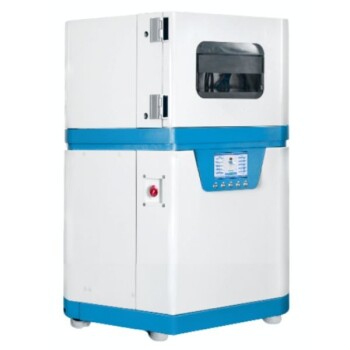
The vacuum environment functions as a dual-purpose control mechanism during the hot pressing of Ag-SnO2-Y2O3 materials. It primarily extracts adsorbed gases from the powder particles to eliminate closed pores, while simultaneously shielding the silver matrix from oxidation to ensure high material purity.
The vacuum environment is essential for achieving maximum density by removing trapped gases and preventing chemical contamination. However, it introduces a specific risk of silver evaporation, necessitating strict adherence to temperature limits during the sintering phase.
Mechanisms of Densification
The application of a vacuum in a hot pressing furnace is not merely about removing air; it is an active participant in the physical consolidation of the material.
Elimination of Adsorbed Gases
Powder particles naturally hold gases on their surfaces. If these gases are not removed prior to or during the pressing stage, they become trapped inside the material.
The vacuum environment extracts these adsorbed gases effectively. This extraction is critical for preventing the formation of closed pores, which are internal voids that significantly reduce the final density and mechanical strength of the composite.
Prevention of Matrix Oxidation
High-temperature operations inherently increase the reactivity of metals. Without a controlled atmosphere, the silver matrix within the Ag-SnO2-Y2O3 composite is susceptible to oxidation.
The vacuum chamber eliminates oxygen from the sintering environment. By preventing oxidation reactions and impurity contamination, the process ensures the purity of the silver matrix is maintained throughout the densification cycle.
Facilitating Grain Diffusion
Densification relies on the adjacent metal powder grains joining together.
The vacuum state promotes this process by providing a clean environment for adhesion and diffusion. By removing surface barriers (like oxides or gas layers), the metal grains can bond more effectively, resulting in a cohesive, high-performance sintered part.
Understanding the Trade-offs
While a vacuum is necessary for density, it creates specific thermodynamic challenges regarding the stability of the silver component.
The Risk of Silver Evaporation
Silver has a relatively high vapor pressure compared to other metals. When placed in a vacuum environment and subjected to high heat, the boiling point of silver effectively decreases.
This increases the risk of the silver matrix evaporating, particularly as the temperature approaches the melting point. Significant evaporation alters the composition of the material and can degrade the furnace components.
Critical Temperature Thresholds
To balance densification against evaporation, precise thermal control is non-negotiable.
The primary constraint is that temperatures must not exceed 950°C. Operating above this threshold in a vacuum significantly accelerates the vaporization of the silver matrix, undermining the structural integrity of the Ag-SnO2-Y2O3 material.
Optimizing Your Sintering Parameters
To achieve the best results with Ag-SnO2-Y2O3 composites, you must balance the benefits of pore removal against the volatility of silver.
- If your primary focus is Maximizing Density: Ensure the vacuum level is sufficient to fully degas the powder particles before the peak temperature is reached to eliminate closed pores.
- If your primary focus is Compositional Integrity: Strictly cap your process temperature at 950°C to prevent the loss of the silver matrix through evaporation.
Successful densification requires a vacuum strong enough to clean the particles, but a thermal profile controlled enough to keep the matrix stable.
Summary Table:
| Feature | Function & Impact |
|---|---|
| Adsorbed Gas Extraction | Removes surface gases to eliminate closed pores and increase density. |
| Oxidation Prevention | Shields the silver matrix from oxygen to maintain high material purity. |
| Grain Diffusion | Removes surface barriers to facilitate bonding and adhesion between powder grains. |
| Silver Volatility Control | Requires strict temperature limits (<950°C) to prevent matrix evaporation. |
| Material Integrity | Ensures a cohesive, high-performance sintered part free of contaminants. |
Elevate Your Material Research with KINTEK
Precision is the foundation of high-performance composites. KINTEK specializes in advanced laboratory equipment designed to meet the rigorous demands of your sintering and densification processes. Whether you are working on Ag-SnO2-Y2O3 materials or specialized metal-matrix composites, our comprehensive range of vacuum hot pressing furnaces, high-temperature furnaces (muffle, tube, vacuum, CVD), and isostatic hydraulic presses provides the exact thermal and atmospheric control you need.
From high-temperature high-pressure reactors and battery research tools to essential ceramics and crucibles, KINTEK delivers the durability and precision required to prevent oxidation, eliminate pores, and ensure compositional integrity.
Ready to optimize your lab’s efficiency and material purity? Contact our technical experts today to find the perfect solution for your research and production needs!
Related Products
- Vacuum Hot Press Furnace Heated Vacuum Press Machine Tube Furnace
- 600T Vacuum Induction Hot Press Furnace for Heat Treat and Sintering
- Vacuum Hot Press Furnace Machine Heated Vacuum Press
- Vacuum Hot Press Furnace Machine for Lamination and Heating
- Vacuum Heat Treat and Pressure Sintering Furnace for High Temperature Applications
People Also Ask
- What advantages does a vacuum hot press furnace provide for LSLBO ceramic electrolytes? Achieve 94% Relative Density
- What role does a Vacuum Hot Press (VHP) furnace play in the densification of austenitic stainless steel 316 composites?
- What are the advantages of using a vacuum hot pressing furnace? Superior Densification for 2024Al/Gr/SiC Composites
- What are the advantages of a vacuum hot press furnace for LTPO solid electrolytes? Boost Density and Conductivity
- What core processing conditions does a vacuum hot press furnace provide? Achieve High-Density Cu-SiC/Diamond Composites