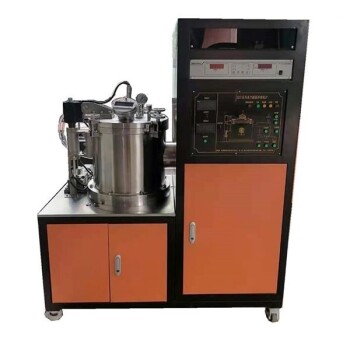
For the preparation of 9-12 wt% Cr experimental alloys, a vacuum induction melting (VIM) furnace is indispensable. It acts as a shield against chemical degradation, utilizing a high-vacuum or controlled atmosphere to prevent the high-temperature oxidation loss of reactive elements like Chromium (Cr), Tungsten (W), and Vanadium (V). Furthermore, it actively removes gaseous impurities such as oxygen and nitrogen, ensuring the final chemical composition aligns strictly with the designed ratios.
Core Takeaway: The VIM furnace is not merely a heat source; it is a purification system. Its primary value lies in decoupling the melting process from atmospheric interference, ensuring that the physical alloy matches the theoretical model required for research.
Preserving Elemental Integrity
Preventing Oxidation Loss
The primary challenge in melting alloys containing 9-12 wt% Chromium is the element's high reactivity. Without protection, Chromium, along with Tungsten and Vanadium, suffers from rapid oxidation at melting temperatures.
A VIM furnace mitigates this by eliminating the oxygen source. This preservation is critical because even a minor loss of Chromium due to oxidation can shift the alloy's composition outside the target 9-12% range, fundamentally altering its properties.
Eliminating Gaseous Impurities
Beyond preventing loss, the VIM process actively cleans the melt. The vacuum environment significantly reduces the concentration of dissolved gases, specifically oxygen and nitrogen.
Lowering these impurities is essential for maintaining the alloy's structural integrity. High levels of retained gases can lead to porosity or the formation of brittle inclusions that compromise the material's mechanical performance.
Achieving Homogeneity and Precision
Electromagnetic Stirring
A distinct advantage of induction melting is the natural electromagnetic stirring of the molten metal. This phenomenon ensures a uniform distribution of all alloying elements throughout the crucible.
For experimental alloys, this uniformity is non-negotiable. It guarantees that a sample taken from one part of the ingot is chemically identical to a sample taken from another, providing a consistent baseline for testing.
Enabling Accurate Modeling
The ultimate goal of creating these experimental alloys is often to link processing variables to material performance. This requires precise chemical composition.
If the actual composition deviates from the design due to oxidation or impurities, the resulting data cannot be used to establish accurate predictive models. The VIM furnace ensures the "input" variables of the experiment remain valid.
Operational Considerations and Trade-offs
Managing High Melting Points
Chromium-based alloys present significant thermal challenges, often possessing melting points 400 to 550°C higher than traditional superalloys.
Consequently, the VIM furnace must be capable of reaching ultra-high temperatures (up to 2200°C). While this capability is essential, it demands robust equipment capable of sustaining these extremes without introducing contaminants from the furnace lining itself.
The Complexity of Atmosphere Control
While VIM is superior for cleanliness, it requires precise management of the vacuum or inert gas (argon) atmosphere.
Inadequate vacuum levels can lead to nitridation or oxide volatilization above 900°C. Therefore, the operator must strictly monitor residual oxygen pressure to prevent the uncontrolled oxidation of highly sensitive components like metallic yttrium, if present.
Making the Right Choice for Your Goal
To determine if VIM is the critical path for your specific project, consider your primary research objectives:
- If your primary focus is fundamental modeling: The VIM furnace is required to guarantee the chemical composition matches your theoretical design, allowing for valid correlations between composition and performance.
- If your primary focus is oxidation resistance: Use VIM to ensure low oxygen content and precise Chromium retention, which are prerequisites for studying oxidation kinetics and minimizing mass changes at extreme temperatures.
- If your primary focus is alloy homogeneity: Rely on the VIM's electromagnetic stirring to prevent segregation of heavy elements like Tungsten, ensuring consistent material properties across the entire ingot.
Precision in the melting phase is the single most critical factor in the success of experimental alloy development.
Summary Table:
| Feature | Benefit for 9-12 wt% Cr Alloys |
|---|---|
| High-Vacuum Environment | Prevents oxidation loss of reactive elements (Cr, W, V) |
| Degassing Capability | Removes oxygen and nitrogen to prevent porosity/brittleness |
| Electromagnetic Stirring | Ensures perfect chemical homogeneity throughout the ingot |
| Ultra-High Temp (2200°C) | Manages high melting points 400-550°C above superalloys |
| Atmosphere Control | Prevents nitridation and oxide volatilization during melting |
Elevate Your Alloy Research with KINTEK Precision
Don’t let atmospheric interference compromise your experimental data. KINTEK specializes in advanced laboratory solutions, offering high-performance vacuum induction melting (VIM) furnaces designed to meet the rigorous thermal and purity demands of 9-12 wt% Cr alloy development.
Our extensive portfolio—from crushing and milling systems to high-temperature high-pressure reactors and specialized crucibles—ensures your lab is equipped for every stage of material science. Partner with KINTEK to achieve unmatched homogeneity and chemical integrity in your research.
Ready to optimize your melting process? Contact our technical experts today to find the perfect furnace for your laboratory.
References
- Osman Mamun, Ram Devanathan. Uncertainty quantification for Bayesian active learning in rupture life prediction of ferritic steels. DOI: 10.1038/s41598-022-06051-8
This article is also based on technical information from Kintek Solution Knowledge Base .
Related Products
- Lab-Scale Vacuum Induction Melting Furnace
- Vacuum Induction Melting Spinning System Arc Melting Furnace
- Vacuum Heat Treat Furnace and Levitation Induction Melting Furnace
- Vacuum Arc Induction Melting Furnace
- Non Consumable Vacuum Arc Induction Melting Furnace
People Also Ask
- How do vacuum induction or arc melting furnaces facilitate the synthesis of U-Al-C MAX phases? Precision Heat & Purity
- Why use VIM for rare earth steel? Essential Precision for Melting Reactive Lanthanum and Cerium
- What types of metals are typically processed in a vacuum induction melting furnace? High-Purity Alloys for Critical Applications
- What is the primary function of a vacuum induction melting furnace in Ni-Mo-Cr-Fe master alloy prep? Ensure High Purity
- What is the function of a vacuum induction melting furnace? Essential Guide for High-Purity FeCrAl Alloy Production