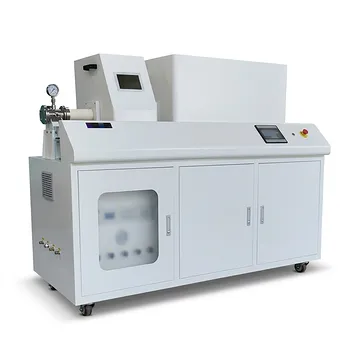
The vertical drop tube furnace is the definitive tool for simulating biomass combustion because it accurately replicates the physical and thermal conditions of industrial-scale boilers. By utilizing a down-flow design, it mimics the specific trajectory of fuel particles as they move under the combined influence of gravity and airflow. This allows researchers to create a realistic reaction environment with stable temperatures between 1100-1150°C.
The device bridges the gap between laboratory theory and industrial reality by creating a reaction environment where temperature, residence time, and particle aerodynamics are precisely controlled to match full-scale combustion systems.
Simulating Real-World Particle Dynamics
To understand biomass combustion, you must replicate how fuel actually moves through a system.
The Role of Gravity and Airflow
In industrial settings, fuel does not sit statically; it travels. The vertical down-flow design is critical because it aligns the airflow with gravity.
This alignment ensures that the simulated trajectory of the fuel particles matches reality. It prevents artificial accumulation that might occur in horizontal setups.
Accurate Residence Time
By controlling the drop height and airflow speed, researchers can define the exact residence time of the particle in the hot zone.
This allows for the precise study of how long a biomass particle takes to burn completely under specific conditions.
Achieving Precise Thermal Conditions
Accurate combustion data requires more than just high heat; it requires stability and uniformity.
High-Temperature Stability
Simulating industrial boilers requires sustaining temperatures between 1100-1150°C.
The vertical drop tube furnace maintains this range rigorously. This ensures the chemical reactions observed in the lab are identical to those occurring in power plants.
Advanced Control Systems
Modern units utilize PID (Proportional-Integral-Derivative) control systems.
These systems offer precision as tight as ±1ºC, preventing thermal fluctuations that could skew data regarding reaction rates or emissions.
Uniform Temperature Zones
The furnace design, often utilizing polycrystalline fiber materials, creates a balanced temperature field.
Excellent temperature uniformity along the tube's length ensures that particles experience consistent heat regardless of their position in the vertical drop.
Critical Research Applications
The physical design of the furnace directly enables specific types of material analysis.
Ash Deposition Analysis
Because the particle trajectory is realistic, the ash deposition patterns generated in the furnace are representative of industrial outcomes.
Researchers can accurately predict where and how fast ash will build up on boiler walls.
High-Temperature Corrosion Studies
Biomass fuels often contain corrosive elements.
The vertical setup provides a realistic reaction space to study high-temperature corrosion on materials, helping engineers select durable alloys for boiler construction.
Sample Quenching Capability
The vertical orientation facilitates rapid cooling mechanisms.
Samples can be suspended in the hot zone and then quickly dropped into a cooling medium, instantly "freezing" the chemical state of the material for analysis.
Understanding the Trade-offs
While highly effective, the vertical drop tube furnace has limitations that must be managed.
Sample Size Limitations
These furnaces are designed for laboratory and industrial research, not mass production.
The tube diameter limits the size of the fuel particles that can be tested, often requiring biomass to be ground to specific mesh sizes before testing.
Complexity of Flow Calibration
Achieving the perfect simulation requires balancing gravity against airflow.
If the airflow is too low, gravity dominates; if too high, it distorts the residence time. Precise calibration is required for valid results.
Making the Right Choice for Your Goal
When designing your experiment, consider how the furnace's capabilities align with your data requirements.
- If your primary focus is Ash Deposition or Corrosion: The vertical drop tube is essential because it replicates the directional flow and impact of particles on surfaces.
- If your primary focus is Reaction Kinetics: The precise PID temperature control (±1ºC) and defined residence times will provide the high-fidelity data needed for kinetic modeling.
- If your primary focus is Laboratory Space: The vertical orientation offers a compact footprint, allowing high-performance testing in smaller facilities.
The vertical drop tube furnace is not just a heater; it is a simulator that transforms static materials into dynamic data points.
Summary Table:
| Feature | Benefit for Biomass Combustion |
|---|---|
| Vertical Down-flow Design | Replicates gravity and industrial particle trajectories |
| Temperature Stability | Maintains 1100-1150°C with ±1ºC PID precision |
| Controlled Residence Time | Enables precise study of particle burn rates and kinetics |
| Rapid Quenching | Allows instant freezing of chemical states for analysis |
| Uniform Heat Zones | Ensures consistent reaction environments for all particles |
Elevate Your Combustion Research with KINTEK
Precision is paramount when bridging the gap between laboratory theory and industrial reality. KINTEK specializes in advanced laboratory equipment, offering high-performance vertical drop tube furnaces, muffle furnaces, and tube furnaces engineered for the rigorous demands of biomass and material science research.
From high-temperature stability (±1ºC) to integrated crushing, milling, and sieving systems for sample preparation, our solutions provide the accuracy your data depends on. Whether you are analyzing ash deposition or conducting high-temperature corrosion studies, KINTEK delivers the durability and control you need.
Ready to optimize your thermal processing? Contact KINTEK today to discuss your custom furnace requirements.
References
- W. Kordylewski, Karol Witkowski. Lab-Scale Investigations During Combustion of Agricultural Residues and Selected Polish Coals. DOI: 10.2478/cpe-2014-0019
This article is also based on technical information from Kintek Solution Knowledge Base .
Related Products
- Vertical Laboratory Tube Furnace
- Vertical High Temperature Graphite Vacuum Graphitization Furnace
- Customer Made Versatile CVD Tube Furnace Chemical Vapor Deposition Chamber System Equipment
- Rotary Tube Furnace Split Multi Heating Zone Rotating Tube Furnace
- Graphite Vacuum Furnace Bottom Discharge Graphitization Furnace for Carbon Materials
People Also Ask
- What is the function of a laboratory vertical tube furnace in microalgae catalytic pyrolysis? Optimize Your Bio-Fuel.
- How does a laboratory tube furnace provide atmospheric control during the sintering of glass-ceramics? Achieve Precision
- How does a laboratory tube furnace provide precise temperature control? Expert Simulation for Steam Cracking
- Why is a laboratory tube furnace required for LMTP0.1/CA materials? Achieve Precise Carbon Coating & Crystal Growth
- What role does a laboratory tube furnace play in the high-temperature calcination of LaPrO3+x catalyst precursors? Guide