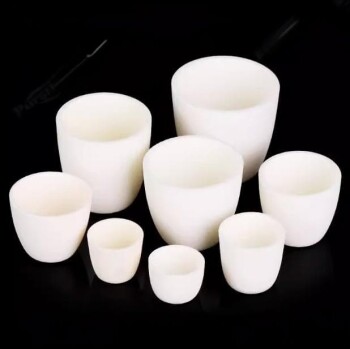
The selection of an alumina crucible is dictated by its superior thermal and chemical stability. Specifically, it is chosen for its high refractoriness and exceptional chemical inertness, which allow it to withstand operating temperatures of 700°C without being eroded by the corrosive nature of the CaCl2-NaCl molten salt system.
Core Takeaway The primary function of the alumina crucible is to act as a non-reactive structural barrier. Its resistance to corrosion prevents the vessel material from dissolving into the molten salt, thereby preventing impurity leaching and ensuring the high purity of the final alloy products.
Thermal and Chemical Resilience
High Refractoriness
The CaCl2-NaCl electrolysis process operates at significant temperatures, typically around 700°C. Alumina ($Al_2O_3$) is a refractory material, meaning it retains its strength and form at temperatures far exceeding this operational requirement.
Resistance to Corrosive Chlorides
Molten chloride salts are notoriously aggressive and can dissolve or erode many standard container materials. Alumina possesses exceptional chemical inertness in this environment. It resists the corrosive attack of the electrolyte, ensuring the vessel does not degrade during the electrolysis process.
Ensuring Product Purity
Preventing Elemental Leaching
The deep need in this process is maintaining the chemical integrity of the electrolyte. Because alumina resists erosion, it prevents the vessel's own components from leaching into the molten salt mixture.
Safeguarding the Alloy
If the crucible were to degrade, impurities would migrate into the electrolyte and contaminate the cathode product. Using alumina ensures that the resulting products, such as nickel-copper alloys, achieve high purity specifications.
Understanding the Trade-offs
The Necessity of High Density
While the material chemistry is correct, the structural density is equally critical. To effectively contain the melt, the alumina crucible must have a high-density structure to prevent the physical penetration of molten salts into the vessel walls.
Managing Thermal Gradients
Although alumina withstands high steady-state temperatures, it is a ceramic material susceptible to thermal shock. The heating and cooling processes must be controlled carefully to prevent cracking, which would compromise the structural foundation of the electrolytic cell.
Making the Right Choice for Your Goal
When designing a molten salt electrolysis system, consider the following based on your specific requirements:
- If your primary focus is product purity: Prioritize alumina for its inertness to ensure no trace elements from the container contaminate your nickel-copper or other alloy outputs.
- If your primary focus is structural longevity: Ensure the crucible specification includes high-density manufacturing to prevent salt penetration and subsequent mechanical failure.
Ultimately, the alumina crucible acts as the silent guardian of the process, maintaining strict separation between the harsh reaction environment and the external world.
Summary Table:
| Feature | Advantage in CaCl2-NaCl Electrolysis |
|---|---|
| High Refractoriness | Maintains structural integrity at 700°C+ operating temperatures |
| Chemical Inertness | Prevents erosion from aggressive molten chloride salts |
| Purity Control | Eliminates elemental leaching into nickel-copper alloy products |
| Material Density | Prevents physical penetration of molten salt into vessel walls |
Optimize Your Molten Salt Electrolysis with KINTEK
Maintaining the integrity of your electrolytic process requires high-performance materials that resist chemical erosion and thermal stress. KINTEK specializes in precision laboratory equipment, providing high-density alumina crucibles, high-temperature furnaces, and specialized electrolytic cells tailored for demanding research and production environments.
Whether you are producing high-purity alloys or conducting advanced battery research, our comprehensive range of high-temperature high-pressure reactors, ceramics, and crushing systems ensures consistent results and equipment longevity. Let our expertise in laboratory consumables and heating solutions safeguard your purity standards.
Ready to upgrade your lab's performance? Contact KINTEK today to find the perfect crucible and equipment solutions for your specific application!
References
- Dan Wang, Xionggang Lu. Electrolysis of Converter Matte in Molten CaCl<sub>2</sub>-NaCl. DOI: 10.4236/msce.2018.62001
This article is also based on technical information from Kintek Solution Knowledge Base .
Related Products
- Arc-Shaped Alumina Ceramic Crucible High Temperature Resistant for Engineering Advanced Fine Ceramics
- Alumina Al2O3 Ceramic Crucible Semicircle Boat with Lid for Engineering Advanced Fine Ceramics
- Engineering Advanced Fine Ceramics Alumina Crucibles (Al2O3) for Thermal Analysis TGA DTA
- Engineering Advanced Fine Ceramics Alumina Al2O3 Crucible With Lid Cylindrical Laboratory Crucible
- Engineering Advanced Fine Alumina Al2O3 Ceramic Crucible for Laboratory Muffle Furnace
People Also Ask
- Why Use Alumina Crucibles & Powder Burial for NaSICON? Ensure Phase Purity and Prevent Elemental Volatilization
- What is the primary purpose of using alumina crucibles for LLTO ceramics? Optimize Your High-Temperature Sintering
- Why are alumina crucibles and mother powder essential for LATP sintering? Optimize Your Solid Electrolyte Performance
- Why are high-purity alumina crucibles used for liquid lead corrosion experiments? Ensure Data Accuracy at 550°C
- Primary considerations for choosing alumina crucibles and quartz tubes in indium intercalation: Ensure Material Purity