Knowledge Why is calendering important? Achieve Superior Fabric Finishing for Your Textiles
Author avatar

Tech Team · Kintek Solution

Updated 6 days ago

Why is calendering important? Achieve Superior Fabric Finishing for Your Textiles


Calendering is a critical finishing process used to intentionally alter the physical properties of a fabric. Its primary functions are to create a smoother surface, impart a specific luster or shine, and significantly improve the fabric's "hand," which is the technical term for how it feels to the touch.

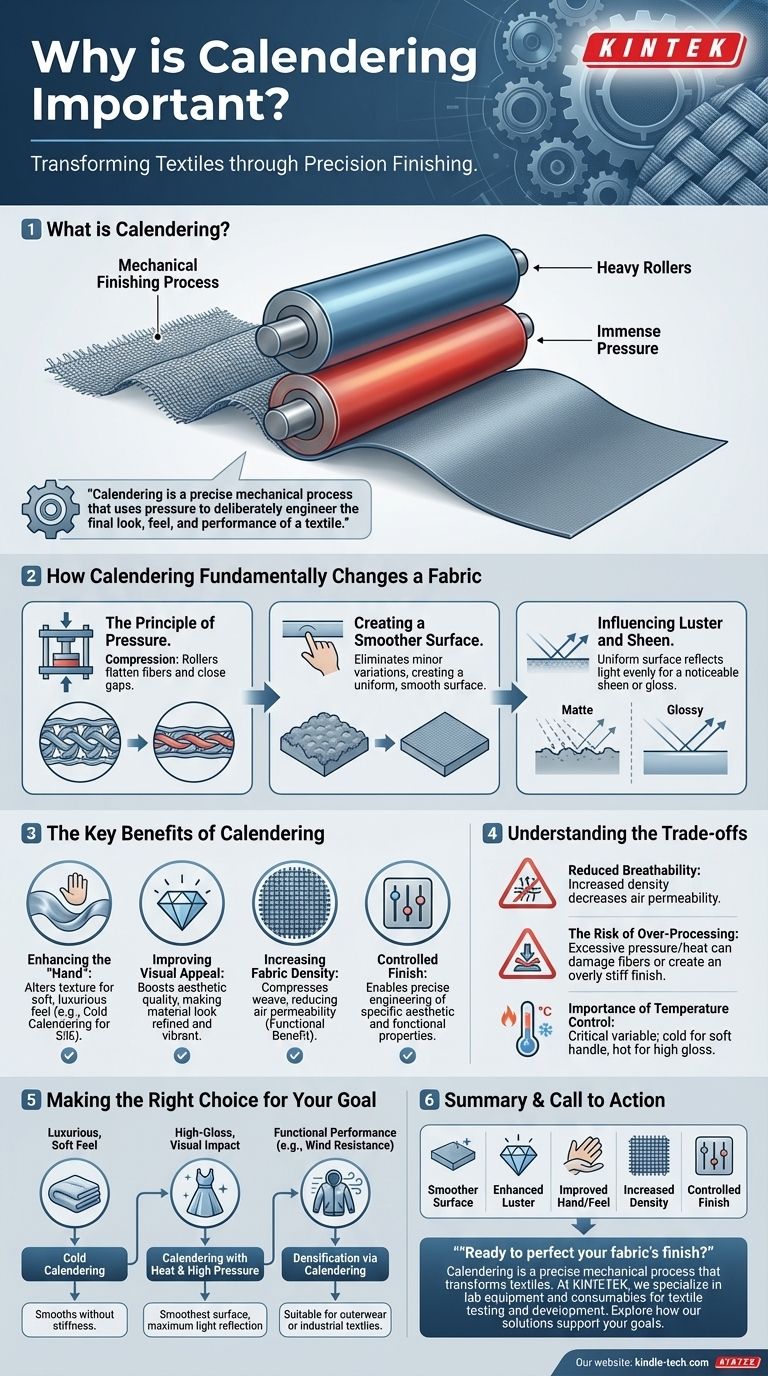
Calendering is not merely a cosmetic step; it is a precise mechanical process that uses pressure to deliberately engineer the final look, feel, and performance of a textile, transforming it from a raw material into a finished product.
Why is calendering important? Achieve Superior Fabric Finishing for Your Textiles

How Calendering Fundamentally Changes a Fabric

Calendering is a mechanical finishing process where fabric is passed between two or more large, heavy rollers. These rollers apply immense pressure, and sometimes heat, to flatten the fibers and yarn within the fabric's weave.

The Principle of Pressure

The core mechanism of calendering is compression. The rollers press the yarns, flattening them and closing the gaps between them in the fabric's structure.

Creating a Smoother Surface

By flattening the individual fibers and the overall weave, the calendering process eliminates minor surface variations. This results in a much smoother, more uniform fabric surface.

Influencing Luster and Sheen

A fabric's luster is determined by how it reflects light. A rough, uncalendered surface scatters light in many directions, appearing matte. A smooth, calendered surface reflects light more uniformly, creating a noticeable sheen or gloss.

The Key Benefits of Calendering

The changes made during calendering produce specific, desirable outcomes that are crucial for a fabric's intended application.

Enhancing the "Hand" or Feel

The term "hand" or "handle" refers to the tactile qualities of a fabric. Calendering directly influences this by altering the texture.

For example, silk is often calendered in a cold state. This process smooths the fibers without making them stiff, resulting in the soft, luxurious handle for which silk is known.

Improving Visual Appeal

Beyond just feel, the process significantly boosts a fabric's aesthetic quality. The light luster created by the smooth surface makes the material look more refined, vibrant, and expensive.

Increasing Fabric Density

A direct result of compressing the fibers is an increase in fabric density. This can be a purely aesthetic choice or a functional one, as it often leads to reduced air permeability, making the fabric more resistant to wind.

Understanding the Trade-offs

While highly effective, the calendering process involves important considerations and potential downsides that must be managed.

Reduced Breathability

The same compression that increases density and smoothness also reduces the space between fibers. This can significantly decrease the fabric's breathability, which may be undesirable for certain types of apparel.

The Risk of Over-Processing

Applying excessive pressure or heat can damage delicate fibers. It can also create an overly stiff or plastic-like finish, permanently ruining the fabric's desired hand and appearance.

The Importance of Temperature Control

As the example with silk illustrates, temperature is a critical variable. Cold calendering produces a soft handle, while hot calendering (not mentioned for silk) is used on other fabrics to create a much higher gloss and a stiffer finish. The choice depends entirely on the desired outcome.

Making the Right Choice for Your Goal

The decision to calender a fabric and the specific method used should always be driven by the end goal for the product.

  • If your primary focus is a luxurious, soft feel: Cold calendering is often the best choice, as it smooths the fabric without creating stiffness.
  • If your primary focus is a high-gloss, visual impact: Calendering with heat and high pressure will create the smoothest possible surface for maximum light reflection.
  • If your primary focus is functional performance like wind resistance: The densification from calendering can be a key benefit, making it suitable for outerwear or industrial textiles.

Ultimately, calendering provides precise control, allowing manufacturers to transform a standard textile into a material with specific aesthetic and tactile qualities.

Summary Table:

Key Benefit Description
Smoother Surface Flattens fibers to eliminate variations and create a uniform finish.
Enhanced Luster Reflects light uniformly for a noticeable sheen or gloss.
Improved Hand/Feel Alters tactile qualities for a softer or more luxurious texture.
Increased Density Compresses weave to boost wind resistance and reduce permeability.
Controlled Finish Uses pressure and heat to engineer specific aesthetic and functional properties.

Ready to perfect your fabric's finish? Calendering is a precise mechanical process that transforms textiles from raw materials into high-performance products. At KINTEK, we specialize in lab equipment and consumables for textile testing and development, helping you achieve the exact look, feel, and durability your fabrics need. Whether you're focusing on luxurious softness, high-gloss visuals, or functional wind resistance, our solutions support your goals. Contact us today to explore how KINTEK can enhance your textile finishing processes!

Visual Guide
Why is calendering important? Achieve Superior Fabric Finishing for Your Textiles Visual Guide

Related Products

People Also Ask

Related Products

Lab Plastic PVC Calender Stretch Film Casting Machine for Film Testing

Lab Plastic PVC Calender Stretch Film Casting Machine for Film Testing

The cast film machine is designed for the molding of polymer cast film products and has multiple processing functions such as casting, extrusion, stretching, and compounding.

Powerful Plastic Crusher Machine

Powerful Plastic Crusher Machine

KINTEK's powerful plastic crusher machines process 60-1350 KG/H of diverse plastics, ideal for labs and recycling. Durable, efficient, and customizable.

Metallographic Specimen Mounting Machine for Laboratory Materials and Analysis

Metallographic Specimen Mounting Machine for Laboratory Materials and Analysis

Precision metallographic mounting machines for labs—automated, versatile, and efficient. Ideal for sample prep in research and quality control. Contact KINTEK today!

Precision Wire Saw Laboratory Cutting Machine with 800mm x 800mm Workbench for Diamond Single Wire Circular Small Cutting

Precision Wire Saw Laboratory Cutting Machine with 800mm x 800mm Workbench for Diamond Single Wire Circular Small Cutting

Diamond wire cutting machines are mainly used for precision cutting of ceramics, crystals, glass, metals, rocks, thermoelectric materials, infrared optical materials, composite materials, biomedical materials and other material analysis samples. Especially suitable for precision cutting of ultra-thin plates with thickness up to 0.2mm.

12 Inch 24 Inch High Precision Automatic Diamond Wire Cutting Machine Laboratory Saw Precision Wire EDM Cutting Machine

12 Inch 24 Inch High Precision Automatic Diamond Wire Cutting Machine Laboratory Saw Precision Wire EDM Cutting Machine

The high precision automatic diamond wire cutting machine is a versatile cutting tool that uses a diamond wire to cut through a wide range of materials, including conductive and non-conductive materials, ceramics, glass, rocks, gems, jade, meteorites, monocrystalline silicon, silicon carbide, polycrystalline silicon, refractory bricks, epoxy boards, and ferrite bodies. It is especially suitable for cutting various brittle crystals with high hardness, high value, and easy to break.

Liquid Nitrogen Cryogenic Grinder Mill Cryomill Airflow Ultrafine Pulverizer

Liquid Nitrogen Cryogenic Grinder Mill Cryomill Airflow Ultrafine Pulverizer

Discover the Liquid Nitrogen Cryogenic Grinding Machine, perfect for lab use, ultra-fine pulverization, and preserving material properties. Ideal for pharmaceuticals, cosmetics, and more.

Single Punch Tablet Press Machine and Mass Production Rotary Tablet Punching Machine for TDP

Single Punch Tablet Press Machine and Mass Production Rotary Tablet Punching Machine for TDP

Rotary tablet punching machine is an automatic rotating and continuous tableting machine. It is mainly used for tablet manufacturing in the pharmaceutical industry, and is also suitable for industrial sectors such as food, chemicals, batteries, electronics, ceramics, etc. to compress granular raw materials into tablets.

Inclined Rotary Plasma Enhanced Chemical Vapor Deposition PECVD Equipment Tube Furnace Machine

Inclined Rotary Plasma Enhanced Chemical Vapor Deposition PECVD Equipment Tube Furnace Machine

Introducing our inclined rotary PECVD furnace for precise thin film deposition. Enjoy automatic matching source, PID programmable temperature control, and high accuracy MFC mass flowmeter control. Built-in safety features for peace of mind.

Laboratory Sterilizer Lab Autoclave Herbal Powder Sterilization Machine for Plant

Laboratory Sterilizer Lab Autoclave Herbal Powder Sterilization Machine for Plant

The herbal powder sterilization autoclave machine for Chinese medicine uses saturated steam for effective sterilization. It utilizes the heat and penetrative properties of steam, achieves sterilization after heat preservation, and maintains a good drying effect with a dedicated drying system.

Touchscreen Automatic Vacuum Heat Press

Touchscreen Automatic Vacuum Heat Press

Precision vacuum heat press for labs: 800°C, 5-ton pressure, 0.1MPa vacuum. Ideal for composites, solar cells, aerospace.

Lab Blown Film Extrusion Three Layer Co-Extrusion Film Blowing Machine

Lab Blown Film Extrusion Three Layer Co-Extrusion Film Blowing Machine

Lab blown film extrusion is mainly used to detect the feasibility of film blowing of polymer materials and the colloid condition in the materials, as well as the dispersion of colored dispersions, controlled mixtures, and extrudates;

Single Punch Electric Tablet Press Machine TDP Tablet Punching Machine

Single Punch Electric Tablet Press Machine TDP Tablet Punching Machine

The electric tablet punching machine is a laboratory equipment designed for pressing various granular and powdery raw materials into discs and other geometric shapes. It is commonly used in pharmaceutical, healthcare products, food, and other industries for small batch production and processing. The machine is compact, lightweight, and easy to operate, making it suitable for use in clinics, schools, laboratories, and research units.

Single Punch Electric Tablet Press Machine Laboratory Powder Tablet Punching TDP Tablet Press

Single Punch Electric Tablet Press Machine Laboratory Powder Tablet Punching TDP Tablet Press

The single-punch electric tablet press is a laboratory-scale tablet press suitable for corporate laboratories in pharmaceutical, chemical, food, metallurgical and other industries.

Laboratory Vibratory Sieve Shaker Machine for Dry and Wet Three-Dimensional Sieving

Laboratory Vibratory Sieve Shaker Machine for Dry and Wet Three-Dimensional Sieving

KT-VD200 can be used for sieving tasks of dry and wet samples in the laboratory. The screening quality is 20g-3kg. The product is designed with a unique mechanical structure and an electromagnetic vibrating body with a vibration frequency of 3000 times per minute.

High Energy Planetary Ball Mill Machine for Laboratory Horizontal Tank Type

High Energy Planetary Ball Mill Machine for Laboratory Horizontal Tank Type

The KT-P2000H uses a unique Y-axis planetary trajectory, and utilizes the collision, friction and gravity between the sample and the grinding ball.

Small Injection Molding Machine for Lab Use

Small Injection Molding Machine for Lab Use

The small injection molding machinehas fast and stable movements; good controllability and repeatability, super energy saving; the product can be automatically dropped and formed; the machine body is low, convenient for feeding, easy to maintain, and no height restrictions on the installation site.

High Precision Diamond Wire Cutting Machine Laboratory Saw Precision Wire EDM Cutting Machine

High Precision Diamond Wire Cutting Machine Laboratory Saw Precision Wire EDM Cutting Machine

The high precision diamond wire cutting machine is a versatile and precise cutting tool designed specifically for material researchers. It utilizes a continuous diamond wire cutting mechanism, enabling precise cutting of brittle materials such as ceramics, crystals, glass, metals, rocks, and various other materials.

Mini Planetary Ball Mill Machine for Laboratory Milling

Mini Planetary Ball Mill Machine for Laboratory Milling

Discover the KT-P400 desktop planetary ball mill, ideal for grinding and mixing small samples in the lab. Enjoy stable performance, long service life, and practicality. Functions include timing and overload protection.

Double Plate Heating Press Mold for Lab

Double Plate Heating Press Mold for Lab

Discover precision in heating with our Double Plate Heating Mold, featuring high-quality steel and uniform temperature control for efficient lab processes. Ideal for various thermal applications.

Manual Heated Hydraulic Press Machine with Heated Plates for Laboratory Hot Press

Manual Heated Hydraulic Press Machine with Heated Plates for Laboratory Hot Press

The Manual Heat Press is a versatile piece of equipment suitable for a variety of applications, operated by a manual hydraulic system that applies controlled pressure and heat to the material placed on the piston.


Leave Your Message