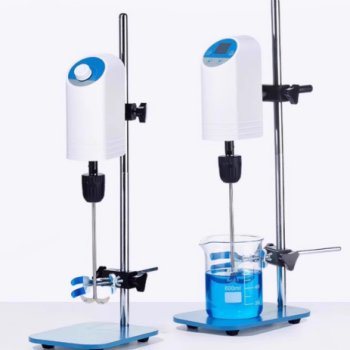
High-speed stirring is essential because it generates the intense fluid shear forces necessary to properly disperse carbon nanotubes within a solution. Without this high velocity (e.g., 1500 rpm), nanotubes tend to clump together, which drastically reduces their effectiveness in capturing heavy metal ions.
Core Takeaway Standard mixing is often insufficient for nanomaterials. High-speed mechanical action is required to overcome particle agglomeration and mass transfer resistance, significantly shortening the time needed to reach adsorption equilibrium.
The Mechanics of Dispersion
Generating Shear Force
To maximize efficiency, you must break apart particle clusters. High-speed rotation creates intense fluid shear forces that physically separate carbon nanotubes.
Ensuring Uniform Distribution
Once separated, these fine particles become highly dispersed throughout the aqueous solution. This prevents the nanotubes from settling or sticking together, keeping their active sites available for reaction.
Enhancing Reaction Kinetics
Increasing Collision Frequency
Dispersion is only the first step; contact is the goal. High-speed stirring increases the collision frequency between the carbon nanotube surfaces and the target heavy metal ions.
Accelerating Equilibrium
By maximizing these collisions, the system reaches its end goal faster. The enhanced mass transfer process significantly reduces the time required to reach adsorption equilibrium, ensuring pollutants are removed efficiently in a short duration.
Overcoming Physical Barriers
Breaking Film Resistance
Adsorption is not just about surface contact; it involves crossing physical barriers. Mechanical power helps overcome mass transfer resistance specifically at the liquid-solid interface.
Promoting Pore Diffusion
Beyond surface contact, ions often need to penetrate the material. Vigorous stirring drives the diffusion of ions into the internal pores of the adsorbent, ensuring the full capacity of the nanotube is utilized.
Critical Considerations and Trade-offs
Temperature Control
While high-speed stirring provides necessary mechanical power, it introduces energy into the system. It is vital to maintain a constant reaction temperature to ensure the accuracy of adsorption kinetics data, as fluctuating temperatures can skew results.
Making the Right Choice for Your Experiment
To ensure your carbon nanotube experiments yield accurate and efficient results, align your equipment settings with your specific data needs.
- If your primary focus is process efficiency: Prioritize high RPM settings (e.g., 1500 rpm) to maximize shear forces and minimize the time to reach equilibrium.
- If your primary focus is kinetic accuracy: Ensure your high-speed device is paired with a temperature control mechanism to prevent mechanical heat from altering diffusion rates.
Effective adsorption relies on the balance between maximizing physical contact through speed and maintaining a controlled environment.
Summary Table:
| Factor | Impact of High-Speed Stirring (e.g., 1500 rpm) | Benefit to Experiment |
|---|---|---|
| Particle State | Generates intense fluid shear forces | Breaks clusters and prevents agglomeration |
| Kinetics | Increases collision frequency between ions and nanotubes | Accelerates time to reach adsorption equilibrium |
| Mass Transfer | Reduces liquid-solid film resistance | Facilitates faster ion diffusion into internal pores |
| Uniformity | Ensures high dispersion throughout the solution | Maximizes available active surface area for adsorption |
Maximize Your Nanomaterial Research Precision
To achieve consistent and scalable results in carbon nanotube adsorption, your laboratory requires high-performance equipment capable of maintaining intense shear forces while ensuring thermal stability. KINTEK specializes in advanced laboratory solutions designed for rigorous research environments. From high-speed homogenizers and shakers for perfect dispersion to cooling solutions (ULT freezers, cold traps) and high-temperature reactors for precise environment control, we provide the tools you need to overcome mass transfer resistance and enhance reaction kinetics.
Ready to elevate your experiment efficiency? Contact KINTEK today to explore our comprehensive range of crushing, milling, and high-speed mixing systems tailored for cutting-edge material science.
References
- Deysi Dueñas-Muñoz, Theofilos Toulkeridis. Sustainable Treatment Techniques for Emerging Pollutants—The Case of Personal Hygiene Products. DOI: 10.3390/app12136330
This article is also based on technical information from Kintek Solution Knowledge Base .
Related Products
- High Performance Laboratory Stirrers for Diverse Applications
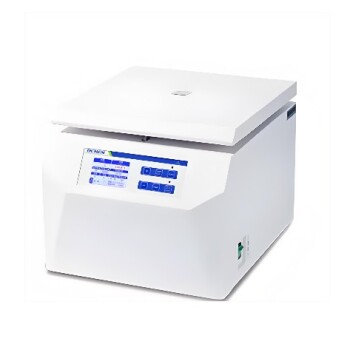
- High-Speed Desktop Centrifuge for Blood Sample Processing
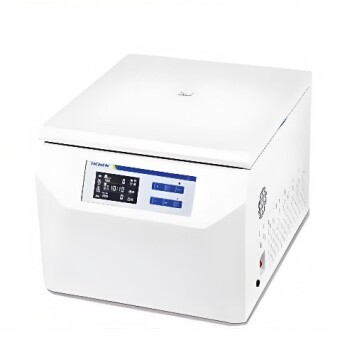
- Benchtop High Speed Small Lab Centrifuge for Serum Separation and Low Temperature Dehydration
- Laboratory Small Constant Temperature Heated Magnetic Stirrer Heater and Stirrer
- Laboratory Benchtop High Speed Small Centrifuge for Low Temp Serum Separation Dehydration Research
People Also Ask
- How does a laboratory stirrer influence MOF product quality? Master Precision in Non-Solvothermal Synthesis
- What critical role does a Laboratory Stirrer play during leaching? Enhance Titanium-Magnesium Waste Recovery
- What is the primary function of laboratory stirring equipment in the preparation of compost leachate? Optimize Extraction
- What is a laboratory mixer? A Guide to Achieving Perfect Sample Homogeneity
- What is a laboratory mixer used for? Choose the Right Tool for Liquids or Solids