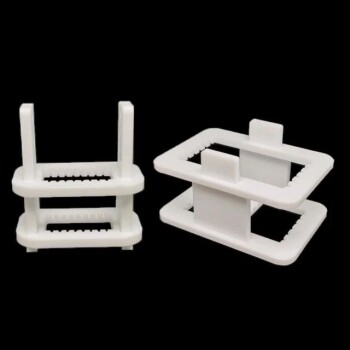
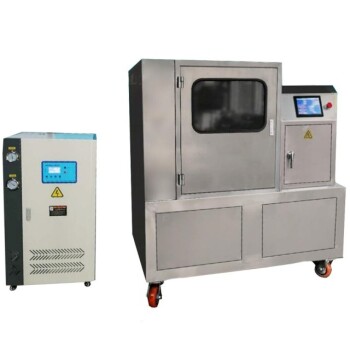
Industrial ultrasonic cleaning provides the microscopic level of surface purity essential for successful plasma nitriding. By utilizing the cavitation effect, this equipment removes deep-seated contaminants like cutting fluids and grease that standard cleaning methods often miss. Without this specific preparation, the nitriding process will likely fail to produce a durable, uniform surface layer on UNS S32750 welded joints.
Plasma nitriding is not just a coating; it is a chemical diffusion process that requires an unobstructed interface. Ultrasonic cleaning removes the microscopic barriers that prevent nitrogen atoms from uniformly penetrating the steel, ensuring the structural integrity of the treated joint.
The Mechanics of Decontamination
The Power of the Cavitation Effect
Industrial ultrasonic cleaners operate by generating high-frequency sound waves in a liquid medium. This creates cavitation, a phenomenon where microscopic bubbles rapidly form and collapse.
The energy released by these collapsing bubbles acts like millions of microscopic scrubbers. This physical force dislodges contaminants from complex surface geometries that are typical in welded joints.
Targeting Specific Contaminants
Welding and machining processes leave behind distinct residues, particularly cutting fluids, grease, and trace mechanical impurities.
These substances often adhere tenaciously to the metal surface. Ultrasonic cleaning effectively strips these layers away, exposing the raw substrate required for subsequent treatment.
Critical Impacts on Plasma Nitriding
Enabling Uniform Nitrogen Diffusion
For plasma nitriding to work, nitrogen atoms must diffuse into the crystal lattice of the UNS S32750 stainless steel.
An extremely clean surface is a strict prerequisite for this interaction. If contaminants remain, they act as a shield, blocking the nitrogen and resulting in a patchy or ineffective diffusion layer.
Preventing Structural Defects
A major risk in surface hardening is the failure of the hardened layer itself. Surface contamination is a primary cause of peeling or unevenness in the nitrided layer.
By ensuring a continuous, defect-free diffusion layer through ultrasonic cleaning, the mechanical properties of the welded joint are preserved and enhanced.
Understanding the Risks of Inadequate Preparation
The Limitations of Manual Cleaning
Standard washing or manual wiping often smears grease rather than removing it, or fails to reach into microscopic surface pores.
In the context of plasma nitriding, "visually clean" is often insufficient. The surface must be chemically clean to allow for the pure interaction of the substrate and the nitrogen plasma.
The Cost of Process Failure
Skipping the ultrasonic cleaning step introduces a high variable of risk. If the diffusion layer is compromised by hidden grease, the part may fail under stress.
This leads to wasted materials and the need to rework expensive components. The precision of the cleaning method must match the precision of the hardening process.
Optimizing Your Surface Preparation Strategy
To ensure the longevity and performance of your UNS S32750 components, consider these priorities:
- If your primary focus is Layer Adhesion: Prioritize ultrasonic cleaning to remove all grease and fluids, as these are the main drivers of layer peeling and delamination.
- If your primary focus is Process Consistency: Use ultrasonic equipment to ensure every square millimeter of the welded joint receives the same level of cleaning, guaranteeing uniform nitrogen diffusion.
The quality of your final nitrided surface is determined entirely by the quality of your initial surface preparation.
Summary Table:
| Feature | Ultrasonic Cleaning Impact | Benefit for Plasma Nitriding |
|---|---|---|
| Contaminant Removal | Eliminates grease, cutting fluids, and microscopic residues | Provides an unobstructed interface for chemical diffusion |
| Cleaning Mechanism | High-frequency cavitation (microscopic scrubbing) | Reaches complex geometries of welded joints effectively |
| Surface Purity | Achieves chemical-level cleanliness | Prevents peeling and unevenness of the hardened layer |
| Process Integrity | Ensures uniform surface preparation | Guarantees consistent nitrogen atom penetration |
Maximize the Integrity of Your Materials with KINTEK
Don’t let surface contamination compromise your high-performance alloys. KINTEK specializes in advanced laboratory and industrial solutions, providing the precision ultrasonic cleaning systems and crushing/milling equipment necessary to prepare your UNS S32750 joints for flawless plasma nitriding.
Our extensive portfolio—from high-temperature furnaces and vacuum systems to high-pressure reactors and essential laboratory consumables—is designed to support researchers and engineers in achieving superior surface hardening and material durability.
Ready to elevate your process consistency and prevent costly failures? Contact our technical experts today to find the perfect equipment for your facility.
References
- Ferdinando Marco Rodrigues Borges, Rômulo Ríbeiro Magalhães de Sousa. Corrosion Resistance and Microstructural Evaluation of a Plasma Nitrided Weld Joint of UNS S32750 Super Duplex Stainless Steel. DOI: 10.1590/1980-5373-mr-2021-0087
This article is also based on technical information from Kintek Solution Knowledge Base .
Related Products
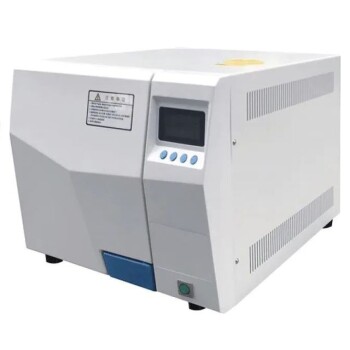
- Laboratory Sterilizer Lab Autoclave Pulse Vacuum Lifting Sterilizer
- Desktop Fast Laboratory Autoclave Sterilizer 20L 24L for Lab Use
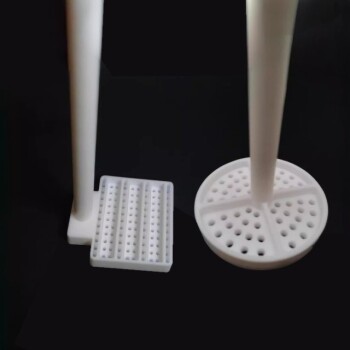
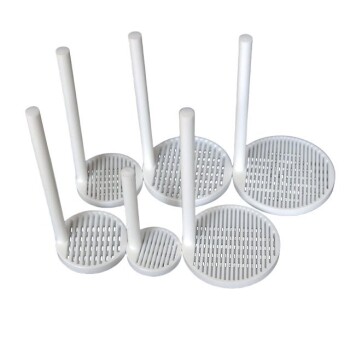
- Custom PTFE Teflon Parts Manufacturer Corrosion Resistant Cleaning Rack Flower Basket
- Laboratory Sterilizer Lab Autoclave Pulsating Vacuum Desktop Steam Sterilizer
- Desktop Fast Laboratory Autoclave Sterilizer 35L 50L 90L for Lab Use
People Also Ask
- What is the primary function of a laboratory sterilization autoclave? Master the Physics of Wet Heat Sterilization
- What precautions should be taken during autoclave in laboratory? A Complete Safety Guide to Prevent Burns and Explosions
- What extreme conditions does a laboratory autoclave simulate? Testing Wear Resistance of Nuclear Fuel Cladding
- What role does a laboratory autoclave play in HEA corrosion research? Key to Validating Advanced Reactor Materials
- Why is a laboratory autoclave necessary for Postgate Medium B (PMB)? Ensure Pure SRB Cultures & Accurate MIC Research