Knowledge Why is it necessary to grind LAGP samples before XRD? Eliminate Preferred Orientation for Accurate Phase Analysis
Author avatar

Tech Team · Kintek Solution

Updated 4 days ago

Why is it necessary to grind LAGP samples before XRD? Eliminate Preferred Orientation for Accurate Phase Analysis


Obtaining reliable crystallographic data depends entirely on the physical state of your sample. You must grind Lithium Aluminum Germanium Phosphate (LAGP) into an extremely fine powder to eliminate preferred orientation effects, which occur when crystal grains align non-randomly. This grinding process ensures a truly random distribution of grains, enabling the X-ray diffraction (XRD) instrument to record accurate peak intensities and clear shapes for precise structural analysis.

The validity of your XRD analysis relies on statistical randomness. By reducing dense LAGP samples to a fine powder, you prevent directional bias from distorting the diffraction pattern, ensuring that the data accurately reflects the material's phase purity and structural integrity.

The Physics of Diffraction Accuracy

Eliminating Preferred Orientation

XRD analysis assumes that the crystallites in your sample are oriented in every possible direction with equal probability. If LAGP particles are too coarse, they may align along specific crystallographic planes.

This alignment, known as preferred orientation, causes certain diffraction peaks to appear artificially intense while others disappear. Grinding the sample into a fine powder disrupts this alignment, forcing the necessary randomization.

Ensuring Accurate Peak Intensities

To determine the crystal phase purity of LAGP, you must compare your observed peak intensities against standard reference patterns.

If the grains are not randomly distributed, the intensity ratios will be incorrect. Fine grinding ensures that the recorded intensities are genuine, allowing you to correctly identify the phases present.

Tracking Structural Changes

LAGP materials often undergo structural evolution during various heat treatment stages. Accurate XRD patterns are required to map these subtle changes.

High-quality powder samples produce sharp, clear peak shapes. This clarity allows for the precise detection of lattice parameter shifts or the emergence of secondary phases during thermal processing.

Handling SPS-Synthesized Samples

Breaking Down Dense Blocks

LAGP samples synthesized via Spark Plasma Sintering (SPS) are typically produced as highly dense, cylindrical blocks.

These blocks cannot be analyzed effectively in their bulk form for phase composition. You must use a mortar or ball mill to physically crush these sintered bodies into a powder to interrogate the bulk material structure rather than just the surface.

Removing Surface Contamination

The SPS process often leaves a layer of residual carbon contamination on the surface of the sample.

Scanning the sample without removing this layer can introduce artifacts into your data. Grinding or polishing the outer surface is a necessary step to strip away this carbon, ensuring the XRD data represents the actual LAGP material and not synthesis byproducts.

Common Pitfalls to Avoid

The Risk of Micro-Absorption

While grinding is essential, inconsistent particle size can lead to micro-absorption problems.

If the powder is not ground uniformly, larger particles may absorb X-rays differently than smaller ones. This creates contrast variation that can be mistaken for structural anomalies.

Equipment Contamination

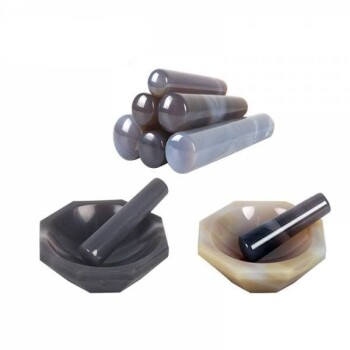
The prompt specifically notes the use of an agate mortar.

Using softer or reactive grinding media can introduce impurities into your LAGP sample. Agate is preferred because it is hard and chemically inert, preventing the grinding tool itself from contaminating the sample and skewing the phase analysis.

Making the Right Choice for Your Goal

To ensure your characterization supports your research objectives, apply the following preparation strategies:

  • If your primary focus is Phase Purity: Grind the sample until it is an ultra-fine, uniform powder to ensure peak intensities are accurate and free from orientation bias.
  • If your primary focus is Analyzing SPS Samples: Ensure you polish or grind away the outer surface first to remove carbon residues before crushing the bulk material.

Strict adherence to sample preparation protocols transforms XRD from a rough estimation tool into a precision instrument.

Summary Table:

Preparation Factor Impact on XRD Results Recommended Solution
Particle Size Coarse grains cause intensity errors Grind to ultra-fine powder
Grain Orientation Preferred orientation masks true phases Randomize via agate mortar/ball mill
SPS Surface Carbon contamination & density bias Surface polishing & bulk crushing
Equipment Choice Material contamination Use chemically inert Agate or Ball Mills

Elevate Your LAGP Research with Precision Sample Preparation

Achieving publication-quality XRD data starts with the right equipment. KINTEK specializes in high-performance laboratory solutions designed to ensure your materials are processed without contamination or structural bias.

Whether you are breaking down dense Spark Plasma Sintering (SPS) blocks or aiming for ultra-fine powder consistency, our premium crushing and milling systems, including high-purity agate mortars and planetary ball mills, provide the reliability you need.

Our Expertise Includes:

  • Milling & Grinding: Advanced systems for uniform particle size reduction.
  • Sintering Solutions: High-temperature furnaces (muffle, vacuum, and tube) for LAGP synthesis.
  • Lab Consumables: Chemically inert crucibles and PTFE products to maintain sample purity.

Don't let sample preparation errors compromise your crystallographic analysis. Contact KINTEK today to discover how our specialized equipment can enhance your lab's efficiency and accuracy!

Related Products

People Also Ask

Related Products

High Energy Planetary Ball Mill for Laboratory Horizontal Tank Type Milling Machine

High Energy Planetary Ball Mill for Laboratory Horizontal Tank Type Milling Machine

KT-P4000H uses the unique Y-axis planetary motion trajectory, and utilizes the collision, friction and gravity between the sample and the grinding ball to have a certain anti-sinking ability, which can obtain better grinding or mixing effects and further improve the sample output.

High Energy Planetary Ball Mill Milling Machine for Laboratory

High Energy Planetary Ball Mill Milling Machine for Laboratory

The biggest feature is that the high energy planetary ball mill can not only perform fast and effective grinding, but also has good crushing ability

High Energy Planetary Ball Mill Milling Machine for Laboratory

High Energy Planetary Ball Mill Milling Machine for Laboratory

Experience fast and effective sample processing with the F-P2000 high-energy planetary ball mill. This versatile equipment offers precise control and excellent grinding capabilities. Perfect for laboratories, it features multiple grinding bowls for simultaneous testing and high output. Achieve optimal results with its ergonomic design, compact structure, and advanced features. Ideal for a wide range of materials, it ensures consistent particle size reduction and low maintenance.

Laboratory Ten-Body Horizontal Jar Mill for Lab Use

Laboratory Ten-Body Horizontal Jar Mill for Lab Use

The Ten-body horizontal jar mill is for 10 ball mill pots (3000ml or less). It has frequency conversion control, rubber roller movement, and PE protective cover.

Laboratory Test Sieves and Vibratory Sieve Shaker Machine

Laboratory Test Sieves and Vibratory Sieve Shaker Machine

Efficiently process powders, granules, and small blocks with a high-frequency vibration sieve. Control vibration frequency, screen continuously or intermittently, and achieve accurate particle size determination, separation, and classification.

Laboratory Jaw Crusher

Laboratory Jaw Crusher

Discover the small jaw crusher for efficient, flexible, and affordable crushing in labs and small mines. Ideal for coal, ores, and rocks. Learn more now!

Heated Hydraulic Press Machine with Integrated Manual Heated Plates for Lab Use

Heated Hydraulic Press Machine with Integrated Manual Heated Plates for Lab Use

Efficiently process heat-pressing samples with our Integrated Manual Heated Lab Press. With a heating range up to 500°C, it's perfect for various industries.

Twin Screw Extruder Plastic Granulation Machine

Twin Screw Extruder Plastic Granulation Machine

Twin screw extruder plastic granulation machine is designed for the mixing and processing experiments of engineering plastics, modified plastics, waste plastics and masterbatches.

Laboratory Vibratory Sieve Shaker Machine for Dry and Wet Three-Dimensional Sieving

Laboratory Vibratory Sieve Shaker Machine for Dry and Wet Three-Dimensional Sieving

KT-VD200 can be used for sieving tasks of dry and wet samples in the laboratory. The screening quality is 20g-3kg. The product is designed with a unique mechanical structure and an electromagnetic vibrating body with a vibration frequency of 3000 times per minute.

Metallographic Specimen Mounting Machine for Laboratory Materials and Analysis

Metallographic Specimen Mounting Machine for Laboratory Materials and Analysis

Precision metallographic mounting machines for labs—automated, versatile, and efficient. Ideal for sample prep in research and quality control. Contact KINTEK today!

Ultra-High Temperature Graphite Vacuum Graphitization Furnace

Ultra-High Temperature Graphite Vacuum Graphitization Furnace

The ultra-high temperature graphitization furnace utilizes medium frequency induction heating in a vacuum or inert gas environment. The induction coil generates an alternating magnetic field, inducing eddy currents in the graphite crucible, which heats up and radiates heat to the workpiece, bringing it to the desired temperature. This furnace is primarily used for graphitization and sintering of carbon materials, carbon fiber materials, and other composite materials.

Vertical High Temperature Graphite Vacuum Graphitization Furnace

Vertical High Temperature Graphite Vacuum Graphitization Furnace

Vertical high temperature graphitization furnace for carbonization and graphitization of carbon materials up to 3100℃.Suitable for shaped graphitization of carbon fiber filaments and other materials sintered in a carbon environment.Applications in metallurgy, electronics, and aerospace for producing high-quality graphite products like electrodes and crucibles.

Benchtop Laboratory Freeze Dryer for Lab Use

Benchtop Laboratory Freeze Dryer for Lab Use

Premium benchtop laboratory freeze dryer for lyophilization, preserving samples with ≤ -60°C cooling. Ideal for pharmaceuticals & research.

Manual High Temperature Heated Hydraulic Press Machine with Heated Plates for Lab

Manual High Temperature Heated Hydraulic Press Machine with Heated Plates for Lab

The High Temperature Hot Press is a machine specifically designed for pressing, sintering and processing materials in a high temperature environment. It is capable of operating in the range of hundreds of degrees Celsius to thousands of degrees Celsius for a variety of high temperature process requirements.

Custom PTFE Teflon Parts Manufacturer for Acid and Alkali Resistant Chemical Powder Material Scoops

Custom PTFE Teflon Parts Manufacturer for Acid and Alkali Resistant Chemical Powder Material Scoops

Known for its excellent thermal stability, chemical resistance and electrical insulating properties, PTFE is a versatile thermoplastic material.

Lab Blown Film Extrusion Three Layer Co-Extrusion Film Blowing Machine

Lab Blown Film Extrusion Three Layer Co-Extrusion Film Blowing Machine

Lab blown film extrusion is mainly used to detect the feasibility of film blowing of polymer materials and the colloid condition in the materials, as well as the dispersion of colored dispersions, controlled mixtures, and extrudates;

Single Punch Electric Tablet Press Machine TDP Tablet Punching Machine

Single Punch Electric Tablet Press Machine TDP Tablet Punching Machine

The electric tablet punching machine is a laboratory equipment designed for pressing various granular and powdery raw materials into discs and other geometric shapes. It is commonly used in pharmaceutical, healthcare products, food, and other industries for small batch production and processing. The machine is compact, lightweight, and easy to operate, making it suitable for use in clinics, schools, laboratories, and research units.

Automatic Heated Hydraulic Press Machine with Heated Plates for Laboratory Hot Press 25T 30T 50T

Automatic Heated Hydraulic Press Machine with Heated Plates for Laboratory Hot Press 25T 30T 50T

Efficiently prepare your samples with our Automatic Heated Lab Press. With a pressure range up to 50T and precise control, it's perfect for various industries.

Electric Split Lab Cold Isostatic Press CIP Machine for Cold Isostatic Pressing

Electric Split Lab Cold Isostatic Press CIP Machine for Cold Isostatic Pressing

Split cold isostatic presses are capable of providing higher pressures, making them suitable for testing applications that require high pressure levels.

Automatic Laboratory Hydraulic Pellet Press Machine for Lab Use

Automatic Laboratory Hydraulic Pellet Press Machine for Lab Use

Experience efficient sample preparation with our Automatic Lab Press Machine. Ideal for material research, pharmacy, ceramics, and more. Features a compact size and hydraulic press functionality with heating plates. Available in various sizes.


Leave Your Message