Sieving is a prerequisite for precision in the thermal analysis of flax straw. It is necessary to use standard grading sieves to enforce high consistency in particle size, removing the dimensional variations that would otherwise compromise experimental data.
By ensuring high particle consistency, sieving eliminates thermal lag during Thermogravimetric Analysis (TGA). This aligns the sample's actual heating behavior with theoretical models, guaranteeing reliable data for critical parameters like activation energy.
The Mechanics of Thermal Reliability
Achieving Particle Consistency
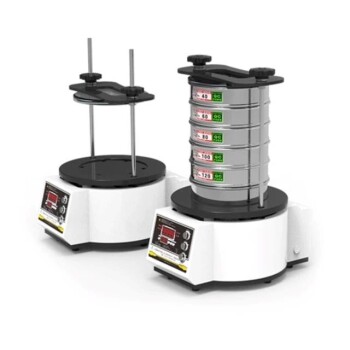
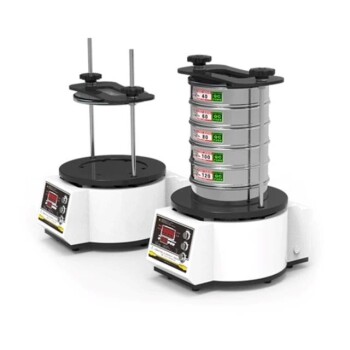
Biomass like flax straw is naturally irregular. Standard grading sieves are the primary tool used to standardize the material before any thermal testing begins.
By filtering the straw through specific mesh sizes, you physically remove particles with inconsistent dimensions. This creates a uniform sample batch where every particle reacts to heat in a similar manner.
Eliminating Thermal Lag
The primary technical threat to your analysis is the thermal lag phenomenon. This occurs when oversized particles are present in the sample during Thermogravimetric Analysis (TGA).
Large particles do not heat through as quickly as small ones. This creates a delay—or lag—between the temperature of the furnace and the actual temperature at the core of the particle. Sieving effectively eliminates this variable by removing the oversized particles responsible for the discrepancy.
Aligning Experiment with Theory
Theoretical calculation models generally assume the material is heating uniformly. If your physical sample contains irregular sizes, it breaks this assumption.
Sieving ensures the physical heating process of the flax straw aligns closely with theoretical calculation models. When the physical reality matches the mathematical model, the resulting data is defensible and accurate.
The Risks of Inadequate Preparation
Distorted Activation Energy
The ultimate goal of TGA is often to determine activation energy—the energy required to initiate the chemical reaction of degradation.
If sieving is skipped or performed poorly, the resulting thermal lag artificially inflates or skews these values. The data you generate will not reflect the true chemical properties of the flax straw, but rather the physical inconsistencies of your sample preparation.
Incomparable Data Sets
Without standard grading sieves, it becomes impossible to compare results across different tests.
Variations in particle size distribution from one test to another introduce random noise into the data. This lack of standardization renders the degradation parameters unreliable for scientific reporting or process scaling.
Ensuring Data Integrity in Biomass Analysis
To ensure your thermal analysis yields usable, scientific-grade data, prioritize particle uniformity above all other preparation steps.
- If your primary focus is Theoretical Modeling: Prioritize sieving to ensure your experimental curves match the assumptions inherent in your calculation software.
- If your primary focus is Process Engineering: Use strict grading to derive accurate activation energy values, which are essential for designing efficient reactors.
Precision in thermal analysis begins before the sample ever enters the furnace.
Summary Table:
| Feature | Importance in Thermal Analysis |
|---|---|
| Particle Consistency | Removes irregular dimensions to ensure uniform reaction to heat. |
| Thermal Lag Mitigation | Prevents core temperature delays in oversized particles during TGA. |
| Model Alignment | Ensures physical samples match theoretical calculation assumptions. |
| Data Integrity | Guarantees accurate activation energy values and repeatable results. |
Maximize Your Research Precision with KINTEK
Don't let inconsistent sample preparation compromise your experimental data. At KINTEK, we understand that high-quality thermal analysis begins with superior preparation.
Whether you are performing biomass degradation studies or complex material synthesis, our comprehensive range of laboratory sieving equipment, high-temperature furnaces (CVD, Vacuum, Muffle), and high-pressure reactors are engineered to meet the strictest scientific standards. We empower researchers and process engineers to achieve perfectly aligned theoretical models and defensible activation energy data.
Ready to elevate your lab's performance? Contact us today to explore our precision solutions!
References
- Bahareh Vafakish, Bishnu Acharya. Pyrolysis and Combustion Behavior of Flax Straw as Biomass: Evaluation of Kinetic, Thermodynamic Parameters, and Qualitative Analysis of Degradation Products. DOI: 10.3390/en16196932
This article is also based on technical information from Kintek Solution Knowledge Base .
Related Products
- Custom PTFE Teflon Parts Manufacturer for PTFE Mesh F4 Sieve
- Laboratory Test Sieves and Sieving Machines
- Three-dimensional electromagnetic sieving instrument
- Laboratory Test Sieves and Vibratory Sieve Shaker Machine
- Vibratory Sieve Shaker Machine Dry Three-Dimensional Vibrating Sieve
People Also Ask
- What are the primary reasons for selecting PTFE as a matrix? Enhance Composites with Carbon Nanotube Reinforcement
- How is PTFE utilized for insulation in Alloy 22 corrosion setups? Ensure Signal Purity & Accuracy
- Is PTFE corrosion resistant? Discover the Ultimate Chemical Resistance for Your Lab
- What are the specific applications of PTFE in micro-batch slug flow systems? Enhance Your Microfluidic Reaction Purity
- What is the mesh size of a sieve? A Guide to Particle Size and Sieve Selection