Knowledge Why use a lidded crucible and mother powder for LLZTO sintering? Essential Techniques for Lithium Stability
Author avatar

Tech Team · Kintek Solution

Updated 3 days ago

Why use a lidded crucible and mother powder for LLZTO sintering? Essential Techniques for Lithium Stability


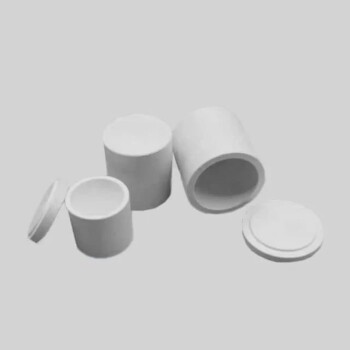
The primary necessity for this technique stems from the high volatility of lithium at sintering temperatures. At high thermal loads (typically 1100°C and above), lithium evaporates rapidly, which threatens the chemical balance of the material; encasing the Lithium Lanthanum Zirconium Tantalum Oxide (LLZTO) pellet in "mother powder" inside a lidded crucible creates a saturated lithium atmosphere that suppresses this evaporation while serving as a physical barrier against crucible contamination.

Core Takeaway The mother powder and sealed crucible technique serves a critical dual purpose: it establishes a thermodynamic equilibrium to prevent lithium loss (preserving ionic conductivity) and acts as a sacrificial barrier to prevent the pellet from chemically reacting with or adhering to the crucible walls.

Managing Chemical Stability

The Thermodynamics of Lithium Loss

Sintering LLZTO requires temperatures often exceeding 1100°C. At these thermal extremes, lithium exhibits high vapor pressure, making it prone to volatilization.

Without containment, lithium atoms escape the ceramic lattice. This loss disrupts the stoichiometric balance of the material, leading to decomposition or the formation of unwanted secondary phases.

Creating a Sacrificial Atmosphere

The "mother powder" is a sacrificial powder with the exact same composition as the pellet. By covering the pellet with this powder inside a lidded crucible, you create a micro-environment.

As the system heats up, the mother powder releases lithium vapor first, saturating the small, enclosed volume. This lithium-rich atmosphere pushes back against the tendency of the pellet to lose its own lithium, effectively maintaining the pellet's chemical composition.

Ensuring Performance and Integrity

Preserving Ionic Conductivity

The performance of LLZTO as a solid-state electrolyte depends heavily on its crystal structure. High ionic conductivity is achieved only when the material maintains a specific cubic phase structure.

If lithium volatilization occurs, the material may degrade into a tetragonal phase or other non-conductive structures. The mother powder technique ensures the lithium content remains high enough to stabilize the desired cubic phase.

Preventing Physical Adhesion

At high temperatures, ceramic pellets soften and become reactive. Without a buffer, the LLZTO pellet is likely to physically stick or fuse to the bottom of the crucible.

The bed of mother powder acts as a physical cushion. This ensures the sintered pellet retains its shape and can be easily removed from the crucible without mechanical damage or stress fractures.

Interaction with Crucible Materials

The Barrier Against Contamination

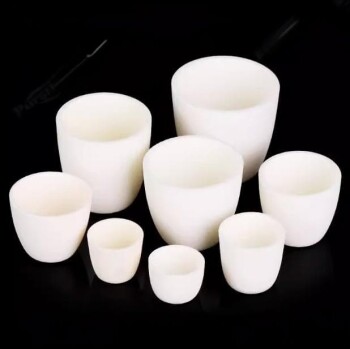
Standard crucibles are often made of Alumina (Al2O3) due to its high heat resistance. However, LLZTO is highly reactive and can chemically interact with alumina.

This reaction can cause aluminum to diffuse into the pellet (Al-doping) or create a glassy phase at the grain boundaries, which increases resistance. The mother powder prevents direct contact between the pellet and the crucible wall, mitigating this contamination.

Understanding the Trade-offs

Material Waste

This technique is chemically effective but material-intensive. The mother powder is essentially "sacrificial" material that cannot be easily reused for high-purity applications, leading to higher material costs per sintering run.

Crucible Selection Nuances

While the mother powder mitigates reactions, it is not a perfect shield. Even with mother powder, Alumina crucibles pose a risk of unintentional doping.

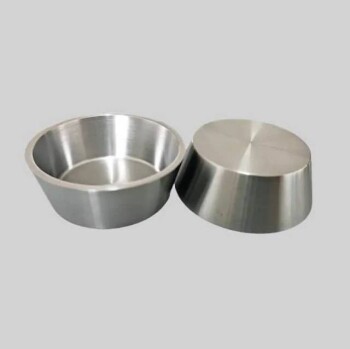
Magnesium Oxide (MgO) crucibles are often preferred as a superior alternative because they are chemically inert regarding LLZTO. However, even when using MgO, the mother powder is still required to manage the lithium volatility issue.

Making the Right Choice for Your Goal

To ensure the success of your sintering process, align your method with your specific technical requirements:

  • If your primary focus is Phase Purity: Ensure the mother powder completely covers the pellet to maintain a strictly lithium-rich environment and preserve the cubic structure.
  • If your primary focus is Chemical Inertness: Do not rely solely on the powder barrier; switch to a Magnesium Oxide (MgO) crucible to eliminate the risk of aluminum contamination entirely.

The integrity of your final electrolyte depends not just on the temperature, but on controlling the micro-atmosphere inside the kiln.

Summary Table:

Feature Purpose in LLZTO Sintering Impact on Performance
Mother Powder Creates a sacrificial lithium-rich micro-atmosphere Maintains stoichiometric balance & cubic phase
Lidded Crucible Encloses the system to prevent vapor escape Ensures thermodynamic equilibrium and saturation
Powder Bed Acts as a physical buffer/cushion Prevents pellet adhesion and stress fractures
Material Choice MgO crucibles preferred over Alumina Eliminates risk of unintentional Al-doping/contamination

Elevate Your Solid-State Battery Research with KINTEK

Achieving the perfect cubic phase in LLZTO requires more than just high temperatures—it demands precise atmospheric control and high-purity containment. KINTEK specializes in providing the specialized laboratory equipment and consumables essential for advanced materials science.

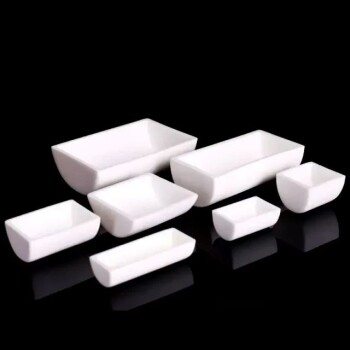
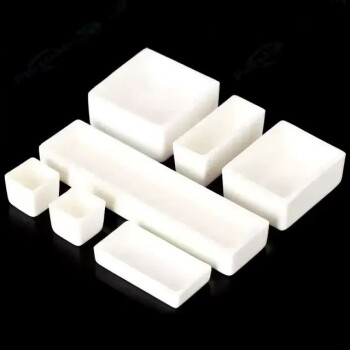
Whether you need Magnesium Oxide (MgO) or Alumina crucibles to prevent contamination, high-performance muffle or vacuum furnaces for precise thermal cycles, or pellet presses for sample preparation, we have the expertise to support your workflow.

Ready to optimize your sintering process? Contact our technical specialists today to discover how our comprehensive range of crucibles and high-temperature solutions can enhance your lab's efficiency and material integrity.

Related Products

People Also Ask

Related Products

Manual High Temperature Heated Hydraulic Press Machine with Heated Plates for Lab

Manual High Temperature Heated Hydraulic Press Machine with Heated Plates for Lab

The High Temperature Hot Press is a machine specifically designed for pressing, sintering and processing materials in a high temperature environment. It is capable of operating in the range of hundreds of degrees Celsius to thousands of degrees Celsius for a variety of high temperature process requirements.

Zirconia Ceramic Gasket Insulating Engineering Advanced Fine Ceramics

Zirconia Ceramic Gasket Insulating Engineering Advanced Fine Ceramics

Zirconia insulating ceramic gasket has high melting point, high resistivity, low thermal expansion coefficient and other properties, making it an important high temperature resistant material, ceramic insulating material and ceramic sunscreen material.

High Temperature Wear-Resistant Alumina Al2O3 Plate for Engineering Advanced Fine Ceramics

High Temperature Wear-Resistant Alumina Al2O3 Plate for Engineering Advanced Fine Ceramics

High temperature wear-resistant insulating alumina plate has excellent insulation performance and high temperature resistance.

Ultra-High Temperature Graphite Vacuum Graphitization Furnace

Ultra-High Temperature Graphite Vacuum Graphitization Furnace

The ultra-high temperature graphitization furnace utilizes medium frequency induction heating in a vacuum or inert gas environment. The induction coil generates an alternating magnetic field, inducing eddy currents in the graphite crucible, which heats up and radiates heat to the workpiece, bringing it to the desired temperature. This furnace is primarily used for graphitization and sintering of carbon materials, carbon fiber materials, and other composite materials.

Folding Molybdenum Tantalum Boat With or Without Cover

Folding Molybdenum Tantalum Boat With or Without Cover

Molybdenum boat is an important carrier for preparing molybdenum powder and other metal powders, with high density, melting point, strength and temperature resistance.

Custom PTFE Teflon Parts Manufacturer Laboratory High Temperature Mixing Paddle Mixer

Custom PTFE Teflon Parts Manufacturer Laboratory High Temperature Mixing Paddle Mixer

The PTFE mixing paddle mixer is a versatile and robust tool designed for laboratory use, particularly in environments requiring high resistance to chemicals and extreme temperatures. Crafted from high-quality PTFE, this mixer boasts several key features that enhance its functionality and durability.

High Quality Alumina Ceramic Screw for Engineering Advanced Fine Ceramics with High Temperature Resistance and Insulation

High Quality Alumina Ceramic Screw for Engineering Advanced Fine Ceramics with High Temperature Resistance and Insulation

Alumina ceramic screws are fastening components made of 99.5% alumina, ideal for extreme applications requiring excellent thermal resistance, electrical insulation and chemical resistance.

Engineering Advanced Fine Ceramics Head Tweezers with Pointed Elbow Zirconia Ceramic Tip

Engineering Advanced Fine Ceramics Head Tweezers with Pointed Elbow Zirconia Ceramic Tip

Zirconia ceramic tweezers are a high-precision tool made of advanced ceramic materials, especially suitable for operating environments that require high precision and corrosion resistance. This type of tweezers not only has excellent physical properties, but is also popular in the medical and laboratory fields because of its biocompatibility.

Custom PTFE Teflon Parts Manufacturer for PTFE Tweezers

Custom PTFE Teflon Parts Manufacturer for PTFE Tweezers

PTFE tweezers inherit the excellent physical and chemical properties of PTFE, such as high temperature resistance, cold resistance, acid and alkali resistance, and corrosion resistance to most organic solvents.

Precision Machined Yttrium Stabilized Zirconia Ceramic Rod for Engineering Advanced Fine Ceramics

Precision Machined Yttrium Stabilized Zirconia Ceramic Rod for Engineering Advanced Fine Ceramics

Zirconia ceramic rods are prepared by isostatic pressing, and a uniform, dense and smooth ceramic layer and transition layer are formed at high temperature and high speed.

Hexagonal Boron Nitride HBN Ceramic Ring

Hexagonal Boron Nitride HBN Ceramic Ring

Boron nitride ceramic (BN) rings are commonly used in high temperature applications such as furnace fixtures, heat exchangers and semiconductor processing.

Assemble Lab Cylindrical Press Mold

Assemble Lab Cylindrical Press Mold

Get reliable and precise molding with Assemble Lab Cylindrical Press Mold. Perfect for ultra-fine powder or delicate samples, widely used in material research and development.

1400℃ Controlled Atmosphere Furnace with Nitrogen and Inert Atmosphere

1400℃ Controlled Atmosphere Furnace with Nitrogen and Inert Atmosphere

Achieve precise heat treatment with KT-14A controlled atmosphere furnace. Vacuum sealed with a smart controller, it's ideal for lab and industrial use up to 1400℃.

Small Vacuum Heat Treat and Tungsten Wire Sintering Furnace

Small Vacuum Heat Treat and Tungsten Wire Sintering Furnace

The small vacuum tungsten wire sintering furnace is a compact experimental vacuum furnace specially designed for universities and scientific research institutes. The furnace features a CNC welded shell and vacuum piping to ensure leak-free operation. Quick-connect electrical connections facilitate relocation and debugging, and the standard electrical control cabinet is safe and convenient to operate.

Boron Nitride (BN) Ceramic Rod for High Temperature Applications

Boron Nitride (BN) Ceramic Rod for High Temperature Applications

Boron nitride (BN) rod is the strongest boron nitride crystal form like graphite, which has excellent electrical insulation, chemical stability and dielectric properties.

High Temperature Constant Temperature Heating Circulator Water Bath Chiller Circulator for Reaction Bath

High Temperature Constant Temperature Heating Circulator Water Bath Chiller Circulator for Reaction Bath

Efficient and reliable, KinTek KHB Heating Circulator is perfect for your lab needs. With a max. heating temperature of up to 300℃, it features accurate temperature control and fast heating.

Automatic Laboratory Hydraulic Pellet Press Machine for Lab Use

Automatic Laboratory Hydraulic Pellet Press Machine for Lab Use

Experience efficient sample preparation with our Automatic Lab Press Machine. Ideal for material research, pharmacy, ceramics, and more. Features a compact size and hydraulic press functionality with heating plates. Available in various sizes.

Engineering Advanced Fine Ceramics Aluminum Oxide Al2O3 Heat Sink for Insulation

Engineering Advanced Fine Ceramics Aluminum Oxide Al2O3 Heat Sink for Insulation

The hole structure of the ceramic heat sink increases the heat dissipation area in contact with the air, which greatly enhances the heat dissipation effect, and the heat dissipation effect is better than that of super copper and aluminum.

Graphite Vacuum Continuous Graphitization Furnace

Graphite Vacuum Continuous Graphitization Furnace

High-temperature graphitization furnace is a professional equipment for graphitization treatment of carbon materials. It is a key equipment for the production of high-quality graphite products. It has high temperature, high efficiency and uniform heating. It is suitable for various high-temperature treatments and graphitization treatments. It is widely used in metallurgy, electronics, aerospace, etc. industry.

Laboratory Manual Hydraulic Pellet Press for Lab Use

Laboratory Manual Hydraulic Pellet Press for Lab Use

Efficient Manure Lab Hydraulic Press with Safety Cover for sample preparation in material research, pharmacy, and electronic industries. Available in 15T to 60T.


Leave Your Message