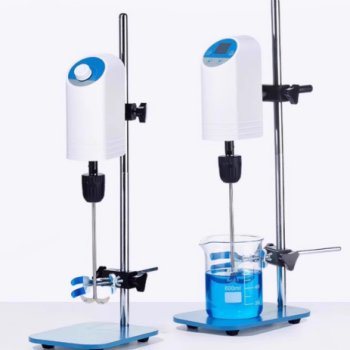
Magnetic stirring acts as the fundamental driver for achieving molecular-level uniformity in sol-gel synthesis. By ensuring the thorough integration of precursors like titanium isopropoxide and copper nitrate, it prevents phase separation before the gelation process begins.
The quality of a mixed metal oxide catalyst is determined long before it becomes a solid; uniformity at the liquid stage dictates the active site distribution of the final product.
The Physics of Molecular Homogeneity
Breaking Down Precursor Isolation
In sol-gel synthesis, precursors must do more than simply exist in the same beaker; they must interact at the molecular level.
Magnetic stirring provides the continuous mechanical energy required to break down isolation between distinct chemical species. This ensures that components like titanium isopropoxide and copper nitrate are not just suspended, but truly integrated.
Prerequisite for Gel Formation
A consistent, high-quality gel cannot form from a heterogeneous solution.
Stirring creates the necessary uniform environment for the solution to transition into a gel (gelation). Without this, the sol-gel network will be irregular, leading to weak structural integrity.
Impact on Final Catalyst Properties
Defining Crystal Structures
The agitation process directly influences the crystalline phase of the resulting oxide.
Specific, desirable crystal structures—such as delafossite or anatase—rely on the precise stoichiometric balance that only thorough mixing can provide. If the mixing is uneven, the material may crystallize into unwanted or inactive phases.
Optimizing Active Site Distribution
The performance of a catalyst depends on the availability of its active sites.
Proper mixing ensures that these active sites are distributed evenly throughout the material rather than clumped in specific regions. This maximization of surface area and site availability is critical for catalytic efficiency.
Controlling Kinetics and Diffusion
Regulating Reaction Rates
Magnetic stirring allows you to control the kinetics of hydrolysis and condensation reactions.
By maintaining a consistent flow, you prevent localized "hot spots" of rapid reaction that could lead to precipitation rather than gelation. This control facilitates a compositionally uniform oxide layer.
Ensuring Uniform Diffusion
For complex applications, such as coating nanoporous scaffolds, stirring drives diffusion.
Continuous agitation ensures precursor molecules penetrate deep into porous structures. This results in a coating that is uniform in both composition and thickness, rather than merely coating the outer surface.
Common Pitfalls to Avoid
The Risk of Phase Segregation
The primary risk in sol-gel synthesis is inadequate agitation leading to phase segregation.
If stirring is intermittent or insufficiently vigorous, heavier or less soluble precursors may settle or cluster. This leads to a final product with inconsistent chemical properties, rendering the catalyst ineffective for its intended reaction.
Overlooking Temperature Integration
While stirring provides mechanical uniformity, it must often work in tandem with thermal control.
Mechanical shear forces ensure contact, but ignoring the interplay between stirring speed and temperature can lead to uneven reaction rates. Ensure your setup allows for precise thermal regulation alongside magnetic agitation to facilitate effective ring-opening or hydrolysis reactions.
Making the Right Choice for Your Goal
To maximize the effectiveness of your sol-gel synthesis, align your stirring protocol with your specific objectives:
- If your primary focus is Crystal Purity: Prioritize vigorous, continuous mixing to ensure the stoichiometric balance required for specific phases like delafossite or anatase.
- If your primary focus is Coating Porous Substrates: Ensure long-duration (24-hour) stirring to facilitate deep diffusion and thickness control within the pores.
Consistency in your mixing process is the single most controllable variable for ensuring high-performance catalytic outcomes.
Summary Table:
| Feature | Role in Sol-Gel Synthesis | Impact on Final Catalyst |
|---|---|---|
| Molecular Mixing | Breaks down precursor isolation | Ensures chemical homogeneity |
| Gelation Control | Creates uniform environment | Prevents phase separation |
| Kinetics Regulation | Manages hydrolysis/condensation rates | Prevents unwanted precipitation |
| Diffusion Support | Drives precursors into porous scaffolds | Achieves uniform coating thickness |
| Structural Phase | Maintains stoichiometric balance | Optimizes crystal purity (e.g., Anatase) |
Elevate Your Material Research with KINTEK Precision
Achieve uncompromising molecular uniformity in your catalysts with KINTEK’s high-performance laboratory equipment. Whether you are optimizing sol-gel kinetics or scaling up mixed metal oxide production, our comprehensive range of magnetic stirrers, high-temperature furnaces (muffle, tube, vacuum), and hydrothermal autoclaves provides the precise control your research demands.
From high-pressure reactors to specialized ceramics and crucibles, KINTEK empowers laboratories to master complex synthesis pathways. Contact us today to find the perfect equipment for your lab and ensure consistent, high-efficiency catalytic outcomes with our industry-leading solutions.
References
- Markus Hammes, Wilhelm F. Maier. Niobium: Activator and Stabilizer for a Copper‐Based Deacon Catalyst. DOI: 10.1002/cctc.201300697
This article is also based on technical information from Kintek Solution Knowledge Base .
Related Products
- Laboratory Small Constant Temperature Heated Magnetic Stirrer Heater and Stirrer
- Custom PTFE Teflon Parts Manufacturer for Magnetic Stirring Bar
- High Performance Laboratory Stirrers for Diverse Applications
- Three-dimensional electromagnetic sieving instrument
- Custom PTFE Teflon Parts Manufacturer for PTFE Stirring Bar Recovery Rod
People Also Ask
- What role does a magnetic stirrer with heating play in ZnO nanoparticle synthesis? Precision Control for Quality Results
- What role does a constant temperature heating magnetic stirrer play in MFC-HAp synthesis? Achieve Material Homogeneity
- What is the function of a laboratory magnetic stirrer in Ni–Cr–P electrodeposition? Optimize Ion Transport & Coating
- Why is a laboratory magnetic stirrer required for benzoic acid esters? Boost Reaction Speed & Yield with High RPM
- What role does a laboratory magnetic stirrer play in TiO2 and TiO2-Ag sol preparation? Master Chemical Kinetics