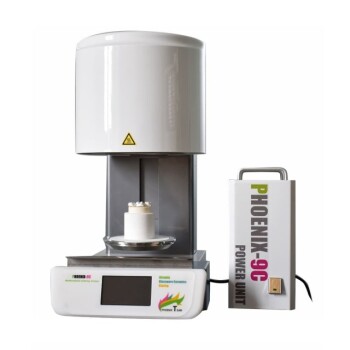
Precise thermal management is the single most critical variable in determining the structural integrity and performance of nanoporous zirconia membranes. In a high-precision sintering furnace, strictly controlled temperature profiles regulate the material's phase transformation, preventing catastrophic cracking caused by volume expansion while optimizing the crystal structure for maximum strength.
The fabrication of zirconia relies on a delicate martensitic transformation between monoclinic and tetragonal phases. Precision heating ensures this transition occurs without the significant volume changes that cause membrane failure, locking in the mechanical strength and chemical stability required for high-performance applications.
The Mechanics of Phase Transformation
Managing the Martensitic Transition
Zirconia is unique because it undergoes a specific physical change known as a martensitic transformation. This process involves shifting between its monoclinic and tetragonal crystal phases.
This is not a passive change; it involves significant internal volume fluctuations within the material. If these volume changes occur unevenly or too rapidly, they generate massive internal stress.
The Role of Heating and Cooling Rates
The furnace does not simply reach a set point; it must control the rate of change. Improper heating or cooling speeds can trigger the volume expansion associated with phase changes unpredictably.
If the thermal profile is erratic, the resulting stress leads directly to membrane cracking. High-precision control ensures the transition happens uniformly throughout the membrane, mitigating physical failure.
Optimizing Material Performance
Targeting the Tetragonal Phase
The primary goal of the sintering process is to optimize the content of the tetragonal phase within the zirconia. This specific crystal structure is superior for membrane applications.
To achieve this, the furnace must maintain a precise sintering temperature, typically within the narrow window of 450 to 600 degrees Celsius.
Enhancing Mechanical and Chemical Properties
By locking in the correct phase balance, the membrane achieves higher mechanical strength. This makes the final product more robust against physical pressures.
Furthermore, this specific thermal history enhances chemical stability. A properly sintered membrane exhibits superior crack resistance, ensuring longevity even in demanding operational environments.
Understanding the Trade-offs
The Risk of Thermal Deviation
Operating outside the 450-600°C window results in immediate performance penalties. Temperatures too low may result in incomplete phase transformation, leaving the material mechanically weak.
Conversely, aggressive thermal ramping to save time risks inducing immediate fractures due to the volume mismatch discussed earlier.
Balancing Throughput vs. Yield
There is often a temptation to increase heating rates to speed up production. However, in zirconia fabrication, speed is the enemy of structural integrity.
The "trade-off" here is strictly between processing time and yield. Precision furnaces prioritize the stability of the heating curve over raw speed to ensure the membrane survives the sintering process intact.
Making the Right Choice for Your Goal
To maximize the success of your zirconia membrane fabrication, align your thermal strategy with your specific performance metrics:
- If your primary focus is Mechanical Durability: rigorous adherence to the 450-600°C dwell time is required to maximize the tetragonal phase content for superior strength.
- If your primary focus is Manufacturing Yield: Prioritize the precision of your heating and cooling rates to manage volume changes and eliminate cracking during phase transitions.
Mastering the thermal profile is not just about heating the material; it is about sculpting the microstructure to ensure reliability.
Summary Table:
| Parameter | Influence on Zirconia Membrane | Optimal Range/Goal |
|---|---|---|
| Sintering Temperature | Determines tetragonal phase content & stability | 450°C to 600°C |
| Heating/Cooling Rate | Manages volume expansion & internal stress | Uniform, controlled ramping |
| Phase Transformation | Prevents martensitic transition-induced cracking | Monoclinic to Tetragonal balance |
| Primary Outcome | Mechanical strength & chemical durability | High-integrity, crack-free structure |
Elevate Your Material Research with KINTEK Precision
Structural integrity in nanoporous zirconia membranes depends entirely on thermal accuracy. KINTEK specializes in high-precision laboratory equipment, offering a comprehensive range of high-temperature furnaces (muffle, tube, vacuum, and atmosphere) designed to deliver the exact thermal profiles required for sensitive sintering processes.
Beyond furnaces, we empower your lab with advanced crushing and milling systems, hydraulic presses, and high-temperature high-pressure reactors to streamline every stage of material fabrication. Whether you are optimizing phase transitions or scaling production, our expertise ensures your research achieves maximum yield and durability.
Ready to refine your thermal strategy? Contact KINTEK today to find the perfect furnace for your application.
References
- Qiang Yan, Yiqun Fan. Ultrasound Assisted Synthesis of Size-Controlled Aqueous Colloids for the Fabrication of Nanoporous Zirconia Membrane. DOI: 10.3389/fchem.2019.00337
This article is also based on technical information from Kintek Solution Knowledge Base .
Related Products
- High Temperature Muffle Oven Furnace for Laboratory Debinding and Pre Sintering
- Vacuum Heat Treat and Pressure Sintering Furnace for High Temperature Applications
- 2200 ℃ Tungsten Vacuum Heat Treat and Sintering Furnace
- Ultra-High Temperature Graphite Vacuum Graphitization Furnace
- 2200 ℃ Graphite Vacuum Heat Treat Furnace
People Also Ask
- Why is the annealing treatment in a high-temperature muffle furnace critical for the preparation of an Sb-SnO2 interlayer?
- What is the primary function of high-temperature muffle or tube furnaces for ceramic coatings? Ensure Peak Durability
- What is the role of a high-temperature muffle furnace in preparing Cs-aluminosilicate waste? Key Simulation Insights
- What are the main components of a high-temperature muffle furnace? A Guide to the Core Systems
- Why is a high-temp muffle furnace essential for ZnO-WO3 & ZnO-BiOI? Optimize Heterojunction Catalyst Performance