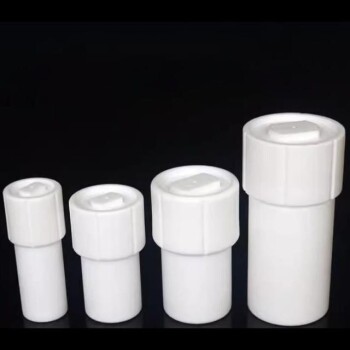
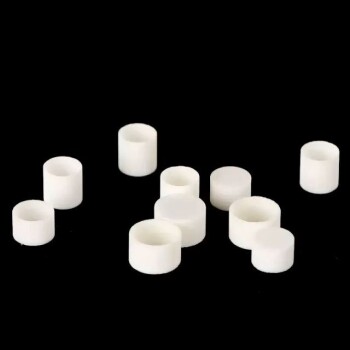
In High Purity Quartz (HPQ) processing, the reaction vessel is the first line of defense against product failure. You cannot treat the container as a passive element; it must be constructed from specialized materials like polytetrafluoroethylene (PTFE) or high-grade ceramics. Using standard materials will lead to the container degrading under acid exposure, releasing contaminants back into the quartz and making it impossible to reach the required purity standards.
Core Takeaway: To achieve High Purity Quartz (99.995%+), reaction vessels must be inert to aggressive agents like hydrofluoric acid. Using PTFE or specialized ceramics prevents "secondary contamination," ensuring that metal ions from the container walls do not leach into and ruin the purified product.
The Aggressive Chemical Environment
Handling Corrosive Acids
The acid leaching process relies on a potent mix of chemicals designed to strip impurities from quartz. This typically involves hydrofluoric acid (HF), hydrochloric acid, and nitric acid.
These acids are highly destructive. Any material that interacts with them will not only corrode but also introduce new impurities into the batch.
Thermal and Chemical Resistance
The reaction vessel must withstand more than just chemical attack. The process often requires elevated temperatures to be effective.
Therefore, the material selected must be both acid-resistant and temperature-resistant. It must maintain its structural integrity without softening or degrading under thermal stress.
The Danger of Secondary Contamination
Leaching from Container Walls
The primary reason for strict material selection is to avoid "secondary contamination." This occurs when the vessel itself becomes a source of pollution.
If the container walls react even slightly with the acid mixture, they release metal ions into the solution.
Compromising the Purity Standard
HPQ requires an extremely high purity level, typically 99.995% or higher.
If metal ions leach from the vessel, this target becomes unattainable. The vessel material must remain chemically distinct from the process to preserve the integrity of the quartz.
Recommended Materials
The Role of PTFE
Polytetrafluoroethylene (PTFE) is a leading choice for reaction containers in this industry.
Its chemical structure provides exceptional resistance to hydrofluoric acid. It creates a non-reactive barrier that prevents the container from contaminating the slurry.
Utilizing Specialized Ceramics
Specialized ceramics are the other standard option for these reaction environments.
Like PTFE, specific high-purity ceramics are engineered to resist acid corrosion and high temperatures, ensuring the final product remains free of external metal ions.
Understanding the Trade-offs
Cost vs. Compliance
High-purity materials like PTFE and specialized ceramics represent a significant investment compared to standard industrial plastics or metals.
However, this is not an area where cost-cutting is viable. Using cheaper, less resistant materials introduces a high probability of batch rejection due to contamination.
Maintenance and Lifespan
While these materials are resistant, they are not invincible. Over time, even high-grade materials may degrade if subjected to conditions beyond their specific ratings.
Regular inspection of vessel integrity is required to ensure that the acid resistance has not been compromised by long-term exposure.
Making the Right Choice for Your Goal
Selecting the correct vessel material is a prerequisite for successful HPQ production.
- If your primary focus is Purity: Mandate the use of PTFE or high-grade ceramics to completely eliminate the risk of metal ion leaching and guarantee 99.995% results.
- If your primary focus is Process Safety: Ensure your chosen material is explicitly rated for both hydrofluoric acid resistance and the specific operating temperatures of your leaching cycle.
Treat your reaction vessel not merely as storage, but as a critical component of your quality assurance system.
Summary Table:
| Material Feature | Standard Industrial Materials | PTFE / High-Grade Ceramics |
|---|---|---|
| Acid Resistance | Poor; corrodes under HF/HCl | Excellent; chemically inert |
| Secondary Contamination | High risk (leaches metal ions) | Near-zero risk |
| Thermal Stability | Varies; often low | High; maintains integrity |
| Process Compatibility | Not suitable for HPQ | Ideal for 99.995%+ purity |
| Investment Level | Low initial cost | Higher cost; essential for compliance |
Elevate Your HPQ Production with KINTEK
Don't let subpar containers compromise your quartz purity. KINTEK specializes in high-performance laboratory solutions designed for the most aggressive chemical environments. From acid-resistant PTFE products and specialized ceramics to high-temperature high-pressure reactors and autoclaves, we provide the precision tools necessary to reach 99.995%+ purity standards.
Whether you are refining battery materials, performing semiconductor research, or scaling industrial HPQ leaching, our team offers the expertise and consumables—including cruibles, crushing systems, and cooling solutions—to optimize your workflow.
Ready to eliminate secondary contamination? Contact KINTEK today to discuss your equipment needs!
References
- Hailin Long, Zhengqi Guo. Advanced Processing Techniques and Impurity Management for High-Purity Quartz in Diverse Industrial Applications. DOI: 10.3390/min14060571
This article is also based on technical information from Kintek Solution Knowledge Base .
Related Products
- High Purity Pure Graphite Crucible for Evaporation
- Customizable High Pressure Reactors for Advanced Scientific and Industrial Applications
- Custom PTFE Teflon Parts Manufacturer for Microwave Digestion Tank
- Stainless High Pressure Autoclave Reactor Laboratory Pressure Reactor
- Engineering Advanced Fine Ceramics Alumina Crucibles (Al2O3) for Thermal Analysis TGA DTA
People Also Ask
- Why is a high-purity graphite crucible required for Chromel-TaC composites? Ensure Peak Purity at 1400°C
- Why are high-purity graphite crucibles preferred for sulfide solid electrolytes? Achieve Superior Material Purity
- What role do high-purity graphite crucibles play in molten salt corrosion research? Ensure Reactor-Grade Precision
- Why are high-purity graphite crucibles used for magnesium distillation? Ensure 3N8 Purity & Thermal Stability
- What role does a high-purity graphite crucible play in CaO-MgO-Al2O3-SiO2 system equilibrium experiments? Maximize Accuracy