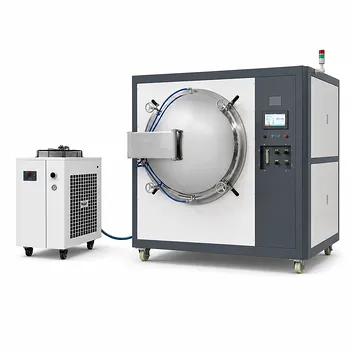
Precise temperature control is the critical regulator that determines whether a Silicon Carbide/Aluminum (SiC/Al) composite achieves a strong metallurgical bond or suffers from irreversible material degradation. By utilizing thermocouple feedback systems, vacuum hot pressing furnaces maintain the process within a narrow thermal window, ensuring the interface bonds securely without triggering destructive chemical reactions.
Core Takeaway The interface between SiC and Al is highly reactive; precise temperature control balances the heat required for dense diffusion bonding against the threshold where brittle phases form. Specifically, it prevents the generation of Aluminum Carbide (Al4C3), a byproduct of overheating that compromises both the mechanical integrity and thermal conductivity of the final composite.
The Dual Challenge of Interface Optimization
Achieving the ideal SiC/Al interface requires navigating two competing physical processes. The temperature must be high enough to fuse the materials but low enough to prevent chemical degradation.
Preventing Brittle Phase Formation
The most significant threat to SiC/Al composites is the formation of Aluminum Carbide (Al4C3). According to the primary reference, this phase generates readily at higher temperatures.
Al4C3 is a brittle compound that acts as a flaw in the microstructure. Once formed, it degrades the material's thermal conductivity and mechanical properties. Precise control ensures the temperature never spikes into the zone where this reaction accelerates.
Promoting Dense Diffusion Bonding
While high heat carries risks, insufficient heat leads to structural failure. You must achieve a stable "optimal temperature point" to facilitate diffusion bonding.
This process allows atoms to migrate across the boundary between the Aluminum matrix and SiC particles. This migration creates a dense, cohesive interface necessary for load transfer. Without adequate heat, sintering is incomplete, leaving the material weak and porous.
The Mechanics of Control in Vacuum Hot Pressing
The vacuum hot pressing furnace utilizes specific technologies to maintain this delicate balance.
Thermocouple Feedback Loops
The furnace does not simply "heat up"; it actively monitors the environment. Thermocouples provide real-time feedback to the heating elements.
This feedback loop allows the system to stabilize the process temperature with high accuracy. This stability is what permits the formation of dense interfaces while strictly limiting the kinetic energy available for harmful Al4C3 formation.
The Role of the Vacuum Environment
While temperature is the primary variable, the vacuum environment is the enabler. Aluminum is highly active and prone to oxidation.
By removing oxygen, the furnace prevents the formation of oxide layers on the powder surfaces. This ensures that the applied heat is directed entirely toward densification and bonding, rather than fighting surface impurities.
Understanding the Trade-offs
When defining your process parameters, you must understand the consequences of deviating from the optimal thermal window.
The Consequence of Overheating
If the control system fails or the set point is too high, the interface reaction becomes aggressive. In addition to Al4C3, overheating can lead to the formation of other harmful phases like MgAl2O4 or coarse Mg2Si (if magnesium is present in the alloy).
These phases disrupt the continuity of the matrix. The result is a composite that is brittle and thermally inefficient.
The Consequence of Underheating
If the furnace errs on the side of caution and runs too cool, the pressure applied will not be sufficient to close internal voids.
This results in incomplete sintering and low material density. The interface will lack the necessary diffusion depth, leading to poor adhesion between the ceramic reinforcement and the metal matrix.
Making the Right Choice for Your Goal
To optimize your SiC/Al composite, you must align your temperature strategy with your specific performance requirements.
- If your primary focus is Thermal Conductivity: Prioritize the upper limit of your temperature control to strictly prevent the formation of Al4C3, as this phase acts as a thermal barrier.
- If your primary focus is Mechanical Strength: Ensure your temperature is sufficient to guarantee 100% theoretical density and complete diffusion bonding, avoiding the porosity associated with low-temperature sintering.
- If you are using Complex Alloys (e.g., Al-Zn-Mg-Cu): Maintain a strict range (often 500-560°C) to prevent the coarsening of precipitating phases like Mg2Si which strengthen the matrix.
Ultimately, the quality of the SiC/Al interface is not defined by how hot the furnace gets, but by how precisely it sustains the exact temperature required for bonding without reaction.
Summary Table:
| Factor | High Temperature Impact | Low Temperature Impact | KINTEK Solution |
|---|---|---|---|
| Interface Phase | Brittle Al4C3 formation | Incomplete diffusion bonding | Precise thermocouple feedback |
| Material Density | Degradation of conductivity | High porosity & weak structure | Uniform pressure & heat |
| Microstructure | Coarse precipitates (Mg2Si) | Incomplete sintering | Controlled thermal window |
| Environment | Rapid oxidation (if no vacuum) | Surface impurity retention | High-vacuum atmosphere |
Elevate Your Composite Materials with KINTEK Precision
Achieving the perfect SiC/Al interface requires more than just heat—it requires total control. KINTEK specializes in advanced laboratory equipment designed for the most demanding material science applications. Our high-performance vacuum hot pressing furnaces provide the thermal stability and vacuum integrity necessary to prevent brittle phase formation and ensure 100% theoretical density.
From high-temperature furnaces (muffle, tube, and rotary) to hydraulic presses (pellet, hot, and isostatic) and crushing systems, KINTEK offers a comprehensive range of tools to optimize your research and production.
Ready to master your material interface? Contact KINTEK today for expert guidance and customized solutions!
Related Products
- Vacuum Hot Press Furnace Heated Vacuum Press Machine Tube Furnace
- 600T Vacuum Induction Hot Press Furnace for Heat Treat and Sintering
- Vacuum Hot Press Furnace Machine Heated Vacuum Press
- Vacuum Hot Press Furnace Machine for Lamination and Heating
- Vacuum Heat Treat and Pressure Sintering Furnace for High Temperature Applications
People Also Ask
- What advantages does a vacuum hot press furnace provide for LSLBO ceramic electrolytes? Achieve 94% Relative Density
- What role does a Vacuum Hot Press (VHP) furnace play in the densification of austenitic stainless steel 316 composites?
- What are the advantages of using a vacuum hot pressing furnace? Superior Densification for 2024Al/Gr/SiC Composites
- What are the advantages of a vacuum hot press furnace for LTPO solid electrolytes? Boost Density and Conductivity
- What core processing conditions does a vacuum hot press furnace provide? Achieve High-Density Cu-SiC/Diamond Composites