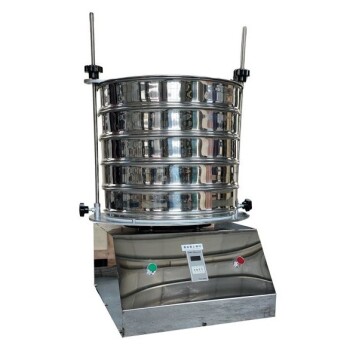
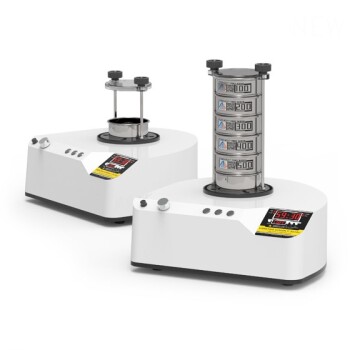
Precision sieving is a critical post-synthesis step used to regulate particle size distribution and eliminate large agglomerates. By employing a standard 300-mesh sieve, manufacturers ensure that $Mn_3Zn_{0.8}Sn_{0.2}N$ reinforcement particles maintain a consistent average size of approximately 40 micrometers. This technical control is vital for achieving uniform dispersion within a metal matrix, which directly dictates the composite’s ability to suppress thermal expansion effectively.
The use of a precision standard sieve ensures microstructural consistency and optimal thermal performance by removing oversized agglomerates and standardizing the reinforcement phase's particle size distribution to approximately 40 micrometers. This process is essential for achieving the high density and structural isotropy required in advanced metal matrix composites.
Achieving Microstructural Integrity
Controlling Particle Size Distribution
The primary role of a precision sieve, such as a 300-mesh screen, is to strictly limit the range of particle sizes within the reinforcement phase. A narrow distribution ensures that the $Mn_3Zn_{0.8}Sn_{0.2}N$ powder behaves predictably during the blending and sintering stages.
Eliminating Large Agglomerates
Synthesis and storage often result in the formation of hard agglomerates or secondary clusters that can exceed 100 micrometers. Removing these coarse lumps prevents the formation of localized defects and "bridging" effects that can weaken the final material.
Ensuring Average Particle Size
For $Mn_3Zn_{0.8}Sn_{0.2}N$, maintaining an average particle size of approximately 40 micrometers is the technical benchmark for performance. This specific dimension is optimized to interface correctly with the metal matrix, ensuring the reinforcement phase functions as intended.
Enhancing Composite Performance
Optimizing Thermal Expansion Suppression
The core functional goal of $Mn_3Zn_{0.8}Sn_{0.2}N$ is the suppression of thermal expansion in metal matrix composites. Inconsistent particle sizes lead to uneven expansion coefficients across the material, which can cause internal stress and mechanical failure.
Improving Matrix Dispersion
Uniformly sized particles disperse more easily within the matrix, preventing "clumping" that leaves some areas brittle and others soft. This microstructural consistency is fundamental to achieving isotropic properties, meaning the material performs identically in all directions.
Increasing Packing Density
Precision sieving improves the packing density of the powder when it is loaded into molds for Spark Plasma Sintering (SPS) or compression molding. Higher packing density reduces the volume of air pockets, leading to a final sintered product with higher overall density and lower porosity.
Understanding the Trade-offs
Processing Time vs. Precision
While high-precision sieving ensures quality, it can become a bottleneck in production if the powder has a high moisture content or significant static charge. These factors can lead to "blinding" or clogging of the fine 300-mesh screen, requiring slower processing speeds or ultrasonic assistance.
Material Yield and Waste
Strictly adhering to a 40-micrometer threshold may result in the rejection of significant portions of the synthesized powder. If the synthesis process is not well-controlled, a large percentage of the material may be oversized, leading to higher costs and material waste.
Mechanical Degradation
Forcing powders through fine meshes can sometimes cause mechanical attrition or break down delicate crystal structures. It is essential to use equipment that effectively separates particles without applying excessive force that could alter the primary particle morphology.
How to Apply This to Your Project
To maximize the effectiveness of your $Mn_3Zn_{0.8}Sn_{0.2}N$ reinforcement powders, consider your primary performance objectives when selecting your sieving parameters.
- If your primary focus is Thermal Expansion Control: Use a 300-mesh (40 μm) sieve strictly to ensure the particle size distribution is centered on the theoretical optimum for expansion suppression.
- If your primary focus is High Sintered Density: Focus on removing all agglomerates larger than 100 μm to ensure maximum packing efficiency and to eliminate the formation of micron-sized voids during molding.
- If your primary focus is Production Scalability: Consider a multi-stage sieving process (e.g., 100-mesh followed by 300-mesh) to prevent screen clogging and maintain high throughput without sacrificing final powder quality.
Effective precision sieving is the bridge between raw chemical synthesis and the predictable mechanical performance of high-performance composites.
Summary Table:
| Key Processing Factor | Technical Requirement | Impact on Composite Performance |
|---|---|---|
| Sieve Specification | 300-mesh precision screen | Ensures consistent ~40μm average particle size |
| Agglomerate Control | Removal of >100μm clusters | Prevents localized defects and structural weak points |
| Dispersion Quality | Uniform particle distribution | Achieves isotropic properties and expansion suppression |
| Packing Density | High particle-to-matrix ratio | Maximizes sintered density and reduces final porosity |
| Sintering Prep | Precise size distribution | Optimizes Spark Plasma Sintering (SPS) efficiency |
Elevate Your Material Integrity with KINTEK Precision Solutions
Achieving the perfect 40μm particle distribution for $Mn_3Zn_{0.8}Sn_{0.2}N$ requires more than just a sieve—it requires a controlled, end-to-end processing workflow. KINTEK specializes in high-performance laboratory equipment designed to help you master every stage of powder metallurgy and composite fabrication.
From advanced crushing and milling systems for initial synthesis to precision sieving equipment that eliminates troublesome agglomerates, we provide the tools necessary for microstructural excellence. Our portfolio also features hydraulic presses (pellet, hot, isostatic) and high-temperature furnaces (vacuum, CVD, atmosphere) to ensure your refined powders are sintered to maximum density.
Why choose KINTEK?
- Precision Engineering: Standardized sieving solutions for predictable particle size distribution.
- Comprehensive Workflow: Everything from grinding and sieving to high-pressure reactors and cooling solutions.
- Reliability: Durable consumables like ceramics and crucibles that withstand rigorous lab environments.
Ready to optimize your reinforcement powders for superior thermal performance? Contact our technical team today to find the ideal equipment for your specific research or production needs!
References
- Yongxiao Zhou, Chang Zhou. Sintering Temperature Effect of Near-Zero Thermal Expansion Mn3Zn0.8Sn0.2N/Ti Composites. DOI: 10.3390/ma16175919
This article is also based on technical information from Kintek Solution Knowledge Base .
Related Products
- Custom PTFE Teflon Parts Manufacturer for PTFE Mesh F4 Sieve
- High Purity Alumina Granulated Powder for Engineering Advanced Fine Ceramics
- Liquid Nitrogen Cryogenic Grinder Mill Cryomill with Screw Feeder
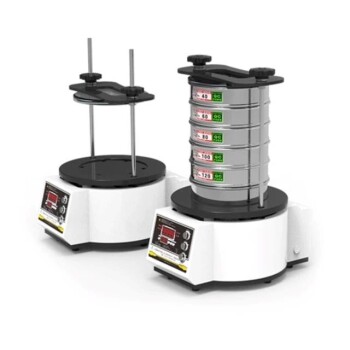
- Laboratory Test Sieves and Sieving Machines
- Round Bidirectional Press Mold for Lab
People Also Ask
- What are the primary reasons for selecting PTFE as a matrix? Enhance Composites with Carbon Nanotube Reinforcement
- How is PTFE utilized for insulation in Alloy 22 corrosion setups? Ensure Signal Purity & Accuracy
- Is PTFE corrosion resistant? Discover the Ultimate Chemical Resistance for Your Lab
- What are the specific applications of PTFE in micro-batch slug flow systems? Enhance Your Microfluidic Reaction Purity
- What is the mesh size of a sieve? A Guide to Particle Size and Sieve Selection